Showing posts with label future trends. Show all posts

Thursday, July 13, 2017

Leading Companies in the Development of Robotics and AI

Image result for robotics and artificial intelligence

We believe that robotics and artificial intelligence (AI) is a transformational technological development with the potential to disrupt a range of industries over the coming decades. To further explore this theme, we took a deeper dive into examples of companies leading in four categories targeted by the Global X Robotics and Artificial Intelligence ETF (BOTZ):
  1. Industrial Robotics and Automation
  2. Non-Industrial Robotics
  3. Unmanned Vehicles and Drones
  4. Artificial Intelligence
Industrial Robotics and Automation: FANUC Corp.
Industrial Robotics
Image result for Industrial Robotics and Automation
While many believe robotics has only recently become a viable technology, some firms have been involved in the space for decades. FANUC, for example, has been a prominent player in the robotics and automation industry since the early 1970’s. The firm focuses on industrial automation and is one of the chief suppliers of robotic machinery to the Japanese and US automobile industries.1 The company largely focuses on developing computerized numerical control (CNC) systems, which are robotic machines that can be fed specific instructions and then execute on those instructions with a high degree of accuracy and efficiency. An example of these instructions could be to lift up a piece of sheet metal from a stack, press it into a specific shape, and weld it to a car frame.
FANUC’s commitment to enhancing the industrial manufacturing process through robotics technology is deep within the firm’s own DNA; FANUC not only sells robotic tools to customers, but also employs those same robots in its own manufacturing process. FANUC is a forerunner in the “lights out” manufacturing process wherein its own robots build the products the company sells. The company’s factory operates without humans; there isn’t even a need for lights or an HVAC system.
Non-Industrial Robotics: Intuitive Surgical
Non-industrial robotics
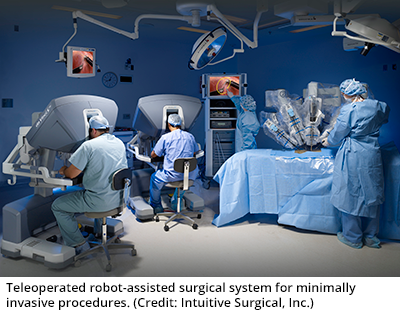
Image result for Non-Industrial Robotics: Intuitive SurgicalWe view robotics & AI as a transformational theme because its disruptive force is not limited to industrial manufacturing. Health care is one non-industrial segment that is rapidly adopting robotics technology. Companies such as Intuitive Surgical are pioneering robotic-assisted surgery in an effort to improve patient outcomes. The firm builds robotic devices used in minimally invasive surgeries including wristed instruments that can bend and rotate further than a human hand. These robotic devices enable surgeons to operate with enhanced vision, precision, and control, which can lead to less damage to patients’ nerves, quicker healing, and smaller scars versus the more traditional ‘human-only’ way of performing selected surgeries.2
A study published in European Urology revealed that prostate cancer patients who underwent robotic-assisted surgeries had fewer cancer cells, lost less blood, and spent less time recovering in the hospital. Since 2000, the da Vinci robotic surgical system has now been used in more 3 million surgeries.3
Unmanned Vehicles and Drones: Parrot SA
Drones and Unmanned Vehicles
Although militaries remain the predominant users of drone technology, commercial usage is accelerating as firms incorporate drones into parcel delivery, agriculture, inspections, and emergency response. According to the FAA, commercial drone usage is expected to grow 10-fold from 2016 to 2021.4
One prominent player in the space is Parrot, which develops drones, software, and accessories for both amateurs and professionals. While early adopters of unmanned aerial vehicles (UAVs) included business-to-consumer (B2C) flight enthusiasts and photographers, Parrot has become increasingly focused on the business-to-business (B2B) market. The company has found that UAVs mounted with HD cameras can effectively monitor production and yield on farms, inspect buildings, pipelines, and power lines, and generate 3D models of buildings and interiors.5
Artificial Intelligence: Faro Technologies Inc.
Artificial Intelligence (AI)
Artificial intelligence (AI) is an essential component to the advancement of robotics technology. AI allows robots to not just execute on human or pre-planned inputs, but also to operate in an unstructured environment and make decisions. In order to carry out these tasks, an essential component of AI is ‘robotic vision’ or the ability for machines to image and process their surroundings. One firm dedicated to advancing this space is Faro Technologies, which develops high precision imaging devices and software. The application for this technology is virtually boundless; it can create 3D models and measurements of large environments or small goods, compare parts and structures for quality assurance, or rapidly prototype items.6
This software has become particularly popular among factories using the imaging software for automated inspections and calibrations. The software has also found applications in construction for surveying purposes as well as public safety for investigating fires, crime scenes, and accidents.7
Click here to learn more about the Global X Robotics & Artificial Intelligence ETF (BOTZ).

Wednesday, June 28, 2017

Apple Glasses will be bigger than the iPhone, analyst Gene Munster says

Apple Inc CEO Tim Cook is shown with TV personality James Corden and musician Pharrell during a taped comedy bit in this image shot from a projection screen during an Apple media event in San Francisco, California, U.S. September 7, 2016.
Beck Diefenbach | Reuters : Apple Media event California, U.S. September 7, 2016
Apple Inc CEO Tim Cook is shown with TV personality James Corden and musician Pharrell  

  • Loup Ventures' Gene Munster says Apple Glasses will be bigger than the iPhone in a few years
  • Apple Glasses are expected to offer augmented reality
  • Munster thinks iPhone sales will peak in 2019.


Apple Glasses will launch by 2020 and will eat into sales of iPhones, Loup Ventures' Gene Munster said this week.
Munster, who's widely followed by Apple watchers, said Apple Glasses will be an augmented reality (AR) wearable that would let users view digital content on top of the real world — including information that users currently rely on iPhones to provide.
Munster believes that iPhone growth will peak in fiscal 2019 before beginning a slow decline with the introduction of Apple Glasses.
"We expect iPhone revenue to grow at 15 percent in FY18 (essential the next iPhone cycle) and account for 64% of revenue," Munster said. "We believe tough comps after the next iPhone cycle will have a negative impact on iPhone growth in FY19, and in FY20 we believe Apple Glasses will start to impact iPhone sales."

WATCH: Apple's Siri vs. Google Assistant: We picked a clear winner


Munster doesn't explain why sales might drop off, but the reason might be simple. Augmented reality glasses could offer features that are redundant on an iPhone, allowing users to interact with apps right on their faces without having to pull out an iPhone.
Munster said he expects iPhone revenues to begin to sink by about 3-4 percent year-on-year between 2020 and 2022, with unit sales falling up to 2 percent.
Apple Glasses are expected to be the next big product from Apple, at least according to Munster. "In 10 years we expect the iPhone will be around, but be a much smaller part of Apple's business as Apple Glasses slowly gains market adoption.
Apple has in no way confirmed it's working on smart glasses, but has discussed how it believes AR will play an important role in the future of technology.
By Todd Haselton

Source: https://goo.gl/xV4Vhk

Friday, June 23, 2017

Ethereum briefly crashed from $319 to 10 cents


  • Ethereum briefly suffered a flash crash on the GDAX exchange on Wednesday.
  • The price fell from around $319 to 10 cents in a matter of seconds.
  • Many ethereum traders lost large sums of money.
  • The cryptocurrency later rebounded.


The price of ethereum crashed as low as 10 cents from around $319 in about a second on the GDAX cryptocurrency exchange on Wednesday, a move that is being blamed on a "multimillion dollar market sell" order.
Ethereum is an alternative digital currency to bitcoin and had been trading as high as $352 on Wednesday. It has since rebounded from its flash-crash lows to trade to about $325 on the GDAX exchange. According to industry and price tracking website Coinmarketcap, which takes into account the price on several exchanges, ethereum was trading around $338.

Image result for Ethereum

Adam White, the vice president of GDAX which is run by U.S. firm Coinbase, posted on the exchange's blog, outlining what took place at around 12:30 p.m. PT on Wednesday. According to White, the multimillion dollar market sell order resulted in a number of orders being filled from $317.81 to $224.48.
As the price continued to fall, another 800 stop loss orders and margin funding liquidations caused ethereum to trade as low as 10 cents.
A stop loss order is a trade that is executed automatically once a security — in this case ethereum — hits a particular price. Margin funding is essentially trading with borrowed funds. Liquidation is when these positions are closed automatically in order to prevent further losses. The knock-on selling effect caused the flash crash on GDAX.
The chart below is a screenshot of the GDAX price showing the high and low price.

GDAX
Many on social media criticized GDAX and alleged there was some sort of illegal activity taking place. GDAX denied this.
"Our initial investigations show no indication of wrongdoing or account takeovers. We understand this event can be frustrating for our customers. Our matching engine operated as intended throughout this event and trading with advanced features like margin always carries inherent risk," White said in a blog post.
"We are continuing to conduct a thorough investigation and will keep customers updated with any resulting actions."
White also noted that these trades are final and will not be reversed. The exchange temporarily halted trading of ethereum on Wednesday before restoring the system shortly after.
As well as the issues on GDAX, investor demand at the funding launch for an ethereum-based messaging app called Status clogged the ethereum network, an industry insider told CNBC.

User makes $1 million off $380?

Ethereum traders were outraged by the crash blaming GDAX for not having proper controls, and even accusing whoever put the sell order in of market manipulation.

Wednesday, June 21, 2017

Beyond Tesla: 2 Lithium Stocks to Buy Now

Image result for tesla gigafactory


While the market for Lithium-ion (Li-ion) batteries has a ton of untapped potential, Tesla Inc.’s (TSLA) decision to build a $5 billion Gigafactory to meet its requirement of lithium-ion battery packs brought glaring focus on the shortage of supply of this emerging energy storage technology.
Image result for Li-ion batteriesLi-ion batteries are a type of rechargeable battery in which lithium ions move from the anode to cathode during discharge, and from cathode to anode when charging. They are a popular choice by electric car manufacturers, and are used by General Motors (GM - Free Report) , Navistar International (NAV - Free Report) , BMW AG (BAMXF - Free Report) , Daimler AG (DDAIF - Free Report) , and Ford (F - Free Report) , among many others. Li-ion batteries are also used in cellphones, laptops, and other electronic devices, as well as in the aerospace and defense sector.

By 2020, Tesla expects its Gigafactory to reach full capacity, and by just next year, the electric car maker anticipates annual lithium-ion battery production of the factory to reach near its original goal of 35 gigawatt-hours by the same year, which equals the total global production from 2014. Last January, electronics company Panasonic (PCRFY - Free Report) agreed to invest up to $1.6 billion in Tesla’s Gigafactory. Kazuhiro Tsuga, President of Panasonic, said that "We are sort of waiting on the demand from Tesla. If Tesla succeeds and the electric vehicle becomes mainstream, the world will be changed and we will have lots of opportunity to grow.”
Initial production at the Gigafactory began this past January, but there are other lithium-related companies investors should consider, some that manufacture lithium-ion batteries and those that directly handle the chemical element.
Let’s take a look at two stocks that are looking good at the moment:
Arotech Corp. (ARTX - Free Report) has two business divisions: Training and Simulation, and Battery and Power Systems. The Battery and Power Systems division manufactures and sells Lithium and Zinc-Air batteries and smart chargers for the military and to the private defense industry in the Middle East, Europe, and Asia.
ARTX stock has gained almost 15% over the past 12 months, and has an average earnings surprise of 125%. It’s a relatively smaller company, with a market cap of currently $84.51 million. Arotech, however, is in a fast-growing industry; Electronics-Military is in the top 15% of all industries ranked on the Zacks Industry Rank.
Arotech has a price-to-book (P/B) ratio of 1.41, lower than the industry average of 1.72. It has seen historic cash flow growth of 51.58% and historic EPS growth of 1,000%, both well above the industry averages of -1.34% and 14.24%, respectively. The second half of 2017 looks promising for Arotech. The company expects year-over-year earnings growth of 200% for the current quarter and 28.6% for the current year.
Albemarle Corp. (ALB - Free Report) is a major producer of fine and performance chemicals including lithium, bromine, and catalysts, and the company became the world’s largest supplier of lithium when it acquired Rockwood Holdings back in January 2015. Bloomberg estimates Albemarle’s share of the world’s lithium to be about 35%.
While ALB is a #3 (Hold) on the Zacks Rank, the company has beaten analyst estimates in the last four consecutive quarters, boasting an average earnings surprise of almost 9%. The company sits in a fairly strong industry as well; Chemical-Diversified is in the top 9% of all industries ranked on the Zacks Industry Rank. The Zacks Consensus Estimate for the company’s current year (ending December 2017) is $4.33 per share, reflecting 21.20% year-over-year growth.
Albemarle has a price-to-earnings (P/E) ratio of 26.04, above the industry average of 16.54. Its price-to-sales (P/S) ratio is 4.23, while its current PEG ratio sits at 1.80. ALB stock has seen historic EPS growth of 23.04% and historic cash flow growth of 3.41%.
Bottom Line
As a whole, the lithium industry has blossomed over the last couple of years, and according to Frost & Sullivan, the global market for Li-ion batteries doubled to $22.5 billion in 2016 from $11.7 billion in 2012. Consumer goods and automobile sectors, in large part drove the demand.
And, the share of the automobile sector in the Li-ion battery market grew to 25% in 2016 from 14% in 2012, per the data from Frost & Sullivan. This represents a Compounded Annual Growth Rate (CAGR) of 37%.
As lithium emerges as a vital component in battery supply, in addition in the increasing use of Li-ion batteries in consumer electronic products and efforts to promote the use of electric cars by many governments to curb pollution, the demand for these batteries is expected to rise.
For an in-depth discussion on Li-ion batteries and the rise of electric vehicles, make sure to check out Zacks’ free report “Electric Cars: Which Companies Will Surge?” It profiles EV technology, EV manufacturers, and the future of the electric vehicle industry. Click here to see the free report >>
Will You Make a Fortune on the Shift to Electric Cars?
Here's another stock idea to consider: Much like petroleum 150 years ago, lithium power may soon shake the world, creating millionaires and reshaping geo-politics. Soon, electric vehicles (EVs) may be cheaper than gas guzzlers. Some are already reaching 265 miles on a single charge.

With battery prices plummeting and charging stations set to multiply, one company stands out as the #1 stock to buy according to Zacks research.

It's not the one you think. See This Stock for Free >>
by Zacks Equity Research
- Source: https://goo.gl/m37gdA

Monday, April 10, 2017

Biotech stocks are soaring! The next winner could be RepliCel

RepliCel’s groundbreaking therapies, which could dominate the combined $11 billion hair restoration, skin rejuvenation, and tendon repair markets

Not long ago, tiny Aquinox Pharmaceuticals was trading at under $2.00; at $1.84, to be specific.Then something incredible happened… The company released positive mid-stage clinical trial results on their bladder pain drug.

Twitter went mad. The stock took off. By that afternoon, shares had traded up as much as 500%.Over the next two weeks nearly 18 million shares changed hands – roughly 90 times the stock’s 30-day average. By that Friday Aquinox hit a high of $22.13, a gain of 1,103%.3


Another stock, Celator Pharmaceuticals, recently jumped over 600% on positive Phase 3 results. That move took just seven days.Then Incyte Corp. went from $2.54 to $131 – a leap of 5,057% – on a series of positive news.And a whole slew of others have rewarded investors just as much. Spectacular profits, to be sure, and not as rare as you might think.

The trick, of course, is finding stocks that are about to soar…

RepliCel (OTCQB: REPCF / TSX.V: RP)
 could potentially achieve what no one else has been able to do before now.

Until advancements in stem cell therapy, there was no way for your body’s soft tissues to heal themselves effectively.6

This represents a monumental advance in the medical world.

The company’s scientists are figuring out how to use YOUR OWN CELLS to GROW HEALTHY NEW TISSUE.

RepliCel is pioneering the use of collagen-producing cells deep within your hair follicle to heal collagen-rich tissues such as aging skin and damaged tendons, as well as highly specialized cells to regrow hair for those suffering from pattern baldness.

Collagen represents 30-40% of all your body’s proteins, and is essential to the health of skin, tendons, hair, membranes, and connective tissue.7

It is the substance that holds your body together, and the breakdown of collagen is associated with numerous health conditions.

RepliCel is developing a way to deliver NEW COLLAGEN right within your own body, by taking a minute number of your healthy cells and replicating them in a lab, then reintroducing them into your body at the site of damage.

The result is “self-healing” tissues, with the goal of little to zero scar tissue or other hindrances to full function.

Nothing like this has been done before. The science is new, and it could be worth billions.

Right now Replicel has :


The continued advancement of three groundbreaking cell-based therapies based on positive data received to date.
An exclusive marketing license with global giant Shiseido of Japan, the fourth largest cosmetics and personal care company in the world; Shiseido is entirely financing clinical research ongoing now on RepliCel’s hair restoration therapy
A brand new proprietary next-generation dermal injector device with broad applications in the $3.2 billion facial rejuvenation market

The Shiseido deal gives us confidence that the company’s technology and market potential are significant. After all, Shiseido doesn’t do business with any fly-by-night or unpromising company.

And with the continued advancement of these three products, you could see an increase in demand for the company’s stock.

Be sure to take immediate action and add RepliCel to your watch list, as this could be your best chance to profit from this regenerative medicine company.

“On the cusp of a revolution”
In 2012, the Nobel Prize in Medicine went to two scientists who discovered that certain mature cells can be reprogrammed to become new, immature cells capable of developing into any tissues in your body.8

That discovery was the extension of a revolution that is changing the future of medicine today, as scientists around the world race to develop cell-based therapies capable of REGENERATING HEALTHY TISSUE.
But while these two Nobel scientists and their colleagues were working on cell reprogramming, RepliCel’s researchers were leveraging a much simpler idea: find cells with a desired function, remove a few of them, grow millions more, and put them back into the patient where the cells’ function is designed to help the body heal itself.

Since the early 2000s, RepliCel’s scientists had been investigating cells hidden within the hair follicle as robust agents for regrowing hair and producing collagen, the primary protein in skin and tendons.

By 2003, they had discovered that your body’s dermal sheath cup (DSC) cells could induce NEW hair fiber growth, something once thought impossible.

Since then, RepliCel has discovered that other cells grown from your own dermal sheath can regenerate new skin and new tendons by producing the collagen that makes up these tissues. 9,10

That was the beginning…

Today RepliCel – an emerging biotech company well on its way to what could be a tremendous success story – is at the forefront of the regenerative medicine field.

That’s because cell-based medical therapies are the FUTURE.
The journal Science Translational Medicine calls cell-based therapeutics “the next pillar of medicine.” They say, “Today, biomedicine sits on the cusp of a new revolution: the use of microbial and human cells as versatile therapeutic engines.”11
Mahendra Rao, director of the National Institutes of Health’s new Intramural Center for Regenerative Medicine says that cell therapies “could be paradigm-shifting for the healthcare field.”12
Wendell Lim, PhD, director of the UCSF Center for Systems and Synthetic Biology, says that today we are “on the cusp of a revolution.”13
The University of California at San Francisco says that “Treating patients with cells may one day become as common as it is now to treat the sick with drugs made from engineered proteins, antibodies or smaller chemicals.”14
Cell-based therapies are now being called the “third pillar” of medicine. First came small-molecule drugs produced by Big Pharma. Next came the genetic engineering revolution and targeted drugs developed by biotech firms. Finally, we have cell-based technologies.

Just like genetic engineering was a disruptive technology several decades ago, cell therapy is disrupting the medical landscape today.

The ability to regenerate tissue means that conditions can potentially be treated, not just managed, as has been the case with nearly all past drugs and biologic agents.
New technology puts your own cells to work to repair and rejuvenate your body
RepliCel (OTCQB: REPCF / TSX.V:RP) is working on unlocking the unique biological function of your body’s key cells to regenerate tissue.

Working tirelessly in their labs, company scientists discovered that the dermal sheath of your hair follicles is an excellent source of fibroblasts, the cells in connective tissue that produce collagen.

These cells are about five times more prolific than skin cells in their production of type 1 collagen, the major cell structure of skin and tendons.15

Collagen also plays a big part in renewing cells, and is responsible for maintaining the strength and elasticity of tendons and skin.

But your body’s ability to produce collagen decreases from around the age of 30. This is what gives you wrinkles and leads to weakness in your tendons.

RepliCel aims to create therapies for conditions related to diminished collagen by generating new collagen-producing cells in a laboratory and then injecting them into targeted areas.

Two of the company’s products are for conditions where there are too few healthy fibroblasts, such as chronic tendinosis and damaged skin.

The third product is their treatment for pattern baldness, where there is a deficit of dermal sheath cup cells that are responsible for maintaining the hair fiber within the follicle.

Those cells are easily isolated and replicated under lab conditions.

RepliCel has developed cell manufacturing technology and procedures to commercialize these products. They have also developed specialized delivery devices which have unique potential for licensing for other medical and cosmetic uses.

And because tissue is regenerated from your body’s own cells, it means RepliCel’s risk profile may be lower than with most other drugs and biologics today. That translates to SHORTER CLINICAL TRIAL TIMELINES and LOWER COMMERCIALIZATION COSTS.

Their breakthrough cell-based hair replacement therapy has already been PROVEN EFFECTIVE in pre-clinical and Phase 1 preliminary results. Those results show that it can be…
Preliminary results show it could be more effective than any drug or topical treatment now on market!
This new cell-based technology has the potential to become the WORLD’S FIRST minimally invasive solution for hair loss.

There are three problems with hair transplants today. First, when transplanting hair follicles from one location of your scalp to another, there are only a limited number of follicles available to harvest.

Second, hair transplantation only achieves a satisfactory result when performed by a gifted surgeon, of which there are few.18


Third, hair transplantation is not an option women have commonly pursued, and a significant population of women suffer from hair loss.19
RepliCel’s cell therapy solves those problems:

With a cell transplant, there is no limit to the number of cells that can be grown to use in regenerating new hair fibers.21
As a simple cell injection, even technicians can perform the procedure.22
The technique is as effective on women as men.23
Both pre-clinical and Phase 1 studies found that the procedure resulted in hair growth in an outstanding 63% of test subjects.24,25 In comparison, minoxidil (Rogaine®), the leading hair replacement treatment, regrows moderate to dense hair in only 26% of subjects.26

That means RepliCel’s therapy is likely as effective if not more than current products!

And once a person stops using Rogaine or its competitor, Propecia®, all the new hair falls out again. Treatment must continue indefinitely, which is a tremendous negative for users.59

What’s more, use of Rogaine results in an approximate 8-15% increase in hair density after 12 months of use. Propecia results are similar to Rogaine’s, with an approximate 7-14% density increase at 12 months.28

Plus, those products have serious side effects including erectile dysfunction and loss of libido.

By comparison, in early clinical testing, RepliCel’s proprietary treatment results in an average 11.8% density increase at JUST SIX MONTHS! And 70% of those responders averaged 14.3% DENSITY INCREASE! And so far, there have been no serious side effects recorded.29

Imagine what could happen when RepliCel’s technology hits the market. RepliCel could potentially own a big piece of the $3 billion hair replacement market shortly thereafter! These are all reasons why RepliCel is…

Setting up to revolutionize the $3 billion hair replacement market

The hair restoration market is valued at an enormous $3 billion a year,30 and is expected to grow by 30% a year through 2020.31

Yet current treatments are known to be only partially effective, or, in the case of surgery, time-consuming, painful, and prohibitively expensive.

In fact, the American Hair Loss Association states that, “Unfortunately, 99% of all products being marketed in the less than ethical hair loss treatment industry are completely ineffective for the majority of those who use them.”32


The hair restoration market is valued at an enormous $3 billion a year,30 and is expected to grow by 30% a year through 2020.31

Yet current treatments are known to be only partially effective, or, in the case of surgery, time-consuming, painful, and prohibitively expensive.

In fact, the American Hair Loss Association states that, “Unfortunately, 99% of all products being marketed in the less than ethical hair loss treatment industry are completely ineffective for the majority of those who use them.”32