Includes: ALK, AMZN, BA, CALM, CNI, CVGW, CXO, DOW, DPSGY, DSKE, DXCM, FCNTX,
Summary
Through April 2017, the LLGP was up eight percent.
New position adds included Schneider National, Greenbrier, Prologis and Daseke.
Positions averaged during the month included Cal-Maine and Hub Group.
The portfolio now has 41 holdings under management.
Overview
The Lean Long-Term Growth Portfolio (LLGP) was created in early February 2016. The objective of this portfolio is for long-term capital appreciation and will include both companies that pay dividends and those that do not. The projected dividend yield for 2017 is around one percent. Over the long-term, yield may become a higher priority.

There are currently 41 individual stock holdings under management. For some this may seem like too many, others may think it is too little. Management strategies utilize business and industry growth drivers from a variety of source information. The biggest challenge of managing around 40 companies is maintaining enough cash to grow all holdings consistently over time. A firm structure is in place to allow for this, but the reality is that overweight positions will sporadically occur as different industry-related cycles ebb and flow.
As some of you may know, I focus intently on transports. The substantial majority of this focus is freight-related, so airlines, airports, and transit services are not strongly covered. I also focus intently on industries for holdings within the portfolio. Overall, 115 or so companies have detailed databases tracking quarterly information. Additionally, most industries also have other pricing and demand trends, which are monitored.
Currently only individual stocks are purchased. The primary objective is for long-term growth, but there are strategies in place to accumulate larger positions, which may be sold for short-term gains. Motif is used for both ROTH IRA and Traditional IRA accounts. The primary benefits of Motif over some other brokerage services include the ability to build one's own portfolio as a motif which can be invested in by any amount for only $9.95, up to 30 companies; and to be able to purchase fractional shares with a trading commission of $4.95. The $4.95 trading fee is becoming more of a standard, but buying fractional shares still is not.
As of April 28, 2017, the fund held 41 companies including:
- Alaska Air Group (NYSE:ALK)
- Amazon.com (NASDAQ:AMZN)
- Cal-Maine Foods (NASDAQ:CALM)
- Calavo Growers (NASDAQ:CVGW)
- Canadian National (NYSE:CNI)
- Concho Resources (NYSE:CXO)
- Daseke, Inc. (NASDAQ:DSKE)
- Deutsche Post DHL Group (OTCPK:DPSGY)
- DexCom (NASDAQ:DXCM)
- FedEx Corporation (NYSE:FDX)
- Grupo Aeroportuario Del Pacifico (NYSE:PAC)
- Hanesbrands (NYSE:HBI)
- Hub Group (NASDAQ:HUBG)
- JB Hunt Transport (NASDAQ:JBHT)
- JD.com (NASDAQ:JD)
- Kansas City Southern (NYSE:KSU)
- Lamb Weston Holdings (NYSE:LW)
- LINE Corporation (NASDAQ:LN)
- Lockheed Martin (NYSE:LMT)
- Matson, Inc. (NYSE:MATX)
- McCormick & Company (NYSE:MKC)
- Old Dominion Freight Lines (NASDAQ:ODFL)
- Pioneer Natural Resource (NYSE:PXD)
- Prologis, Inc. (NYSE:PLD)
- Raytheon Company (NYSE:RTN)
- Rice Energy (NYSE:RICE)
- Rice Midstream Partners (NYSE:RMP)
- Republic Services (NYSE:RSG)
- Sanderson Farms (NASDAQ:SAFM)
- Schneider National (NYSE:SNDR)
- Sprouts Farmers Market (NASDAQ:SFM)
- The Boeing Company (NYSE:BA)
- The Dow Chemical Company (NYSE:DOW)
- The Greenbrier Companies (NYSE:GBX)
- The J.M. Smucker Company (NYSE:SJM)
- ULTA Salon, Cosmetics and Fragrance (NASDAQ:ULTA)
- Unilever (NYSE:UL)
- US Foods Holdings (NYSE:USFD)
- VF Corporation (NYSE:VFC)
- Visa, Inc. (NYSE:V)
- XPO Logistics (NYSEMKT:XPO)
Current Holdings Performance - Update
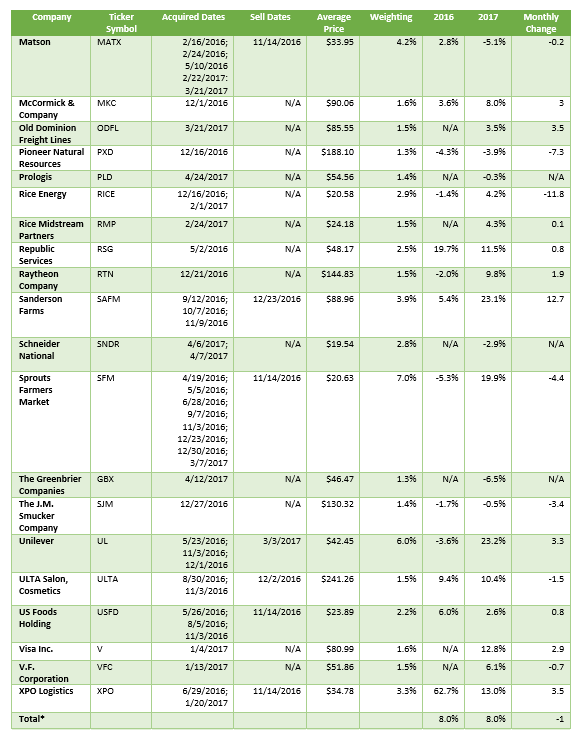
As of April 28, 2017, the table below provides the stock acquired and sell dates, average price, weighting, performance by year and monthly change. All dividend payouts are included in the performance to illustrate total returns.

Source: Personal Database
As transports have been weaker when compared to broader indices thus far, I assumed that the LLGP's first monthly decline was driven by transport holdings. However, under closer review, it appears that some over-weighted positions outside of transports had significant impacts for the lower performance.
LINE Corporation was the biggest laggard and reflected the second largest weighted position at the end of March. As such, the 12.2 percentage point decline was a big impact on the LLGP. Both Rice Energy and DexCom also witnessed percentage point declines greater than 11 percent. Rice Energy's weighting was above average, while DexCom's was not. Clearly, though, the weakest performers were not in the transports area.
Other weaker non-transports holdings included Pioneer Natural Resources, Sprouts and The JM Smucker Company. For transports, Hub Group and Alaska Air Group were the weakest performers. Other negative transports included Canadian National and FedEx. April witnessed a substantial increase in transports as five of the seven moves occurred in this area.
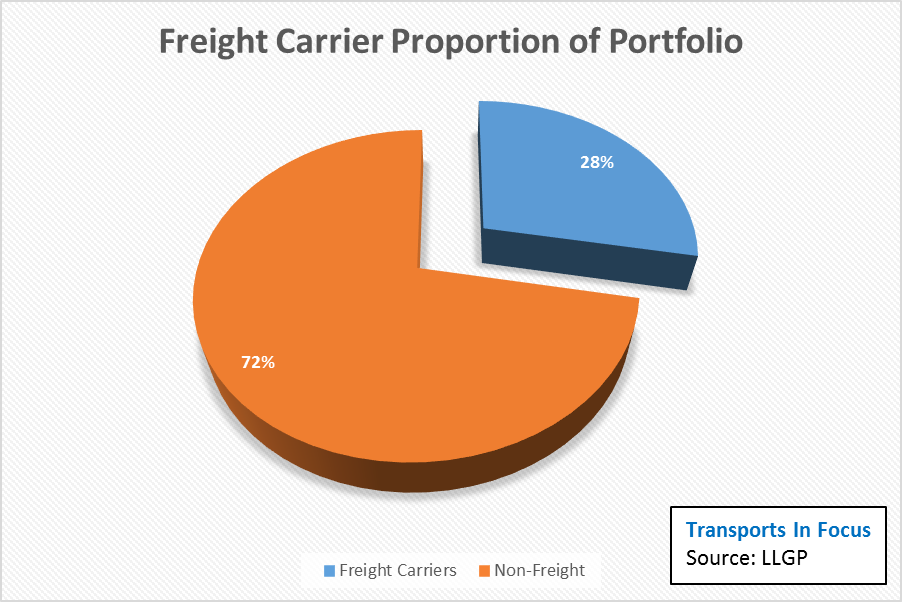
Freight holdings, as a percent of the total, increased by six percentage points to 28 percent. During April, as stated above, the majority of activity was related to transports. Contrarily, the most impactful declines were form non-transport companies. Collectively, this led to a stronger mix with freight-based companies as a proportion of the portfolio. I remain focused on incorporating the top freight companies in the LLGP.
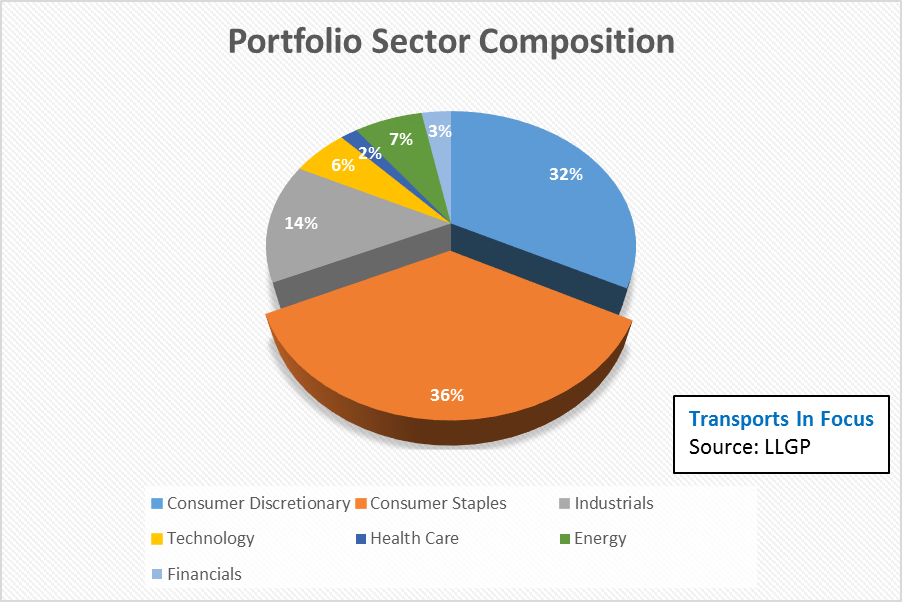
Most transports in the LLGP are categorized within the consumer discretionary sector. As a result of April's moves, this sector increased by three percentage points from the previous month. Sectors witnessing declines included consumer staples, technology, and energy.
Moving forward, the technology sector will be a focus over the next few weeks and may see multiple companies added. The NASDAQ (^IXIC) has continued to be one of the top performing indices through 2017.
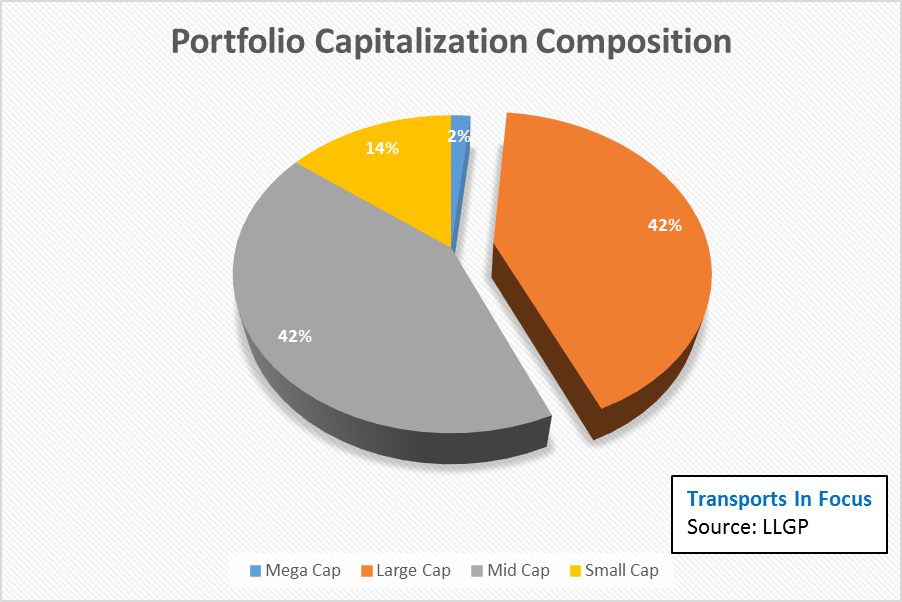
Large cap holdings decreased by two percentage points to 42 percent of the LLGP's total. This reflected the second consecutive month of declines. Mid cap holdings witnessed an increase to 42 percent as many companies added were within this category. Currently, 56 percent of the LLGP's portfolio capitalization is mid or small-cap.


