Showing posts with label value investment. Show all posts

Wednesday, November 4, 2015

10 Best Stocks For Value Investors This Week

Includes: ALLAXPELJWNRTNSTWDSWKSTSCOWFMWNR

Image result for investing in stocks

Summary

ModernGraham analyzed 16 different companies this week and has narrowed the list to the best of those companies.
All of the stocks listed here are suitable for either the Defensive Investor or the Enterprising Investor following the ModernGraham approach.
Each company is either found to be undervalued or fairly valued by the ModernGraham formula.
We evaluated 16 different companies this week to determine whether they are suitable for Defensive Investors, those unwilling to do substantial research, or Enterprising Investors, those who are willing to do such research. We also put each company through the ModernGraham valuation model based on Benjamin Graham's value investing formulas in order to determine an intrinsic value for each. Out of those 16 companies, only 10 were found to be undervalued or fairly valued and suitable for either Defensive or Enterprising Investors.

The Elite

The following companies were found to be suitable for either the Defensive Investor or Enterprising Investor and undervalued:

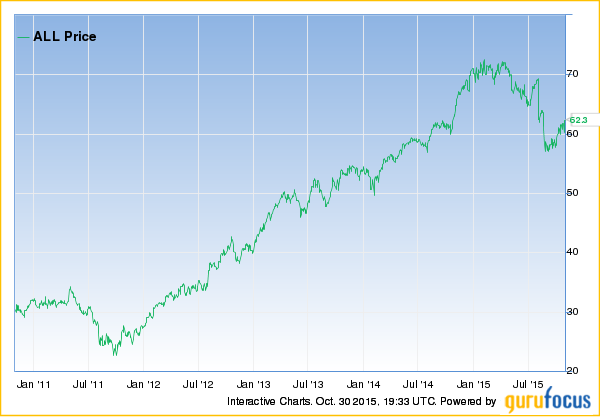
Allstate Corporation (NYSE:ALL)

Image result for Allstate Corporation
Allstate Corporation qualifies for the Enterprising Investor but not the more conservative Defensive Investor. The Defensive Investor is concerned with the insufficient earnings stability or growth over the last ten years. The Enterprising Investor has no initial concerns. As a result, all Enterprising Investors following the ModernGraham approach based on Benjamin Graham's methods should feel comfortable proceeding with further research into the company.
As for a valuation, the company appears to be undervalued after growing its EPSmg (normalized earnings) from $1.38 in 2011 to an estimated $4.89 for 2015. This level of demonstrated earnings growth outpaces the market's implied estimate of 2.14% annual earnings growth over the next 7-10 years. As a result, the ModernGraham valuation model, based on Benjamin Graham's formula, returns an estimate of intrinsic value above the price. (See the full valuation)
American Express Company (NYSE:AXP)

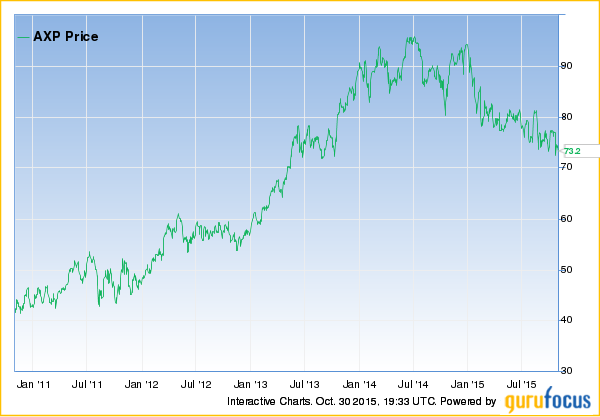
Image result for American Express CompanyAmerican Express Company qualifies for the Enterprising Investor but not the more conservative Defensive Investor. The Defensive Investor is concerned with the high PB ratio. The Enterprising Investor has no initial concerns. As a result, all Enterprising Investors following the ModernGraham approach based on Benjamin Graham's methods should feel comfortable proceeding with further research into the company.
As for a valuation, the company appears to be undervalued after growing its EPSmg (normalized earnings) from $3.11 in 2011 to an estimated $4.57 for 2015. This level of demonstrated earnings growth outpaces the market's implied estimate of 3.89% annual earnings growth over the next 7-10 years. As a result, the ModernGraham valuation model, based on Benjamin Graham's formula, returns an estimate of intrinsic value above the price. (See the full valuation)
Starwood Property Trust Inc. (NYSE:STWD)

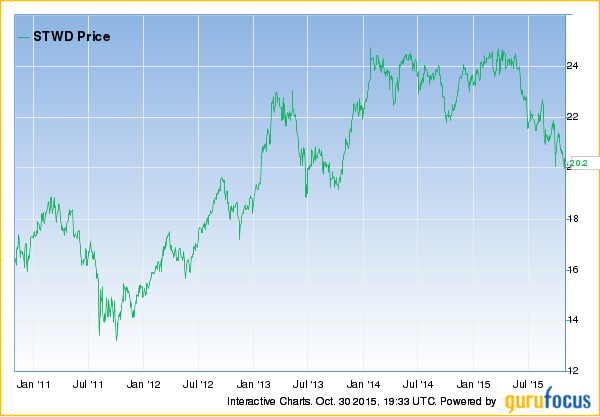
Image result for Starwood Property Trust Inc.Starwood Property Trust Inc. qualifies for the Enterprising Investor but not the more conservative Defensive Investor. The Defensive Investor has concerns regarding the company's short history as a publicly traded entity while the Enterprising Investor has no initial concerns. As a result, all Enterprising Investors following the ModernGraham approach based on Benjamin Graham's methods should feel comfortable proceeding with the next stage of the analysis.
As for a valuation, the company appears to be undervalued after growing its EPSmg (normalized earnings) from $0.75 in 2011 to an estimated $1.97 for 2015. This level of demonstrated earnings growth outpaces the market's implied estimate of 0.91% annual earnings growth over the next 7-10 years. As a result, the ModernGraham valuation model, based on Benjamin Graham's formula, returns an estimate of intrinsic value above the price.
Western Refining Inc. (NYSE:WNR)

Image result for Western Refining Inc.
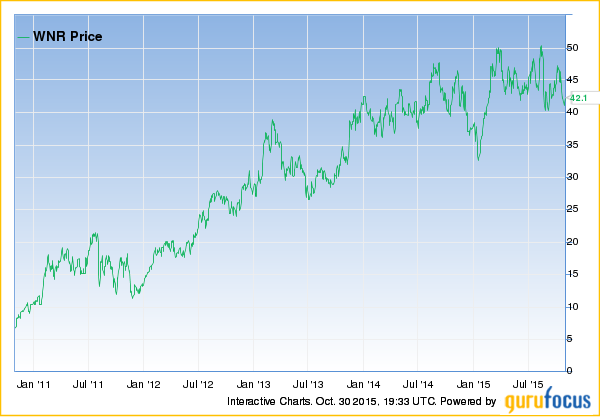
Western Refining Inc. qualifies for the Enterprising Investor but not the more conservative Defensive Investor. The Defensive Investor is concerned with the insufficient earnings stability over the last ten years as well as the inconsistent dividend record. The Enterprising Investor is only concerned by the level of debt relative to the net current assets. As a result, all Enterprising Investors following the ModernGraham approach based on Benjamin Graham's methods should feel comfortable proceeding with further research into the company.
As for a valuation, the company appears to be undervalued after growing its EPSmg (normalized earnings) from a loss of $0.13 in 2011 to an estimated gain of $3.98 for 2015. This level of demonstrated earnings growth outpaces the market's implied estimate of 0.98% annual earnings growth over the next 7-10 years. As a result, the ModernGraham valuation model, based on Benjamin Graham's formula, returns an estimate of intrinsic value above the price.
Whole Foods Market (NASDAQ:WFM)

Image result for Whole Foods MarketWhole Foods Market Inc. qualifies for the Enterprising Investor but not the more conservative Defensive Investor. The Defensive Investor is concerned with the low current ratio, inconsistent dividend record and the high PEmg and PB ratios. The Enterprising Investor is only initially concerned by the low current ratio. As a result, all Enterprising Investors following the ModernGraham approach based on Benjamin Graham's methods should feel comfortable proceeding with further research into the company.
As for a valuation, the company appears to be undervalued after growing its EPSmg (normalized earnings) from $0.70 in 2011 to an estimated $1.49 for 2015. This level of demonstrated earnings growth outpaces the market's implied estimate of 5.88% annual earnings growth over the next 7-10 years. As a result, the ModernGraham valuation model, based on Benjamin Graham's formula, returns an estimate of intrinsic value above the price. 

Sunday, July 26, 2015

Coca-Cola Set For Growth Going Forward As Investors Continue To Be Rewarded By The Stock

Image result for coca cola

Summary

  • Growth investments have started adding toward KO’s top-line and bottom-line numbers.
  • Company’s efforts to get leaner cost base will support growth investments and earnings growth.
  • KO’s shareholders will continue to enjoy healthy cash returns in the years ahead.
reaffirm my bullish stance on The Coca-Cola Company (NYSE:KO); the company recently reported strong top-line and bottom-line results for 2Q'15. As a matter of fact, KO's strong global market presence is helping it effectively execute its growth initiatives, under its plan of making 2015 a "Transitional year". Therefore, the company's growth strategies, small bottle sizes but higher prices, attractive partnerships, increased global marketing campaigns and on-track multi-year costs saving plan will positively affect the stock price in future. And owing to its strong growth potentials, I believe the company's cash flows will remain reasonably strong to make healthy cash returns to shareholders through dividends and share repurchases.

Financial Highlights of 2Q'15

The company's strategic growth plans focused on growing its top-line numbers, combined with its attractive multi-year cost saving plans, strongly backed its 2Q'15 results. KO's healthy sales volumes increased its 2Q'15 organic sales by 4%. And despite a double-digit increase in advertisement spending during 2Q'15, the company's increased focus on controlling expense burden improved its operating margin by 50bps and grew its operating income by 6%. Moreover, KO's 2Q'15 net income increased by 20% year-over-year and resulted in an EPS of $0.71, which for the fourth consecutive quarter outpaced analyst estimates, as shown in the chart below.

Source: Nasdaq.com
Growth Drivers remain Intact
With its strong portfolio of globally recognized carbonated and non-carbonated brands, KO has a strong market position in the global beverage industry; the company is presently leading the global beverage industry, with the highest market share, as shown in the chart below.

Source: Staista.com
KO's has been taking aggressive measures to improve its financial performance and its idea of getting most out of transitional year 2015 is working very well. And given the fact that KO is planning to continue the execution of its growth-generating plans, well beyond 2015, I believe the company will remain an impressive growth story in the years ahead.
Packaging Initiatives
One of the most important and intelligent strategic growth initiatives taken by KO, during the first half of 2015, was changing its packaging strategy; under its new packaging strategy, the company increased focus on selling reduced can sizes in the U.S. KO's initiative of selling mini cans came in the wake of increasing healthcare concerns, which shifted people away from carbonated soft drinks to other healthy drinking options. This new packaging strategy seems to have paid off well during 2Q'15; volume of its mini cans witnessed adouble-digit growth during the quarter. Along with the packaging strategy, KO's plan of benefiting from its strong brand positioning by raising prices on its traditional 12-ounce cans added well towards the company's North American region's revenue and profitability base. In fact, KO's North American net revenue and profit figure improved by 3% and 7%, respectively, during 2Q'15. Given this success of disciplined pricing and the reduced packaging strategy, the company is planning to continue with these initiatives in the years ahead, which I believe will keep KO on a growth track.
Partnerships
Along with its attractive pricing policies and intelligent packaging changes, the company has also accelerated its efforts to make intelligent strategic acquisitions. The company's partnerships with Monster Beverages (NASDAQ:MNST) and Keurig (NASDAQ:GMCR) have been positively affecting KO's top-line numbers; KO reported that the distribution of MNST's beverages has added a one-percentage point to its North American sales volume base, year-to-date in 2015.Also, the company is eyeing to acquire Chinese multi-grain drink producer Culiangwang Beverages Holding Limited for $400 million. The company's partnerships and acquisition will allow it to improve its competitive position among other energy drink producers, which will portend well for its long-term growth.
Accelerated Marketing Spending
In its efforts to improve its sales volume, KO has adopted an aggressive marketing strategy. In this regard, the company's globally launched "Share a Coke" campaign has been doing pretty well in gaining volume and revenue growth. In fact, in China, KO's Coca-Cola Break consumer promotion has also seen an impressive customer response. As a matter of fact, both Share a Coke and Coca-Cola Break campaigns have helped the company gain double-digitvolume gains for its flagship Coca-Cola brand in China during 2Q'15. Moving ahead, as KO remains focused on gaining more customers through its successful marketing campaigns, I believe that both the company's global market share and overall revenues will grow at a healthy pace in future.
Slashing Cost
In its efforts improve its cost structure and back its growth investments, KO has designed an attractive costs saving plan. Under this plan, the company is actively saving cost by managing its supply chain network. Thus far, KO has consolidated around three distribution centers and has closed one in North America. Moreover, KO's plan to create an efficient system by refranchising most of its company-owned bottling territories is also on-track. Owing to these on course cost saving plans, I believe the company is rightly headed to attaining its management's anticipated annualized costs savings of around $3 billion, least by 2019, which will positively affect its bottom-line growth.

Investors Remain Rewarded At KO

The company has been regularly returning healthy portions of its cash flows to shareholders in the form of dividends and share repurchases. During the first half of 2015, around $3.8 billion of cash has been returned in the form of dividends and share repurchases. In fact, KO currently offers an attractive dividend yield of 3.23%. Moving ahead, as KO continues with its attractive growth plans, I believe that its cash flow productivity will improve, which will support its cash return policy. The company has announced that around $2 to $2.5 billion worth of common shares will be repurchased during 2015, which will better KO's future EPS and will positively grow its ROE.

Risks

One of the major risks faced by the company is from declining sales of its diet coke brand; during 2Q'15, global diet coke sales volume decreased by 7%. Moreover, a stronger dollar will remain an overhang on sales and earnings growth of the company. Furthermore, KO will continue to face increased competitive headwinds from innovative product launches of its major competitor, PepsiCo (NYSE:PEP). In addition, unforeseen negative economic changes and changing consumer preferences are key risks that might hamper the company's future stock price performance.

Conclusion

KO's regular growth investments to enhance and improve its product portfolio, regular price hikes and increased advertising activity are rightly headed to make 2015 a transitional year for the company. Although these growth investments have started adding toward KO's top-line and bottom-line numbers, I believe the full impact of these efforts will be reflected in 2016 and beyond. In addition, the company's efforts to get a leaner cost base are rightly headed to support its growth investments and will support its earnings growth. Owing to strong growth potentials of KO's strategic growth plans, I believe the company's shareholders will continue to enjoy healthy cash returns in the years ahead. Also, analysts have projected a healthy next five-years growth rate of 6.7% for KO, as shown below. Due to the aforementioned factors, I am bullish on KO.

Source: Nasdaq.com

Friday, April 11, 2014

Buy, hold and prosper: The power of patient investing


It's behavior that determines your success or failure as an investor -- not knowledge, skill or luck.
If you ever needed a lesson in the power of patience, let me remind you of a date in recent history: March 9, 2009.
On that day, the Dow Jones Industrial Average($INDU -0.89%) closed at a gut-wrenching low of 6,547. Stock prices had been cut in half in just 15 months.General Electric (GE -0.59%news) had plunged from $38 to $7, Cisco Systems (CSCO -0.84%news) from $29 to $14, and Bank of America (BAC -2.17%news) from $43 to $4.
Making money in the stock market is hard not because finding great companies is difficult but because the best and easiest-to-understand strategy for winning is so difficult to adhere to. That strategy can be described in three wordsbuy and hold.
Five years from that 2009 bottom, the Dow was up roughly 10,000 points to a new record. No, the stock market doesn't always bounce back so dramatically, but it always bounces back.
No matter what the chart followers say, the market does not rise and fall in repeating patterns. If it's down sharply in a three-year stretch, for example, it won't necessarily rise just as sharply over the next three years. The market works on its own time­table, but there are some eternal verities:
  1. Stocks of large U.S. companies have reliably returned about 10 percent annualized over the past two centuries. They should do just as well for the next two.
  2. In the short term, the market can be risky -- if we define risk as volatility, or the severity of the ups and downs. In the long term, the market is much, much less risky.
  3. Individual companies can vaporize (Enron and Lehman Brothers, to name a couple), but a diversified portfolio protects you from the risk that an individual company will implode and provides a smoother ride.
  4. Compounding is enormously powerful. Over long periods, small price gains and dividend payouts mount up (but note that the expenses charged by mutual funds, brokers and other advisers add up, too).
And that's it! That is all you need to know about succeeding in the stock market. Buy a solid, low-cost, diversified mutual fund (or assemble your own diversified port­folio), forget about it for a long time, and you should do well.
As an example, consider Dodge & Cox Stock (DODGX -2.08%news), with an expense ratio of 0.52 percent. Over the past 15 years, a $10,000 investment in Dodge & Cox, a member of the Kiplinger 25, grew to about $40,000. At that rate, in another 15 years it will become $160,000, and in another 15 years it will be $640,000. And that spectacular growth comes from an annualized return of 9.5 percent, roughly the historical norm. Any 30-year-old who can put away $30,000 -- not every year but just once -- has an excellent chance of becoming a millionaire by age 70.

Psychological hurdles

It is behavior that determines investment success or failure -- not knowledge or skill or luck. Benjamin Graham, the Columbia University professor and financier who was Warren Buffett's mentor, wrote: "The investor's chief problem -- and even his worst enemy -- is likely to be himself." What he meant was that people let their emotions get in the way of smart investment moves. They tend to buy when stocks soar and sell when stocks sink.
The selling part is especially dangerous because people want to avoid losing. Richard Thaler and Cass Sunstein write in their book "Nudge" that academic research has found that "losing something makes you twice as miserable as gaining the same thing makes you happy."

TICKERS IN THIS ARTICLE

NAMELASTCHNG% CHNG
$INDU16,026.75-143.47-0.89
$INDU
GE25.43-0.15-0.59
CSCO22.46-0.19-0.84
BAC15.77-0.35-2.17
DODGX167.83-3.57-2.08
They point out that in 1992, participants in retirement plans administered by Vanguard were allocating 58 percent of their assets to stocks. But by 2000, as stocks had quadrupled in value, the proportion rose to 74 percent. Then, as stocks fell sharply over the next two years, the allocation fell to 54 percent. "Their market timing," they write, "was backward." We saw the same phenomenon during the recent cycle, with investors bailing out of stock funds as prices sank and returning only recently, as indexes hit new highs.
The values that help you succeed in the market are the values that Aristotle extolled: moderation, persistence and humility. The question is how to adopt behaviors that fit those values when the minute-by-minute noise of the market is so dramatic. Here's some advice:
Avoid the noise. One way to make yourself get out of bed in the morning without hitting the snooze button is simply to move the alarm clock away from your bed. The investment equivalent is moving stock-price information as far away as you can. Twenty years ago, I told the editor of the Washington Post's business section to quit running pages and pages of stock prices. Stop encouraging readers to check how their shares were doing each morning. The Post did drop the tables, but mainly because readers can now get prices by the second on their computers and smart phones. Don't fall into that habit. Check your holdings once a month or once a quarter.
Think of your holdings not in dollar terms but as investments in great businesses. When GE drops in price, think of the event not in terms of money that you have lost but in terms of someone else's transitory valuation of your little piece of GE. Do you really want to give up a stake in a wonderful company just because others fleetingly believe it is worth less?
For many investors, sitting still is not an option. They have to do something. If you're in that category, I suggest you set up a "fun and games" account, a separate portfolio that represents, say, 5 to 10 percent of your assets and in which you can trade to your heart's content. Compare its results with that of your buy-and-hold portfolio over five or ten years. Chances are high that your emotions and the costs of trading have taken a toll.
Make purchases in the same amount every month or quarter. This technique, known as dollar-cost averaging, forces you to buy more shares when prices drop. Instead of feeling bad about market declines, you may actually feel good because you are picking up more assets at better prices.
Think buy, not sell. Hunt for bargains. The recovery, by the way, is not over. For example, GE trades today at $26, still about one-third below its 2007 high. Cisco sells for under $23, also about one-third off its high. Bank of America is at $16, still down about 70 percent. I recommend them all.
In urging a buy-and-hold strategy, I am not suggesting that you mindlessly keep companies that have gone sour. The reason to sell, however, is not that the price of a stock has declined but that the business has deteriorated and is unlikely to recover -- a key new product has failed, a rival has started a price war, or the new CEO is clueless. If you have chosen stocks well, these events will be rare. And if you are wise, you will err on the side of keeping what you have. If you had done that five years ago, your portfolio would be up, oh, some 200 percent.
James K. Glassman is a visiting fellow at the American Enterprise Institute. His most recent book is "Safety Net." He owns none of the stocks mentioned.
Source: http://money.msn.com/how-to-invest/buy-hold-and-prosper-the-power-of-patient-investing