Showing posts with label before opening bell. Show all posts

Monday, April 10, 2017

5 Things You Must Know Before the Market Opens Monday

Related image

Here are five things you must know for Monday, April 10:
1. -- U.S. stock futures were pointing to slight gains on Monday as geopolitical tensions were making for a nervous Wall Street.
European and Asian stocks traded mixed.
Last week's U.S. missile strikes on a Syrian air base were followed over the weekend by bombings at two Coptic churches in northern Egypt that killed 44 people. Secretary of State Rex Tillerson said the U.S. missile strikes carry a message for any nation operating outside of international norms, including North Korea.
"Volatility was substantially higher last week, and safe-haven asset prices soared as geopolitical tensions and financial uncertainties rose. Therefore, a 'risk-off' sentiment will probably continue to overshadow stock markets in the near term," said Margaret Yang of CMC Markets, the Associated Press reported.
The S&P 500 fell 0.3% last week, the Dow Jones Industrial Average declined 0.03%, and the Nasdaq slid 0.57%.
"The two larger themes at play [in markets] continue to be relatively strong global economic data, along with the timing and extent of Trump administration policy changes," Bill Merz, investment consultant at U.S. Bank's Private Client Reserve, told TheStreet. "A second attempt at getting a health care bill through Congress in the near term is likely to extend the timing of tax reform efforts. This pushes any potential economic impact well into 2018, contributing to the equity market remaining range-bound in recent weeks."

The economic calendar in the U.S. on Monday is quiet with only the Labor Market Conditions Index for March from the Federal Reserve on the docket at 10 a.m. EDT.
2. -- Barclays (BCS)  CEO Jes Staley was being probed by the U.K.'s financial watchdogs over an internal investigation into whistleblowing.
Shares of the bank fell initially on the news but have since recovered and were rising slightly in trading in London early Monday.
 
The Financial Conduct Authority and the Prudential Regulation Authority have started investigations into Staley as to his individual conduct and senior manager responsibilities related to the bank's whistleblowing program and an attempt to try to identify a whistleblower.


The Barclays board on Monday said it became aware of the matter in early 2017 when the issue was raised by a concerned employee.
 
The board brought in an external law firm to conduct an investigation into the matter. The board concluded that Staley had "honestly, but mistakenly" believed he could identify the whistleblower.
 
The author of the whistleblowing letter hasn't been identified and Staley has apologized for the error, the board said Monday. However, Staley has been formally reprimanded and a "very significant compensation adjustment" will be made to his variable compensation award, the bank said.

3. -- BHP Billiton (BHP)  could create $46 billion in additional value for shareholders by spinning off its U.S. oil business, dropping its London listing and increasing capital returns, according to hedge fund Elliott Management.
Shares of the resources giant rose 4.5% in trading in London.
"Despite the first-class quality of most of BHP's assets, BHP as an investment has underperformed," the hedge fund wrote. The underperformance "has been driven by the incomplete status of management streamlining and value optimization of BHP's group structure and asset portfolio."
BHP shares have added 77% over the past year but remain down almost 30% over five years. 
Under Elliott's proposal, BHP's oil business would be carved out and then listed on the New York Stock Exchange, where the hedge fund claims it could be valued at $22 billion, or about $15 billion more than Elliot believes it is worth within BHP.
Elliott also believes BHP should drop its dual-listing and return to its Australian base -- from which Elliott claims about 90% of BHP assets by revenue are managed. That move would enable the company to more quickly monetize about $9.7 billion of tax credits that have accrued in Australia.
BHP didn't immediately respond to Elliot's demands.
4. --  Mondelez International ( MDLZ)  is preparing to look for a successor to its CEO, Irene Rosenfeld, as the snack giant faces pressure from restive shareholders and the broad shift to healthier eating habits, The Wall Street Journal reported.
The maker of Oreo cookies has hired executive-search firm Heidrick & Struggles, and its board recently discussed outside candidates to potentially replace Rosenfeld, the Journal reported.
The timing of the succession is up to Rosenfeld, who is serves as chairman, and Heidrick & Struggles hasn't yet been asked to interview prospects.
Potential successors among Mondelez's current executives include Tim Cofer, chief growth officer, and Chief Financial Officer Brian Gladden, according to the Journal.
5. -- Spain's Sergio Garcia, 37, held off a late charge by Justin Rose to win the 81st Masters on Sunday after one playoff hole.

It was Garcia's first major championship, and perhaps he could now shed the unwanted title of "best player to never win a major."
Garcia joins idols Seve Ballesteros and Jose Maria Olazabal, who each won two titles, as a Masters champion. Also read : https://goo.gl/eNwbsR
By Joseph Woelfel
Source: https://goo.gl/ujrj4s

Friday, November 25, 2016

5 Things You Must Know Before the Market Opens Friday

Target sees a surge in online traffic on Thanksgiving; U.S. stock futures suggest the Dow will open at another record high; J&J reportedly is bidding for Switzerland's Actelion.


Here are five things you must know for Friday, Nov. 25:
1. -- Target (TGT) saw a "surge" in online traffic on Thanksgiving Day that has the retailer on track to deliver on its goal of double-digit percentage online sales growth for the holidays," said Target Chairman and CEO Brian Cornell. Most encouraging, said Cornell, is that people are shopping multiple departments after scooping up the typical Black Friday doorbuster deals. 
"I continue to be very optimistic on our position for the holidays," Brian Cornell told TheStreet on a conference call with reporters Thursday evening.
Cornell cautioned, however, that it remains very early in the holiday season for Target. 
But what looks to be a good start for the holidays for Target mirrors developments across the retail landscape for early Black Friday openings. 
Thanksgiving Day brought in $1.15 billion in online sales from midnight to 5 p.m., a 13.6% increase from a year a year earlier, according to new data released Thursday night from Adobe. Thanksgiving Day will hit, or come close to, $2 billion in online revenue for the first time, Adobe said, which would represent a strong 15.6% increase from the prior year.
Meanwhile, many brick-and-mortar retailers are opening their stores early on "Black Friday," the day after Thanksgiving that remain one of the busiest shopping days of the year.
2. -- U.S. stock futures were higher Friday, suggesting the run that stocks have been on since the election of Donald Trump as U.S. president earlier this month will continue for another day.
The Dow Jones Industrial Average closed 0.31% higher on Wednesday, another record high, and the S&P 500 also scored a record close after the minutes from the Federal Reserve's policy-setting meeting indicated that an interest rate hike could come "relatively soon."
European stocks on Friday traded flat while Asian stocks ended the session higher. Japanese stocks posted the seventh consecutive session of gains despite a strengthening of the yen.The Nikkei 225 rose 0.26%.
The dollar fell 0.45% against the yen at ¥112.82. The U.S. Dollar Index, which is a measure of the dollar relative to six foreign currencies, fell 0.2% to 101.49. 
The economic calendar in the U.S. on Friday includes International Trade in Goods for October at 8:30 a.m. EST.
Stock markets in the U.S. will close at 1 p.m. on Friday.

Image result for Actelion3. -- Shares in Swiss biotech company Actelion (ALIOF) rose sharply in Zurich Friday on a report that it has attracted a bid from Johnson & Johnson (JNJ) .
Bloomberg reported that J&J, of New Brunswick, N.J., approached the Swiss company with an offer worth about $17 billion.
People familiar with the situation told Bloomberg Actelion is working with an adviser to explore its options. Actelion couldn't immediately be reached for comment.
Actelion is led by fiercely independent co-founder Jean-Paul Clozel, who has for years resisted suggestions the company is a target. Other mooted suitors for Actelion over the years have included Shire, which was last year reported to have made a takeover proposal for the business.

Actelion shares by late morning in Zurich were rising close to 11%.
4. -- President-elect Donald Trump said he was trying to stop the maker of Carrier air conditioners, United Technologies (UTX) , from relocating its Indianapolis manufacturing operations to a company facility in Mexico.
During the presidential campaign, Trump often cited Carrier's decision last February as an example of jobs leaving the country -- in this case, an estimated 1,400 -- and how he as president would slap a tax on any units manufactured in Mexico and sold in the U.S.

"I am working hard, even on Thanksgiving, trying to get Carrier A.C. Company to stay in the U.S.," Trump tweeted on Thursday. "MAKING PROGRESS - Will know soon!"
The company confirmed Thursday to the Associated Press that it had discussed the move with the incoming administration but that there was nothing to announce.
5. -- Wells Fargo (WFC) asked a U.S. court to order dozens of customers who are suing the bank over the opening of unauthorized accounts to resolve their disputes in private arbitrations instead of court, Reuters reported, citing legal documents.
The motion, filed in the U.S. District Court in Utah on Wednesday, is in response to the first class-action lawsuit filed against the bank since it agreed to pay $185 million in penalties and $5 million to customers for opening up to 2 million deposit and credit-card accounts in their names without their permission.

Wells Fargo is a holding in Jim Cramer's Action Alerts PLUS Charitable Trust Portfolio. Want to be alerted before Cramer buys or sells WFCLearn more now.

By 

Source: https://www.thestreet.com/story/13903604/1/5-things-you-must-know-before-the-market-opens-friday.html

Sunday, February 28, 2016

Weighing The Week Ahead: Can U.S. Economic Strength Support Stocks?


Summary

Image result for stock market
Equity markets have rebounded from recent lows, ending the "official" correction.
Recent economic data have been better than the end of 2015.
This week features an avalanche of data -- all of the most important reports.
Will economic strength translate into stock market strength?
Election stories will be a wild card.
This week's economic calendar is loaded with all of the most important data. In addition, Super Tuesday might provide a defining event to the political campaign. Oil remains volatile, and Fed Speakers are on the loose. Despite the political stories, I expect the punditry to be asking:

Can the strengthening U.S. economy support the rebound in stocks?

Prior Theme Recap

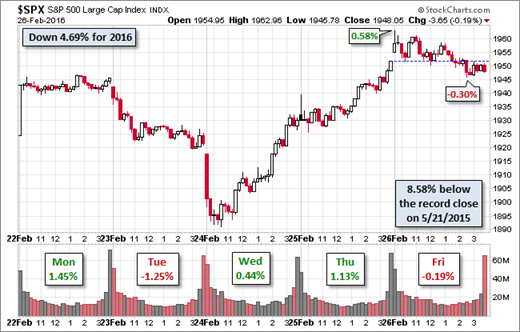
In my last WTWA (two weeks ago) I predicted a focus on the biggest market worries. That guess was not very successful, since the market immediately began a nice, two-week rally. The list of topics was still good preparation, since stories quickly turned to "what could derail the rally?" As Doug Short notes, Friday's market did not respond even when "an avalanche of economic data surprised to the upside". Once again, a modest decline in oil prices accompanied a modest decline in stocks. You can see the story in Doug Short'sweekly chart. (With the ever-increasing effects from foreign markets, you should also add Doug's World Markets Weekend Update to your reading list).
Doug's update also provides multi-year context. See his full post for more excellent charts and analysis.
We would all like to know the direction of the market in advance. Good luck with that! Second best is planning what to look for and how to react. That is the purpose of considering possible themes for the week ahead. You can make your own predictions in the comments.

This Week's Theme

Earnings season continues, and the political stories will be dominant, at least through Tuesday's elections and Wednesday morning's news. In a non-political season, this week would be all about the economy. We have more of the important reports squeezed into a single week (helped by Leap Year?) than we have seen in many months.
Recent economic news suggests improvement, at least in the U.S. At some point, a better economy will lead to better earnings and more support for stock prices. By the end of the week I expect politics to be a sideshow with focus on the economic data. Market observers and pundits will be asking:

Can economic improvement provide a foundation for equity markets?

Background

  1. Doug Short's observations about Friday's trading highlight the ambivalent response to "good news."
  2. Q1 GDP is tracking higher, as much as 2.5% according to the Atlanta Fed's GDP now reports. (James Picerno looks at this source and others).
  3. Are first quarters a "one off" over the last few years? Brian Gilmartin writes:
    Has anyone else noticed how volatile the first quarter has been the last 3 years ?
    In 2014, it was Russia driving tanks into Ukraine, the Venezuelan devaluation and profit-taking after the 32% increase in the SP in 2013.
    In 2015, it was falling crude oil, falling commodities, West Coast Port slowdown, strong dollar and even weather in February '15.
    In 2016, the volatility is the result of Financial stock volatility, European bank worries, negative interest rates, etc.
    Not one of the last three Q1's seems to be driven at all by the US economy and worries therein. Jobless claims remain strong.
    So what gives? What is it with the first quarter every year?
    I don't know, but it is always something.

Viewpoints

I expect the following to be the principal positions, with the usual vigorous support for each, ranging from bearish to bullish.
  • The reported data are flawed - a fluke, faked, subject to poor seasonal adjustments, etc. The economy is much weaker than the government claims.
  • Good news for the economy just means that the Fed will tighten sooner. Only central banks have kept the market afloat.
  • It is all about oil. Oil prices are the best economic barometer.
  • Positive economic news will reduce recession fears, helping many stock sectors.
  • Stronger economic news will lead to higher earnings estimates.
As always, I have my own opinion in the conclusion. But first, let us do our regular update of the last week's news and data. Readers, especially those new to this series, will benefit from reading the background information.

Last Week's Data

Each week I break down events into good and bad. Often there is "ugly" and on rare occasion something really good. My working definition of "good" has two components:
  1. The news is market-friendly. Our personal policy preferences are not relevant for this test. And especially - no politics.
  2. It is better than expectations.

The Good

On balance the news was very good last week, despite the market reaction.
  • Initial jobless claims remained low at 272K.
  • Q4 GDP was revised higher. This is backward looking, of course, but the revision to 1% growth suggests that the base for 2016 was a bit better.
  • Existing home sales remained strong and beat expectations - 5.47M versus 5.3M. (Calculated Risk)
  • Durable goods reversed nicely from the recent slump - up 4.9% overall and 1.8% on the core (ex-transportation).
  • Low oil prices are starting to show benefits. 
    • Gas prices continue to fall. $1/gallon coming this summer? (Oilprice.com)
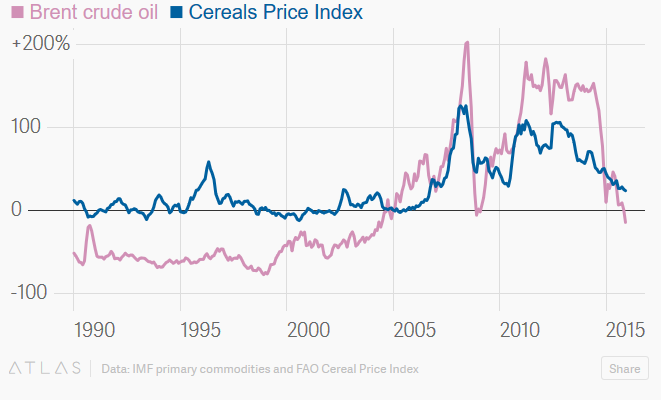
    • Reduced food costs around the world. Quartz has the story and plenty of charts showing the relationship. Christopher Groskopf calls it a "huge hidden upside."
      While the global economy's biggest players are reeling, there is a less visible group of people who stand to benefit tremendously: those without enough to eat.
      The security of the world's poor is inseparable from the price they pay for food, especially the grains that constitute most of their diet. Oil prices are a significant factor in determining the price of other commodities, including food. Tractors and other farm machinery require fuel, as does the manufacture of fertilizer. Once crops are harvested, oil prices dictate the transportation costs to get them to market, whether that's down a highway or over an ocean.
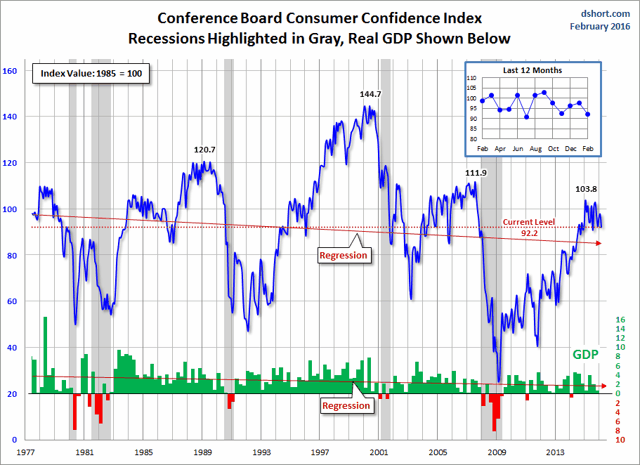
  • Michigan sentiment improved over January and slightly beat estimates. (But see Consumer Confidence below).
  • Personal income and spending both surprised with 0.5% growth. This is good news for housing and the consumer sectors. Maybe the improved employment picture and lower gasoline costs are finally having an effect.

The Bad

Some of the news was negative.
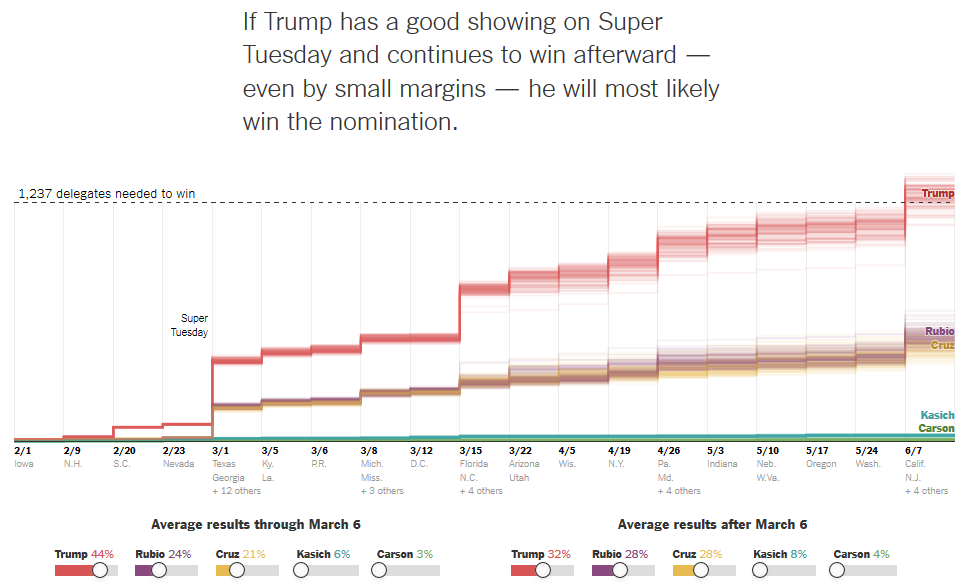
  • Leadership worries. Early primary results have favored "outsider" candidates. In my 2016 preview I said that it was far too soon to draw conclusions about the Presidential election. Things are shaping up faster than I expected. Most observers note that markets prefer establishment candidates and stable leadership. We can and should each express our own viewpoints and vote our consciences, but our personal choices may not be "market friendly." TheUpshot has an interesting interactive GOP simulator. You can plug in your own assumptions and use it to follow the news this week. They lead off with a favorable Trump scenario:

Monday, April 20, 2015

Early movers: MS, HAS, HAL, STI, NOK, RTN & more

Check out which companies are making headlines before the bell:
Image result for opening bell
Morgan Stanley—The firm earned an adjusted 85 cents per share, beating estimates of 78 cents, with revenue also above forecasts. Morgan Stanley's results were helped in part by better-than-expected performance in investment management and fixed income.
Hasbro—Hasbro reported quarterly profit of 21 cents per share, swamping estimates of 8 cents, with revenue also beating forecasts by a wide margin despite the negative impact of the strong dollar. Hasbro saw particularly strong performance in its Transformers and pre-school units.
Halliburton—The oilfield services company beat estimates by 12 cents with adjusted quarterly profit of 49 cents per share, with revenue scoring a slight beat as well. But Halliburton does say it expects the oil sector to remain "challenged."
SunTrust—The bank earned 78 cents per share for its latest quarter, 6 cents above estimates, with revenue essentially in line. SunTrust was helped by lower expenses, and growth in noninterest income.
Nokia—Nokia is planning to return to the consumer mobile handset market, according to Re/code.
Raytheon—The defense contractor announced a deal to buy control of cyber security firm Websense from private equity firm Vista Equity Partners for nearly $1.6 billion.
Callaway Golf—Jefferies began coverage on the golf club maker with a "buy" rating, saying market dynamics are likely to give Callaway a "powerful and sustainable" comeback.
Symantec—Jefferies upgraded the cyber security software maker's stock to "hold" from "underperform," following the company's Financial Analyst Day event. It cited a lack of negative catalysts, and potential benefit in a variety of breakup scenarios.
Splunk—Citi began coverage of the cyber security firm's stock with a rating of "buy/high risk." Citi said Splunk may benefit from a rapidly expanding market, but pointed out that the stock has been volatile as Splunk changed its pricing structure multiple times.
Michael Kors—Mizuho downgraded the luxury goods maker to "neutral" from "buy," following the results of a proprietary survey that the firm said does not necessarily bode well for future sales.
ComcastTime Warner Cable—Sources tell CNBC that the two companies will meet with Justice Department officials this week to negotiate possible concessions to get their planned merger deal approved.
Procter & Gamble—The multinational consumer goods company increased its dividend by 3 percent to just over 66 cents per share, payable to shareholders of record as of the close of business on April 27.
Costco—The wholesale retailer increased its quarterly dividend to 40 cents per share from 35½ cents, and also announced a new stock repurchase program of up to $4 billion. The new program replaces an existing $4 billion authorization which still has about $2.5 billion unused.
Prologis—The owner of warehouses and retail distribution centers will buy the real estate assets of KTR Capital Partners for $5.9 billion.
Sony—The company introduced its new Xperia mobile phone, even as Sony mulls an exit from its mobile handset business.
Patterson Cos.—Patterson is seeking a sale of its rehabilitation supply business for up to $600 million, according to Reuters.