Showing posts with label best energy stock. Show all posts

Sunday, February 19, 2017

Chesapeake Energy Is A Strong Buy

About: Chesapeake Energy Corporation (CHK), Includes: TOT

Summary

Now could be a great time for a takeover of Chesapeake Energy.
Friendly government policies and rising oil will spur M&A activity in the next 12 months.
Chesapeake's large natural gas and oil production in the US makes a great fit for Total SA.
Image result for chesapeake energy
Last week's earnings announcement by Total SA (NYSE:TOT) served notice to the markets that the company will be on the offensive going forward.
The company beat earnings on the top and bottom lines by a wide margin, earning $.96 a share on Revenues of $42.3B, beating street estimates by 8%. It also increased its dividend to 0.62 euros.
As I study the energy space, it appears to me that the best bang for the buck for Total SA may be buying Chesapeake Energy (NYSE:CHK) at a discount.
I recently wrote an article about BP plc (NYSE:BP) (which I believe is making a yearly low today) buying Chesapeake, but after more research, it seems Total SA would be even better served by buying this undervalued company.
One of the knocks against Total SA is its lack of US shale presence. In my view, buying up Chesapeake would instantly give Total SA the world class US shale acreage that would otherwise take years to accumulate.
Chesapeake CEO Mr. Doug Lawler recently gave a presentation at the Credit Suisse Energy Summit where he shared some valuable information about the company and its future. I encourage interested investors to click on the link above for detailed information.
Chesapeake Energy, in my view, is a prime takeout target; the question is who will be the buyer? I believe that Total SA is taking a serious look at Chesapeake right now.
If I was the CEO, I would be salivating at the 5,600 locations and vast possibilities of increasing production and reserves by snapping up this undervalued business model.
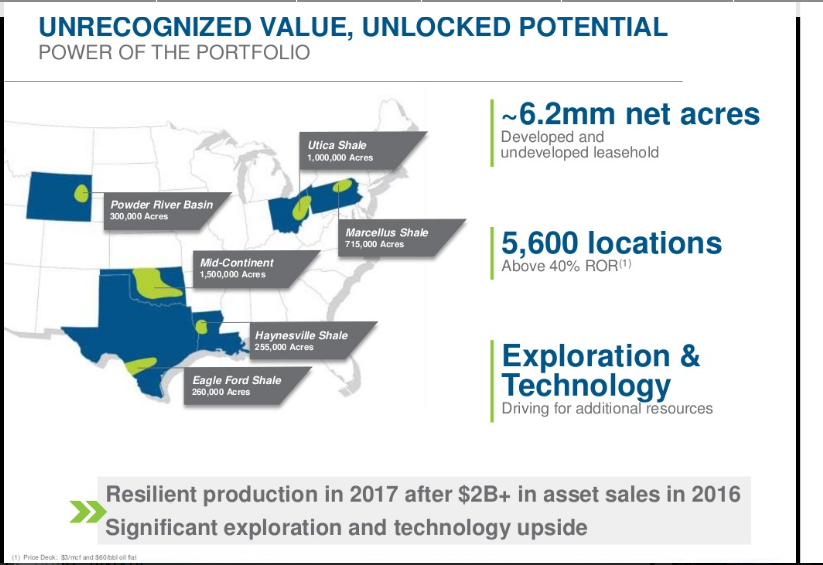
Chesapeake Energy just announced that the company will add seven more drill rigs in 2017 and plans to increase production by 2%.
Total SA wants more access to US shale production and here you have it. The number one independent producer of natural gas in the United States. They could keep CEO Doug Lawler in place, who in my view has done a terrific job of managing the debt structure of the company.
Divestitures
Total SA could buy Chesapeake with stock and cash, retire $3B in debt and sell $3B to $5B in assets, and completely change the cash flow picture while adding 11B of proven BOE reserves.
Chesapeake has pulled back nicely in price right before driving season kicks into gear. While oil inventories are currently rising, I believe summer demand will be strong and the oil market, along with oil stocks, are very near to the yearly low.
Look at the chart of Chesapeake testing its 200DMA.
Carter Worth, a master technician who I respect, says that the 186DMA is a very important factor in the life of a stock. When it turns positive, that is confirmation that the bottom is in. One can see from the chart above that the event occurred last August.
I believe that $5.55 is the absolute bottom for this stock going forward. Any move to that direction, if it comes, will be met with strong buying pressure.
I own the stock here and am saving some powder, but would not be surprised to see it gap up, sending the shorts running for cover any day.
Conclusion
I believe the oil patch is about to see a consolidation period full of mergers and acquisitions in the next 12 to 24 months, as oil continues to rebound on strong demand; those entities strong enough to snap up good assets will be well served going forward.
Total SA is in a strong position with good earnings and strong cash flow. It could increase its US presence in a big way by taking over Chesapeake Energy and keeping management in place.
I am an owner of Chesapeake Energy and will continue to increase my position, understanding that there could be a quick test at the $5.55 level where I bought it at right after the election.
As always, do your own research and know your exit point before making any trade.
Disclosure: I am/we are long LYG,HIMX,BP,ADPT, CHK, SSYS.

Thursday, April 7, 2016

4 Energy Stocks Under $10 To Buy Now

Image result for renewable energy group inc
Crude oil has defined the word volatility over the last year. 2016 has seen a low put in at $26 a barrel and a high put in a couple of weeks ago over $43. We now sit halfway back in the $35-$36 area after a nice pullback, and traders will now be watching for a bounce. I see oil looking to find a trading range between $36 and $42 over the next couple of months as it continues to digest supply issues.
Earnings season is fast approaching and estimates are not looking good for energy companies. The low price of oil has cut into margins and made it difficult for energy companies to be profitable. For many of these oil companies, this idea is already priced into the stocks. If a company were to surprise to the upside and surpass market expectations, we could expect larger-than-normal up moves in the stock.
Energy stocks will benefit if crude can manage a bounce back to $40, so let's take a look at some stocks that could pop in that scenario. Below, I created a list from the Zacks Stock Screener in which I focused on lower priced stocks in the oil industry. These are energy-related companies that are a Zack #1 (Strong Buy) and priced under $10.
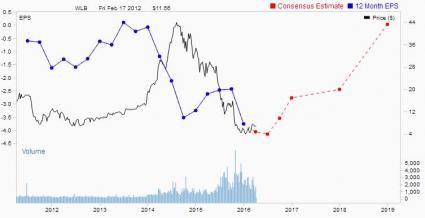
Image result for westmoreland coal companyWestmoreland (NASDAQ:WLB) is a Zack #1 (Strong Buy) whose principal activities include the sale of coal, ownership of power plants, leasing of capacity and storage and vessel loading. The Colorado-based company has over 3,400 employees and was founded in 1854.
Westmoreland has a market cap of $130 million and sports a Zacks Style Score of "B" in value and "B" in growth. Earnings are out on April 22nd and analysts have been raising estimates over the last month. For the current quarter, we have seen a 17% revision higher from -$1.17 to -$.97, and for fiscal-year 2016, we see an 11% raise from -$3.11 to -$2.76.
Looking at the chart below, we see expected future EPS growth for the company. If energy prices can grind higher, this growth will be easier to achieve and the stock should start to normalize to a reasonable price.

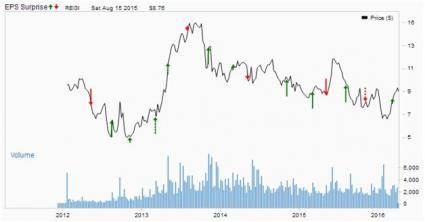
Renewable Energy Group (NASDAQ:REGI) is a Zack #1 (Strong Buy) that produces and sells biofuels and renewable chemicals in the United States. It operates through Biomass-Based Diesel, Services, Renewable Chemicals, and Corporate and Other segments.
REGI has a market cap of $400 million and a forward PE of 4.5. The stock is a value play with low PE and that is reflected in its Zacks Style Score of "B" in value. The company reports on May 3rd and estimates for fiscal-year 2017 have perked up over the last 30 days, going from $0.67 to $0.97, a rise of 44%.
The company has a large short interest and trading at the top of its bearish channel. A break of the channel could put the shorts on edge and an earnings beat, along with the combination of higher oil prices, could force the shorts to cover.

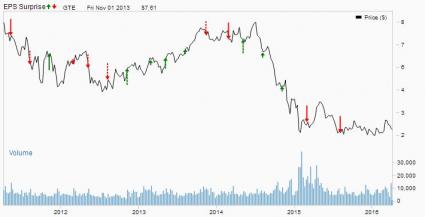
Gran Tierra Energy (NYSEMKT:GTE) is a Zack #1 (Strong Buy) that is an international oil and gas exploration and production company, headquartered in Calgary, Canada. The company strategy is focused on establishing a portfolio of drilling opportunities to exploit undeveloped reserves to grow production, as well as undertaking exploration to grow future reserves.
Gran Tierra has a market cap of $650 million and reports earnings on May 4th. The stock has been punished as oil prices have plunged lower, but now the stock and estimates have flattened out. A tick higher in oil could lead to a reversal in sentiment and lead this stock back above $3 a share.

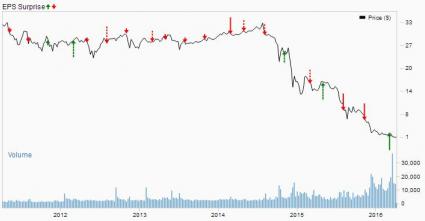
Vanguard Natural Resources (NASDAQ:VNR) is a Zack #1 (Strong Buy) that is an independent natural gas and oil company, focused on the acquisition, exploitation and development of natural gas and oil properties. Vanguard's assets consist primarily of producing and non-producing natural gas reserves located in the southern portion of the Appalachian Basin, primarily in southeast Kentucky and northeast Tennessee. The Houston-based company was founded in 2006.
Vanguard has a market cap of $185 million and a forward PE of 5.2. The stock pays a dividend of 25% and sports Zacks Style Scores of "A" in value, growth, and momentum. The company reports on May 6th and estimates for fiscal-year 2016 have perked up over the last month, going from $0.07 to $0.27, a rise of 285%.
The company had an EPS surprise of 226% last quarter. A repeat of that kind of beat to the upside could bring investors back to the well.

In Summary
If crude oil can get back above $40, speculators will buy these stocks in anticipation of a business turnaround. These companies have had it rough, but a return to $40 oil will help operations become more profitable. The long-term damage has been done and a return to all-time highs for these stocks is unlikely. However, as oil goes higher, the stocks will find more investors willing to bid them up.
By Zacks Investment Research

Sunday, December 14, 2014

Never Let A Good Bear Market Go To Waste: Energy Gems Amidst The Rubble

Summary

  • Investors today face a unique opportunity to purchase energy-sector stocks at deeply discounted prices.
  • Three large-cap names appear to offer excellent, asymmetric risk/reward for conservative investors.
  • The broad indices are hitting new highs, and the energy sector is trolling lows; discounts are hiding in plain sight.
  • Bear markets breed opportunity for patient investors.
Energy sector stocks have taken a pounding on spot crude oil price fears. Typical of today's market, ETFs and index funds both mask and create opportunity. Baskets of stocks get traded as one homogeneous block versus the individual companies represented.
Today, I offer three well-known, large-cap energy stocks that may be purchased significantly below fair value: Royal Dutch Shell (RDS.A, RDS.B), Halliburton (NYSE:HAL), and EOG Resources (NYSE:EOG).
This trio possesses the basic, fundamental characteristics I seek when purchasing any security. Namely, their businesses:
  • Are well managed
  • Have strong franchises
  • Are marked by sound balance sheets
  • Earn profits largely in cash
  • Are shareholder-friendly
Those who have followed my work on Seeking Alpha may recognize that I regularly write about - and own - shares of RDS.A, HAL, and EOG. Therefore, I will not spend much time here re-validating the aforementioned fundamental characteristics. If you are interested in doing so, please review some of my previous articles for a cross-check.
So let's get right to the valuation exercise and find out why I believe these particular energy names may afford the patient investor excellent forward total returns:
Royal Dutch Shell (Industry: Integrated Energy)
Currently, RDS.A shares (ADRs) trade for $67.13 each, down ~18% from summertime highs.
(click to enlarge)
Royal Dutch Shell - 5 Month Price And Volume
Source: Bigcharts.marketwatch.com.
The Federal Reserve Board publishes daily the interest rates for Moody's seasoned Baa bonds. It is now 4.78%. The Wall Street Journal publishes the yield for the High Yield 100 (the 100 largest junk bonds). That index is pegged at 5.54%.
Royal Dutch Shell shares have a 5.60% forward dividend yield; and the payout rock-solid. The annual dividend has not been cut since WWII.
Shell common shares now offer a secure income component that is greater than either mid-level or junk bonds. The company holds an S&P 500 "AA" credit rating.
When evaluating or comparing Super Major energy stocks, I prefer to utilize an historic multiple of operating cash flow instead of price-to-earnings. To help validate relative valuation, I like to use price-to-book.
The table below summarizes the data. Shell appears undervalued versus peers. I added price-to-earnings for additional color. Please note that this metric further supports the premise that Shell is undervalued:
(click to enlarge)
If Shell is undervalued, by how much? What's the fair value estimate?
Let's go back to price-to-cash flow multiples. A 10-year F.A.S.T. graph illustrates the long-term P/CF multiple has been 6.4x. Price has tracked this metric well.
(click to enlarge)
Source: Fastgraphs.com.
We see the ADR shares are trading below fair value when using consensus 2014 cash flow estimates on the normalized average price-to-cash multiple: an $86 price target is the result. In 2014, Royal Dutch Shell generated $35.4 billion cash flow in the first three quarters. Therefore, the company can make the 2014 estimate of $13.57 OCF per share (or ~$43 billion) on 4Q cash flow of only $7.5 billion. Such a result would be down 32% from reported 3Q 2014 figure.
For 2015 estimates, I have a bit of a rub with Wall Street - where analysts anticipate the company will experience a 15% decrease from 2014 cash flow. While I understand that Shell is divesting about 5% of its total assets in 2014/2015, and this will reduce 2015 cash flow; I disagree with such a large projected drop. CEO Ben van Beurden has stated his objective to improve operating cash flows to $50 billion within two years. Meanwhile, the other Super Majors are expected to record 2015 YoY operating cash flows ranging from -4% to +15%.
Even if one elects to utilize the current 2015 S&P estimate and 15% OCF decrease, the Shell price target is still $74 on the historic P/CF ratio. From today's price, that's 10% capital appreciation and a 5.6% yield for a total potential return of 15.6%.
Personally, I believe the upside is greater. I contend Shell stock goes to $78 per ADR next year if oil stabilizes around $80 by mid-year 2015.

Thursday, December 11, 2014

This Could Be One Of 2015'S Best Turnaround Stocks


In the world of investing, winners stay in the spotlight while laggards get pushed into the shadows.
Often times, these stocks get pushed off the radar as investors brace for a period of operational headwinds. Yet as those headwinds abate, opportunity knocks.
That's the set-up in place for Itron, Inc. (Nasdaq: ITRI), one of the world's leading providers of water, electric and gas meters for use in homes, commercial buildings and industrial settings.The company's share price slid nearly 15% since February 2013, while the S&P 500 has surged more than 35%.
To be sure, Itron has been through the ringer, as long-term contracts expired, new contract signings have been postponed and public spending on infrastructure has lagged. The company's revenue base shrank from $2.43 billion in 2011 to an estimated $1.95 billion this year. A lack of profits in three of the past five years surely impacted shares as well.
20092010201120122013
Revenue (billions)$1.7$2.3$2.4$2.2$2.0
Net Income (millions)-$2$105-$510$108-$147
Despite the company's 2014 headwinds, I think Itron is turning the corner and could be poised for a nice run in 2015 and beyond.
Growing Some Smarts
The meter business has steadily progressed with the times, as has Itron's product line-up.
Four decades ago, the company mainly sold low-tech electrical meters that required a periodic visit from a meter reader.
Since then, Itron built a line of advanced meters with a one-way communication module that collects and stores utility usage data. The results can be transmitted to a mobile device or a fixed network used in the analysis of resource usage and billing.
The company's highest-tech offerings, smart meters, provide the most functions. These include collecting and storing utility usage data over time, two-way communication enabling remote operation and data transmission and interfaces with other devices like in-home displays, smart thermostats and much larger interconnected networks.
Itron also sells software packages that help consumers and building managers optimize energy use in homes and commercial settings. It's working with utility companies, too, to develop integrated smart-grid technologies that could help revolutionize water and power management on a broad scale.
Simply put, Itron is right in the thick of the growing movement toward cleaner, more efficient and more sustainable energy and resource use.
Itron's recent problems stem from the fact that demand in the United States for advanced meters has stalled. The company is attempting to foster growth by tapping international markets.
Some of the best growth opportunities are in Western Europe, particularly Spain, France and the U.K., where demand for smart meters will total about 93 million units through 2020, according to projections by market research firm Navigant Research. Together, China, India and Japan will need hundreds of millions of smart meters during the next decade or so.
Globally, the smart meter market will expand 50% to $6.6 billion in 2023 from $4.4 billion last year, Navigant estimates.
Projected Smart Meter Demand
CountryUnits Needed (millions)
Japan (through 2024)80
Spain, France, UK (through 2020)93
India (2017-2027)150
China (through 2020)377
Source: Navigant
Itron is now seeing modest revenue gains after a series of declines in prior years.
Looking ahead, I expect international markets will deliver a boost to Itron's financial performance as the firm ramps up overseas sales efforts.
On November 26, for example, the firm announced a deal to provide smart meters for AES Eletropaulo, a major Brazilian utility with 6.8 million customers that recently began a smart grid project in the city of Barueri.
Itron has been expanding its Asian presence for several years. It opened a high-tech meter manufacturing facility in Southeastern China in 2012 to facilitate the country's efforts to streamline energy use.
In India, a 2013 contract with the infrastructure development firm SPML was established to provide 90,000 advanced meters for several areas of New Delhi, India's capital city. Itron's water meter factory in the Dehradun district of India handled the manufacturing.
Backlog figures highlight a clear positive trend. The company booked $514 million in new orders in the third quarter (up from $478 million in the second quarter), helping total backlog to rise sequentially, to $700 million from $675 million.
Those gains are being muted by a global restructuring effort which will cost Itron $65-to-$75 million during the next few years. But after that process is complete in 2016, the company will save about $40 million per year in operating expenses, according to management.
Risks To Consider: Itron's financial performance can be choppy at times because the firm is so closely tied to the utility sector, where meter demand can vary substantially with factors like construction trends, availability of government subsidies and overall economic conditions.
Action To Take --> With its business recovering, Itron is well-positioned to meet consensus projections for earnings per share of $1.63 this year, followed by 11%-a-year growth for the ensuing five years. Assuming a more conservative price-to-earnings ratio of 25 -- the industry average is currently 29 -- this implies about 70% upside potential for the stock through 2019. Investors seeking a likely turnaround play for 2015 and beyond should consider Itron.