Showing posts with label start ups. Show all posts

Sunday, March 5, 2017

Tech IPOs: What's Next?


Image result for airbnb

 Includes: AIRBAMZNDROPBFBGOOGGOOGLSNAPUBER

Summary

Public markets are again hungry for tech companies.
Snap IPO has opened the door for others to do the same.
The stay private longer trend is being challenged.
2016 tech IPOs performed extremely well.
Markets are hitting all-time highs almost on a weekly basis for several factors such as low interest rates or Trump's promised policies. Tech companies are no strangers to this, with investors increasingly giving them lofty valuations. This raises one question whether it is the right time for private tech companies to start riding this wave?
The "stay private longer" trend
Long gone are the days where tech companies would IPO after only a few years of existence. Before the dot.com crash came and investors lost their appetite for such risky ventures, retail investors were acting like venture capitalists, i.e. they would buy public stocks of a very young and unproven company in the hope of huge returns. At the time, the Internet was the new gold mine, and everything coming out of it was shining.
What investors didn't know was that such potentially huge returns were also associated with risks. For every Google (NASDAQ:GOOG) (NASDAQ:GOOGL) or Amazon (NASDAQ:AMZN), there are hundreds of Pets.com. And so, after the 2000 crash, early tech investing was left to venture capitalists alone.
This total rejection from public investors towards young internet companies in the aftermath of the crash, made tech companies to fear and dislike the public markets. The public markets, in addition to the heavy disclosure requirements and bureaucracy, could also kill a company in a matter of days. This mutual dislike led tech companies to focus on building sustainable businesses privately, and only then consider any sort of public listing.
This trend was further emphasized by the abundance of capital in the private markets, first from traditional venture capital, but now from all sorts of investors, such as hedge funds, mutual funds and corporate investors. Where before, an IPO was primarily driven by a need of liquidity - either by the company itself, or by the founders and investors - it is now a business decision. There is enough money in the private markets to solve any liquidity issue, either by injecting fresh capital into the company, or by acquiring shares from founders, or employees and investors in what are now very well-developed secondary markets.
What this all means is that most of the value upside of a tech company is absorbed by the private markets these days. But with these also come potential losses. Today, for every Facebook (NASDAQ:FB) or Alibaba (NYSE:BABA), there still are hundreds of Fab.coms out there. This stay private longer trend has diminished the risks for retail investors by reducing their options - and therefore, keeping them away from potential huge returns, as the chart below clearly illustrates.
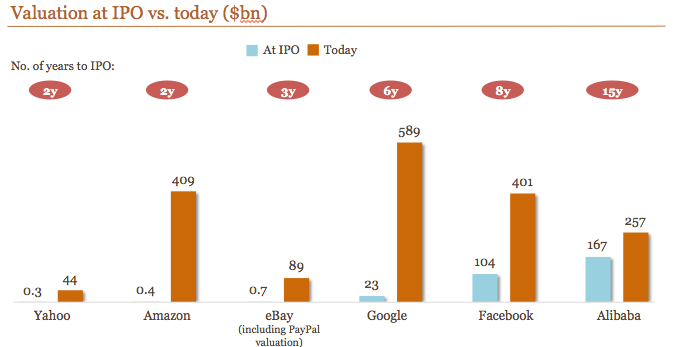
Source: Google Finance data
Some advocate that the rise of crowdfunding solves exactly this problem, but it is well known in the industry that the best companies raise money from the best venture capitalists, and only those who struggle with that path turn to the average Joe online. The notable exception being the companies that have a consumer brand and want to use crowdfunding as a marketing tool, like Monzo.com is currently doing. But for every E-Car Club (exited to Europcar after fundraising through CrowdCube) - notice how few there are that I had to mention a relatively unknown company - there are thousands of those companies that fail early on.
2016 in review
2016 was a relatively good year for tech IPOs, although not very eventful. There were few IPOs, and none by a large well-known company, such as Facebook, Alibaba, Twitter (NYSE:TWTR) or Snap (NYSE:SNAP). These all gathered a lot of attention for their public profile - usually associated with consumer-facing companies - or their unusually large size.
There are a few reasons for the low number of tech IPOs: Markets were not very welcoming ("are we in a bubble?"), the continuous abundance of money on the private markets, and the increasing M&A spree by corporates. Indeed, M&A seems a very interesting alternative to an IPO, with no stock volatility and the pressure associated with it, no public disclosure, and a path for the founders to quietly leave the company if they wish so.
But it also means you lose your independence, which is something young start-up CEOs dread. Some sell early, but there are a few who are bold enough to reject billion-dollar acquisitions, such as Mark Zuckerberg or Evan Spiegel.
But the few tech companies that did IPO in 2016 performed relatively well. Indeed, tech IPOs were the second best asset class in 2016, only after crude oil.
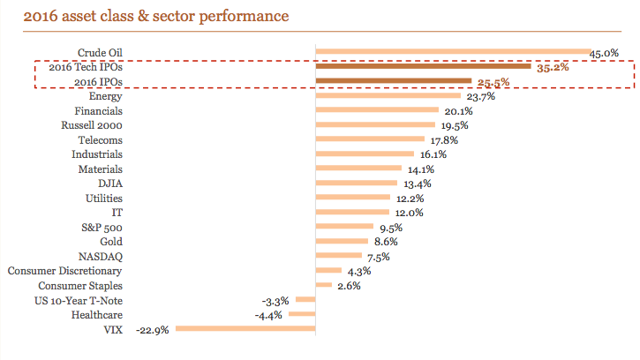
Source: CBInsights (Factset as of December 30, 2016)
Note: IPO performance represents average offer/current price
A closer look at some of the underlying data gives an interesting view on first day pops (note this table does not include all 2016 tech IPOs).
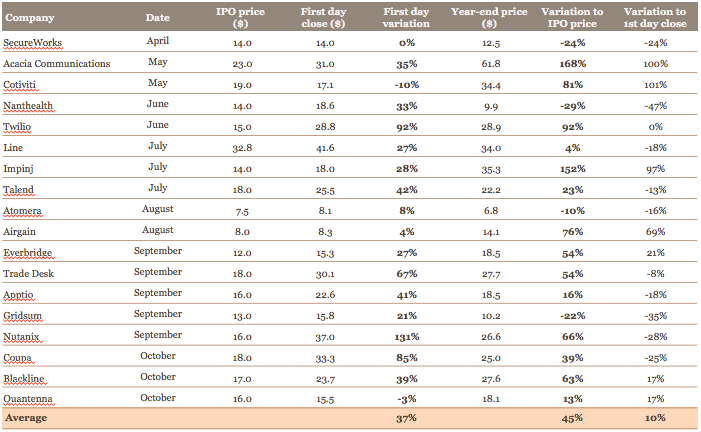
Source: Bloomberg data
While on average these companies were returning 45% at the end of the year, most of that value was captured by big institutional investors who have access to the shares at the IPO price, rather than retail investors like you and me. IPO allocations are a very profitable business, which I will touch upon on a new article next week.
The year ahead
2017 started off quietly on the trading side, but with a lot of buzz around two companies that had filed to go public in Q1: AppDynamics and Snap.
AppDynamics was set to be the first tech IPO of this year, and although it is not a household name, investors were very much looking forward to it to test the waters. Unfortunately, that test was delayed by a month, as Cisco (NASDAQ:CSCO) swooped in last minute and acquired the company for $3.7bn. This was a great outcome for the company and all its shareholders, but it meant public investors would need to wait to deploy capital into new tech companies.
That leaves us with Snap: The young, loss-making, low revenue generating, little understood company that is growing at an impressive rate and seeking a very lofty valuation. This is the ultimate test for the markets: Would they buy it or let it sink? They bought it! The company priced its shares at $17, slightly above the initial $14-16 range, and it closed just under $25 on the first day of trading, with an impressive 44% increase.
The Snap IPO proved two things: First, there is a strong appetite for new tech companies in the public markets, and second, it is again possible to successfully tap the public markets as a very young and unproven business with hyper-growth. Public investors, including retail investors, are again excited to be part of the growth of these companies, "willing to risk 50% of their investment for a 1,000% return potential." Very much inspired by the recent successes of Facebook and Alibaba and the unstoppable performance of the F.A.A.G. stocks (the fact that the dot.com crash was too long ago for anyone to remember the real impact also helps).
Image result for uberThis is obviously very encouraging for other companies, which are looking for an opportunity window to tap the markets for liquidity. Another interesting point is that most companies are (hopefully) aware that there is a limited amount of public money to inject into those larger tech companies, so being first might be an important advantage. Had Snap IPO'd right after Uber (Private:UBER) and Airbnb (Private:AIRB), would there be as much demand? Probably not…
So who are the large private consumer-facing unicorns out there looking closely at the public markets?
My best guess for 2017 is Spotify - in what would be the biggest European venture capital-backed IPO ever - and a great boost for the local ecosystem. It's been rumored for a few years now, and the company seems ready from a governance perspective, but it still needs to lock-down new agreements with the record labels to make it a sustainable business. If that happens in the first half of this year, I'm confident Spotify will IPO in 2017.
Uber most likely won't be able to tap the public markets before 2018/19: The business is still churning too much money, regulation is still a big open question, it is facing too much competition worldwide, and does not yet have the necessary culture to be a public company.

Wednesday, March 1, 2017

The latest hot start-ups to emerge from Israel’s cybersecurity war machine

Israeli soldiers march in front a Merkava tank
David Furst | AFP | Getty Images
Israeli soldiers march in front a Merkava tank
More than $680 million was invested in cybersecurity companies in 2016. But it wasn't in Silicon Valley. It was Israel.
Some of the biggest investment rounds were made in two standout start-ups to emerge from Israel's cybersecurity sector in recent years: GuardiCore and Fireglass. Last year these companies — both of which made CNBC's inaugural Upstart 25 list — raised funding rounds of $20 million. GuardiCore, founded in 2013, helps customers detect active breaches inside their data centers in real time, reducing the time it takes for a company to realize it's even been hacked from months to minutes. FireGlass, founded in 2014, uses isolation technology to protect networks. Users browse the internet or read email within the Fireglass service, which effectively places a secure buffer zone between the user and any malicious online content, preventing hackers from reaching the network. Large enterprises and Fortune 100 companies use the services of both companies to secure their data centers and protect their employees.
Image result for GuardiCore
Although they are separate companies, they share one characteristic that's at the heart of each start-up's meteoric rise: Both the founding teams of GuardiCore and Fireglass contain former members of the Israel Defense Forces.
For nearly four decades the Israeli military has been grooming a new kind of soldier: cybersecurity intelligence experts.
Some are trained in the elite Talpiot program, where they earn degrees in physics, math or computer science. Other soldiers, including some trained in Talpiot, work in the famed intelligence unit of the IDF, credited with creating the Stuxnet virus that infected the computers inside Iran's nuclear enrichment program.
"In Israel, companies and customers are more open to experimentation. So you have this small playground where you can try stuff."-Ron Berman, assistant professor of marketing, Wharton School of the University of Pennsylvania
In the Israeli military, the focus is often on securing large enterprise systems and data centers, practical training that has proved useful to IDF veterans who went on to found their own companies.
"When people leave the military, many go out and start their own companies. When you're finishing your army service at age 21 with three super-intense years of cyberdefense training at the highest level, that's really the biggest edge," said Tal Slobodkin, a veteran of the IDF and now partner at StageOne Ventures in Israel.

Leading the charge

The payoff has been huge. Israeli cybersecurity firms own roughly 10 percent of the worldwide $11.9 billion market today, and the country is home to some 300 cybersecurity companies. In 2016 alone, 83 new cybersecurity start-ups were founded, according to YL Ventures, an investment firm with offices in Silicon Valley and Tel Aviv.
"Israel has always been defense-minded and proactive in their defense," said Judith Germano, senior fellow at New York University's Center for Cybersecurity. "Combine that defense mind-set with an entrepreneurial spirit, and within Israel that has helped to create this boon."
According to YL Ventures data, $560 million was invested in Israeli cybersecurity companies in 2015. In 2016 that number rose to $689 million.
Of course, Israel has a history of cybersecurity success to draw upon. Check Point Software, among the earliest companies to develop firewalls to keep hackers out of computer networks, was founded by three IDF veterans and went public in 1996. CyberArk, whose co-founder and CEO Udi Mokady served in the intelligence unit of the IDF, makes software to identify and then block unauthorized access to privileged parts of an organization's computer network once hackers have made it inside.
Because the Israeli military tries to predict and plan for how cyberattacks of the future will be carried out, it's typically the case that those soldiers who receive cybersecurity training are "ahead of the curve with where things are going," Slobodkin said.
That carries over when IDF veterans found private companies. When CyberArk went public in September 2014, it was already pulling in revenue of more than $100 million. Following the hack of Sony Pictures Entertainment two months later, its share price rose quickly as large organizations recognized the need more than ever to protect their digital assets. By the end of 2015, CyberArk had $161 million in revenue, a 42 percent year-over-year increase, and was worth $1.42 billion.

Staying on the offensive

"Israel has been on the cutting edge on the military side of developing offensive and defensive cybersecurity. It's natural that this stuff has migrated from military applications to consumer applications," said Scott Tobin, a partner with Battery Ventures, based in Israel, who led the firm's investment in GuardiCore's latest funding round.
That cutting-edge cybersecurity found its way into GuardiCore and Fireglass.
Fireglass co-founder Guy Guzner worked 13 years at Check Point as director and then head of security products before leaving to start his own company. His co-founder, Dan Amiga, is a veteran of the IDF's intelligence unit, which is how isolation technology became the core of Fireglass' business today.

Tuesday, March 22, 2016

Million-dollar idea: A smart water bottle for the masses

Image result for nadya nguyen hidrate
Hidrate, a start-up founded in mid-2015, is nearing the $1 million mark in revenue, a success that would not have occurred if the founder had bothered to drink enough water.
Nadya Nguyen, the 23-year-old Hidrate founder and CEO, became so dehydrated after volunteering at a TedX event last year, she nearly passed out on a bus ride home.
By using a combination of data points, including height, weight, age and level of activity, the Hidrate app alerts a user when it's time to drink more water.
Source: Hidrate
By using a combination of data points, including height, weight, age and level of activity, the Hidrate app alerts a user when it's time to drink more water.
That 10-hour walk turned into a 54-hour sprint with Nguyen and a team using a plastic bottle, a circuit board and hair scrunchie to assemble the prototype of a smart water bottle that tracks water intake and hydration. Called HidrateSpark, the water bottle comes with a smartphone app that's compatible with Android, iOS and Apple Watch. (The app also connects to the most popular fitness apps, such as Fitbit, Apple Health Kit, MyFitnessPal, Jawbone and Misfit.)
Using a combination of data points — including height, weight, age and level of activity — the Hidrate app alerts a user when it's time to drink more water by sending a notification to their phone and making the bottle glow.
But it's another data-usage pattern uncovered in the Hidrate story that should be of interest to entrepreneurs in search of a million-dollar idea.
Before Hidrate was conceived, Nguyen was consulting at Deloitte on a data analytics project. Studying and working with data sets and behavioral market analysis helped Nguyen launch Hidrate with confidence that a market existed for it beyond start-up founders who forget to drink water on long walks.
"Data by itself is great, but when you combine it with a field, that's when the magic happens," Nguyen said.
Image result for nadya nguyen
Nguyen said her background in data analytics allowed her to devise a systematic way to identify the market fit for Hidrate. Marketing intuition helped her come up with a number of potential markets, but it was the hard analytical skills that helped her set up tests to validate the markets.
"It's important for there to be a balance between data and intuition," she said.
Wilson Raj, global director of customer intelligence at SAS Institute, said for small businesses like Hidrate, data analytics needs to be a tool used with a narrow goal in mind. "The first thing any small business needs is a very tight goal in terms of what it wants to use analytics for. For example, they can use it to validate their customer strategy or product strategy and then collect data and figure out what they know about those people and see what it says about their market," Raj said.
Nguyen and her team at Hidrate did just that. With a list of all possible markets spanning close to 30 different demographics, they set up a model to validate each market. The process involved a combination of focus group interviews, surveys, observation of the lifestyles of people within a certain group, and advertising on Facebook to target different demographics and see which ones performed best or got the most click-through.
"We were able to analyze the sentiment of the comments posted on our ads," Nguyen said. "It was great to see unfiltered comments about the product, because we got a range of responses. People either couldn't wait to get their hands on the product or they downright hated it. We took those comments as a sign to double down on some markets and eliminate others."

Finding your early adopters

The data ultimately showed that Hidrate's primary market opportunities were geared toward weight loss, fitness and health care. For instance, those who suffered from chronic diseases of the kidneys are a key demographic for the company. Hidrate also realized its markets were particularly skewed toward women, which is evident inHidrate's branding.
Nguyen and other co-founders and Hidrate team members — Coleman Iverson, Alex Hambrock and Jeremiah Harris — have received attention from the press for accumulating more than 8,000 backers in a Kickstarter campaign, but the data-based marketing work behind that success gets less attention.
"The tricky thing about finding your market is that people you think would be early adopters turn out to be the exact opposite — athletes, for example, aren't a big part of the marketing strategy," Nguyen said. "Finding these early adopters ... was critical in launching Hidrate. ... It was the early adopters who helped build the product and shared it with others."
"The tricky thing about finding your market is that people you think would be early adopters turn out to be the exact opposite."-Nadya Nguyen, co-founder and CEO Hidrate
"Social media has changed marketing and analytics," Raj said. "Progressive brands are not just concerned with vanity metrics such as 'likes' and 'shares. Instead, the data they collect from a social media perspective speaks to the sentiment and lets them find what topics resonate with the business and what topics don't. ... Businesses no longer use social media as a popularity contest."
Leo Sadovy, an expert in industry marketing at SAS Institute, said start-ups like Hidrate can draw tremendous value from analyzing social media usage as a particularly cost-efficient way to gain market insight.
Once Nguyen and her co-founders identified their key markets, they reached out to social media "influencers," as she dubs them, within that market.
After pinpointing Facebook and Instagram as their main social media channels, Nguyen said "the secret to discovering the right Instagram influencers lies in the fact that people follow similar popular users within an industry."
To see how users kept up with news, they asked, for instance, how many went to Popsugar for fitness-related news and tips and whom they followed on social media. Hidrate also hired a virtual assistant to go into different users' profiles and note who they followed on Instagram. The company then made a list of potential Instagram influencers to reach out to. So far, they have 2,000 on board and 4,000 "in the pipeline," she said.

Thursday, May 14, 2015

Meet the 2015 CNBC Disruptor 50 companies


Image result for Space xIn the third annual Disruptor 50 list, CNBC features private companies in 16 industries—from aerospace to financial services to cybersecurity to retail—whose innovations are revolutionizing the business landscape. These forward-thinking upstarts have identified unexploited niches in the marketplace that have the potential to become billion-dollar businesses, and they rushed to fill them. In the process, they are creating new ecosystems for their products and services. Unseating corporate giants is no easy feat. (Tweet this.) But we ranked those venture capital–backed companies doing the best job. Already it's hard to think of the world without them. Read more about the list ranking and the methodology.
1Moderna TherapeuticsReprogramming cells to fight disease.
2SpaceXElon Musk's mission to Mars.
3Bloom EnergyLive off the grid; keep the lights on.
4UberA $50 billion on-demand ride.
5AirbnbThe newest idea in room service: Renting one.
6DropboxSaving a billion files every day.
7Palantir TechHelped find Bin Laden. Don't like to talk about it.
8TransferWiseGetting bankers out of the forex biz.
9SlackGiving "slacker" a whole new meaning.
10Warby ParkerTaking on the Luxottica eyewear machine.
11HouzzIf you rebuild it ...
12LISNRUsing sound to make waves in the app world.
13DocuSignRead their lips: No new faxes.
14SurveyMonkeyQuestions for everyone.
15QuirkyCrowdsourcing an idea for basement tinkerers.
16Pure StoragePredicting a flash flood of data.
17OscarHealth insurance for the Obamacare era.
18Personal CapitalA 360-degree view of your finances.
19BlipparAn augmented reality check for your smartphone.
20GitHubCracking the code on collaboration.
21SynackThe white-hat army.
22GENBANDDisrupting telecom by helping the disrupted.
23Motif InvestingBuilding theme-based portfolios online.
24Hampton CreekThe egg comes first; no chicken necessary.
25SoFiTrying to ease the student-debt crisis.
26ZenPayrollChanging the way we get paid.
27MongoDBSolving humongous data problems.
28Rent the RunwayNice dress. Can I borrow it?
29Intarcia TherapeuticsA better way to treat diabetes.
30HackerRankHelping nerds get hired.
31CoinbaseThe closest thing bitcoin has to a central bank.
32SugarCRMBuilding a better Salesforce.
33KlarnaNo cart left behind.
34WealthfrontSilicon Valley’s plan to oust wealth managers.
35PinterestThe world's bulletin board.
36BettermentRobo-advising for the masses.
37Dollar Shave ClubDisrupting the cutting edge.
38OptoroOn a mission to turn trash into treasure.
39Hearsay SocialTeaching Wall Street to tweet.
40SquareSaying good-bye to "cash only."
41TwilioA stealth giant tapping into telecom’s mobile moment.
42Impossible FoodsIntroducing the meatless, cheeseless cheeseburger.
43BirchboxFree samples, for a price.
44NutanixBreaking companies out of their IT handcuffs.
45DraftKingsFantasy sports without the real-life commitment.
46Narrative ScienceHere come the robo-writers.
47SpotifyThe most controversial act in music.
48QuboleBig-data turnkey service with a smile.
49NextdoorA social network for neighborhoods.
50SnapchatThe app for selfie photo lovers.