Showing posts with label Unicorns. Show all posts

Sunday, March 5, 2017

Tech IPOs: What's Next?


Image result for airbnb

 Includes: AIRBAMZNDROPBFBGOOGGOOGLSNAPUBER

Summary

Public markets are again hungry for tech companies.
Snap IPO has opened the door for others to do the same.
The stay private longer trend is being challenged.
2016 tech IPOs performed extremely well.
Markets are hitting all-time highs almost on a weekly basis for several factors such as low interest rates or Trump's promised policies. Tech companies are no strangers to this, with investors increasingly giving them lofty valuations. This raises one question whether it is the right time for private tech companies to start riding this wave?
The "stay private longer" trend
Long gone are the days where tech companies would IPO after only a few years of existence. Before the dot.com crash came and investors lost their appetite for such risky ventures, retail investors were acting like venture capitalists, i.e. they would buy public stocks of a very young and unproven company in the hope of huge returns. At the time, the Internet was the new gold mine, and everything coming out of it was shining.
What investors didn't know was that such potentially huge returns were also associated with risks. For every Google (NASDAQ:GOOG) (NASDAQ:GOOGL) or Amazon (NASDAQ:AMZN), there are hundreds of Pets.com. And so, after the 2000 crash, early tech investing was left to venture capitalists alone.
This total rejection from public investors towards young internet companies in the aftermath of the crash, made tech companies to fear and dislike the public markets. The public markets, in addition to the heavy disclosure requirements and bureaucracy, could also kill a company in a matter of days. This mutual dislike led tech companies to focus on building sustainable businesses privately, and only then consider any sort of public listing.
This trend was further emphasized by the abundance of capital in the private markets, first from traditional venture capital, but now from all sorts of investors, such as hedge funds, mutual funds and corporate investors. Where before, an IPO was primarily driven by a need of liquidity - either by the company itself, or by the founders and investors - it is now a business decision. There is enough money in the private markets to solve any liquidity issue, either by injecting fresh capital into the company, or by acquiring shares from founders, or employees and investors in what are now very well-developed secondary markets.
What this all means is that most of the value upside of a tech company is absorbed by the private markets these days. But with these also come potential losses. Today, for every Facebook (NASDAQ:FB) or Alibaba (NYSE:BABA), there still are hundreds of Fab.coms out there. This stay private longer trend has diminished the risks for retail investors by reducing their options - and therefore, keeping them away from potential huge returns, as the chart below clearly illustrates.
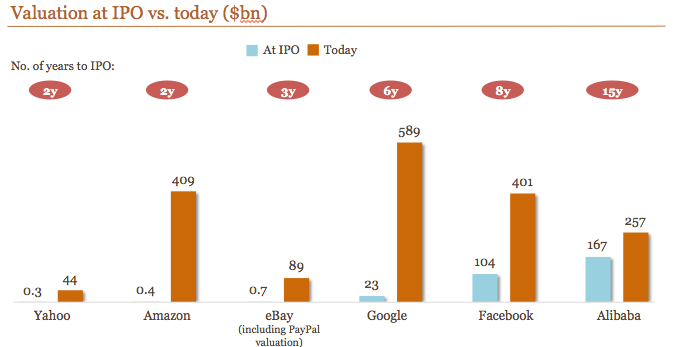
Source: Google Finance data
Some advocate that the rise of crowdfunding solves exactly this problem, but it is well known in the industry that the best companies raise money from the best venture capitalists, and only those who struggle with that path turn to the average Joe online. The notable exception being the companies that have a consumer brand and want to use crowdfunding as a marketing tool, like Monzo.com is currently doing. But for every E-Car Club (exited to Europcar after fundraising through CrowdCube) - notice how few there are that I had to mention a relatively unknown company - there are thousands of those companies that fail early on.
2016 in review
2016 was a relatively good year for tech IPOs, although not very eventful. There were few IPOs, and none by a large well-known company, such as Facebook, Alibaba, Twitter (NYSE:TWTR) or Snap (NYSE:SNAP). These all gathered a lot of attention for their public profile - usually associated with consumer-facing companies - or their unusually large size.
There are a few reasons for the low number of tech IPOs: Markets were not very welcoming ("are we in a bubble?"), the continuous abundance of money on the private markets, and the increasing M&A spree by corporates. Indeed, M&A seems a very interesting alternative to an IPO, with no stock volatility and the pressure associated with it, no public disclosure, and a path for the founders to quietly leave the company if they wish so.
But it also means you lose your independence, which is something young start-up CEOs dread. Some sell early, but there are a few who are bold enough to reject billion-dollar acquisitions, such as Mark Zuckerberg or Evan Spiegel.
But the few tech companies that did IPO in 2016 performed relatively well. Indeed, tech IPOs were the second best asset class in 2016, only after crude oil.
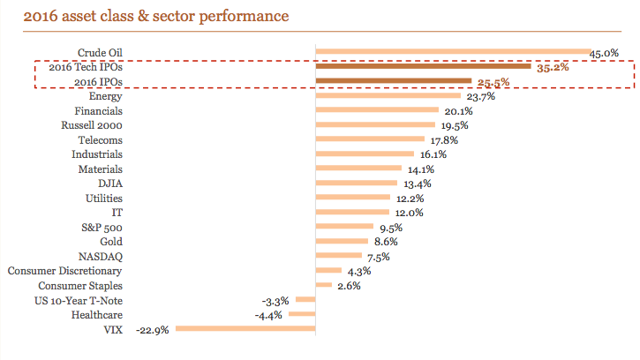
Source: CBInsights (Factset as of December 30, 2016)
Note: IPO performance represents average offer/current price
A closer look at some of the underlying data gives an interesting view on first day pops (note this table does not include all 2016 tech IPOs).
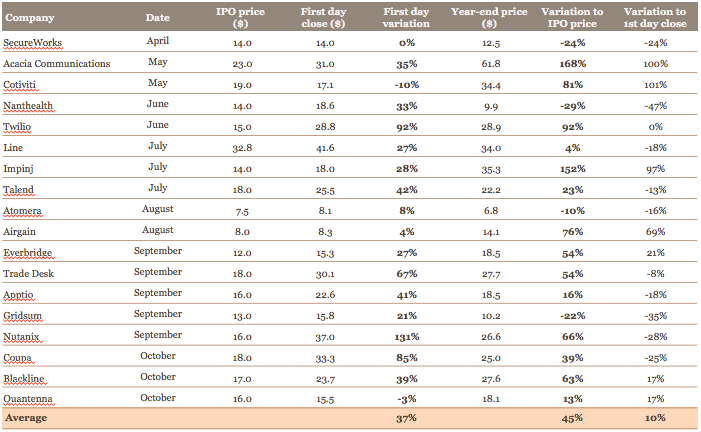
Source: Bloomberg data
While on average these companies were returning 45% at the end of the year, most of that value was captured by big institutional investors who have access to the shares at the IPO price, rather than retail investors like you and me. IPO allocations are a very profitable business, which I will touch upon on a new article next week.
The year ahead
2017 started off quietly on the trading side, but with a lot of buzz around two companies that had filed to go public in Q1: AppDynamics and Snap.
AppDynamics was set to be the first tech IPO of this year, and although it is not a household name, investors were very much looking forward to it to test the waters. Unfortunately, that test was delayed by a month, as Cisco (NASDAQ:CSCO) swooped in last minute and acquired the company for $3.7bn. This was a great outcome for the company and all its shareholders, but it meant public investors would need to wait to deploy capital into new tech companies.
That leaves us with Snap: The young, loss-making, low revenue generating, little understood company that is growing at an impressive rate and seeking a very lofty valuation. This is the ultimate test for the markets: Would they buy it or let it sink? They bought it! The company priced its shares at $17, slightly above the initial $14-16 range, and it closed just under $25 on the first day of trading, with an impressive 44% increase.
The Snap IPO proved two things: First, there is a strong appetite for new tech companies in the public markets, and second, it is again possible to successfully tap the public markets as a very young and unproven business with hyper-growth. Public investors, including retail investors, are again excited to be part of the growth of these companies, "willing to risk 50% of their investment for a 1,000% return potential." Very much inspired by the recent successes of Facebook and Alibaba and the unstoppable performance of the F.A.A.G. stocks (the fact that the dot.com crash was too long ago for anyone to remember the real impact also helps).
Image result for uberThis is obviously very encouraging for other companies, which are looking for an opportunity window to tap the markets for liquidity. Another interesting point is that most companies are (hopefully) aware that there is a limited amount of public money to inject into those larger tech companies, so being first might be an important advantage. Had Snap IPO'd right after Uber (Private:UBER) and Airbnb (Private:AIRB), would there be as much demand? Probably not…
So who are the large private consumer-facing unicorns out there looking closely at the public markets?
My best guess for 2017 is Spotify - in what would be the biggest European venture capital-backed IPO ever - and a great boost for the local ecosystem. It's been rumored for a few years now, and the company seems ready from a governance perspective, but it still needs to lock-down new agreements with the record labels to make it a sustainable business. If that happens in the first half of this year, I'm confident Spotify will IPO in 2017.
Uber most likely won't be able to tap the public markets before 2018/19: The business is still churning too much money, regulation is still a big open question, it is facing too much competition worldwide, and does not yet have the necessary culture to be a public company.

Monday, December 26, 2016

Corralling the Unicorns: Nasdaq and NYSE Work to Court the Next Blockbuster IPO

TheStreet talks to representatives from the exchanges to explore what they are doing to entice companies, especially ahead of a number of big potential tech listings.

Related image

The four-year-old parent company of Snapchat - Snap Inc. has held meetings with potential investors in the weeks leading up to its much-anticipated initial public offering, the Wall Street Journal reported Monday. The meetings came after the company confidentially filed paperwork on Nov. 15, with Morgan Stanley (MS) and Goldman Sachs Group (GS) as the lead underwriters, for an IPO that could value the company at as much as $25 billion.
Snap was eligible to file its paperwork for IPO confidentially due to the 2012 Jumpstart Our Business Startups Act, which allows companies with annual revenue below $1 billion to have the option to file an initial draft of their IPO prospectus with regulators at the Security and Exchange Commission and make necessary adjustments before unveiling it publicly.


Snap's likely $25 billion IPO, the biggest since Chinese e-commerce giant Alibaba Group (BABA) made its IPO debut at a $168 billion valuation in 2014, is expected to revitalize what has been a dismal year for tech IPOs. Statistics from data provider Dealogic shows that only 103 companies have listed their shares in the U.S. in 2016, raising a total of $21.8 billion.
As talks of Snap's highly coveted IPO have finally come into fruition, the social media company's decision on where it will lis is also something to watch as the rivalry between America's largest exchanges presses on. (no details on the exchange were given in the Journal's report and Snap did not immediately respond to requests for comment) 
Editors' Pick: This article was originally published on Nov. 16 and has been updated to reflect recent news about Snap's IPO plans.
Although Nasdaq has remained favorable with tech companies, the rivalry between Nasdaq and the NYSE has only become fiercer over the years as more than 60% of tech companies have chosen to list on the NYSE over the last four years compared to when in 2006 it only had 12% of all tech IPOs . Companies like Twilio (TWLO) , Square (SQ) , Line (LN) and GoDaddy (GDDY) have run counter to preconceived notions to join Twitter (TWTR) , Yelp (YELP) , Box (BOX) , and Oracle (ORCL) on NYSE. The race between the two exchanges continues to heat up.
Snap, the parent of popular instant photo-messaging app, Snapchat, which boasts more than 150 million active daily users is expected by many to choose the Nasdaq as its listing site just as former tech darling Facebook (FB)  had done. But as many experts say, the choice is less of a foregone conclusion as the New York Stock Exchange has implemented a number of changes over the past few years and presents a number of benefits over the Nasdaq. Still, Nasdaq is no slouch and the competition will certainly take place to land one of the most high profile listings in recent history.
So, how do companies choose which exchange to list on and what benefits do each provide? How did the Nasdaq become the defacto destination for tech companies and how is the NYSE competing with its uptown brethren? There are a number of reasons.
Although Nasdaq has had a higher number of tech IPOs, the ones that succeeded in raising the vast majority of capital to help companies grow, expand their businesses, pay down debt or provide meaningful liquidity events for investors have almost exclusively listed on the NYSE, according to John Tuttle, Global Head of Listings at the New York Stock Exchange. Year-to-date, companies that have listed on the NYSE have raised $11.3 billion from 33 IPOs while Nasdaq won 81 of the 111 IPOs this year (73% win rate) raising $9.4 billion.
"The majority of companies on Nasdaq are actually quite small. If you look at the median market cap, if you look at all of the companies listed on the stock exchange, and all of the companies listed on Nasdaq, the median cap for companies listed on the NYSE is roughly $2.4 billion, for Nasdaq it's under $300 million," said Tuttle. 
Back in the 80s and 90s, the NYSE focused on older and more established blue chips companies, its stringent and restrictive rules disqualified many of the then up-and-coming tech companies.
"In 1983 the tech companies were just starting to grow. They weren't big enough to pass the listing requirements on the American and New York [stock exchanges]. By the time they were big enough to switch, the rule had changed and Nasdaq effectively convinced them that. They now offered the same trade info as the other exchanges so switching wouldn't get them much," said Daniel Weaver, professor of finance at Rutgers Business School.
"I have taken three technology companies public, all of them on Nasdaq. Over the past decade, Nasdaq has consistently demonstrated their alignment with Coupa's core values of ensuring customer success, striving for excellence, and focusing on results. Thus, the partnership is a natural fit," said Todd Ford, CFO at Coupa Software (COUP) , which went public in October raising about $133 million.
"We've been in the Silicon Valley for 25 years. If you look at the companies that are listed in the Western region that I oversee, the market cap of all those combined companies is $4 trillion," said Jeff Thomas, Vice President and Head of Western Region Listings at Nasdaq.
Nasdaq has continued to attract technology-focused companies since its inception in 1971 as the world's first electronic stock exchange. According to recent statistics from the Nasdaq, 82 percent of technology IPOs have listed with Nasdaq so far this year, with 91 percent of them being venture-backed new listings.
"Many tech companies like the aura associated with the many successful tech companies that listed on Nasdaq and never left, such as Apple (AAPL) , Alphabet (GOOGL) , Facebook, Microsoft (MSFT) , and Amazon (AMZN) , the top 5 market cap stocks," said Jay Ritter, finance professor at the University of Florida.
Although it is hard to pick a clear-cut exchange winner in the tech IPO space of 2016, as a strong pipeline of big tech names like Uber, AirbnbPinterestSpotify and Dropbox are expected to come to the public market, the race between Nasdaq and NYSE to win over and seat those companies is not going to slow down anytime soon.
Alphabet, Apple and Facebook are holdings Jim Cramer's Action Alerts PLUS Charitable Trust Portfolio. Want to be alerted before Cramer buys or sells GOOGL, AAPL or FBLearn more now.

Source :https://www.thestreet.com/story/13861757/1/corralling-the-unicorns-nasdaq-and-nyse-work-to-court-the-next-blockbuster-ipo.html

Thursday, December 17, 2015

Tech players emerge as public vs private boils over into 2016


After a hit-or-miss year of initial public offerings in the technology sector, the most likely candidates to go public in 2016 probably aren't who you'd think, according to a new report.
The not-so-sexy fields of analytics, data centers, security and application integration top a list of 531 companies most likely to enter the public markets next year, according to a new report by data and predictive analytics company CB Insights. Still, the report does highlight some well-known unicorns that could go public.
Topping the list of public market contenders are copy data virtualization company Actifio, integration platform MuleSoft, enterprise virtualization and storage company Nutanix, secure cloud company Okta, and subscription billing company Zuora. But household names like Buzzfeed, Airbnb, Uber and Snapchat also made the cut.
CB Insights ranked the companies based on scores from a technology called Mosaic, which uses "nontraditional public signals" such as customer signings, hiring activity, media sentiment, web traffic and mobile app data. The report also highlights which industries and venture capital firms are likely to shine when it comes to getting funding, and which venture capital firms are most likely to back them.
Internet companies comprise 64 percent of CB Insights' IPO pipeline companies, followed distantly by mobile, hardware, software and electronics companies. Among Internet companies, business intelligence, advertising, apparel, customer relationship management and security were dominant categories.
But the capital-intensive electronics sector is the most cash-rich field of companies on the list, with a roundtable of top investors in pipeline companies including SV Angel, Sequoia Capital, Andreessen Horowitz, Fidelity Investments and Kleiner Perkins Caufield & Byers.
Despite an unprecedented number of private technology companies reaching valuations over $1 billion, the 2016 forecast comes after a year of less-than-stellar starts for technology company IPOs.
Financial technology company Square, for instance, priced its IPO at 30 percent less than in a private fundraising round a year ago, and flash storage company PureStorage debuted for trading below its IPO price. In the third quarter of 2015, average IPO returns were negative for the first time since 2011, according to a report by Renaissance Capital.
"Twenty-fifteen was a surprise to the downside," Byron Deeter of Bessemer Venture Partners told CNBC Wednesday. "Fewest IPOs since 2008 — in the cloud industry in particular ... but we see more ahead for 2016. The pipeline is fantastic in terms of late-stage companies that are pre-IPO. There's a lot of discussion around companies like Dropbox, Stripe, DocuSign, Twilio, et cetera. We expect companies like that will make their debut in the coming quarters."
To be sure, there have been some bright spots to round out 2015. Square has since seen its stock price rise, and Australian business software maker Atlassian saw shares soar on its trading debut. 
"Given the maturity of many of the companies in the pipeline, the uncertainty about private markets and the increasing calls by investors for companies to go public, we expect 2016 will see public market activity pick up," CB Insights' CEO and co-founder Anand Sanwal wrote in the report. "Given how bad 2015 was, the reality is it couldn't get worse."
There's certainly an appetite for technology sector stocks. Indeed, some already-public technology companies are flying high into the new year, technology analyst Mark Mahaney of RBC Capital Markets told CNBC.
Expedia, Alphabet and Amazon all saw their stock prices rise over 40 percent in 2015 to date, and Mahaney has them as top picks for 2016, as well.