Showing posts with label China. Show all posts

Thursday, April 20, 2017

As fear of a space war mounts, US Air Force taps start-up technology

 
Steven Puetzer | Getty Images


Tapping Elon Musk's SpaceX to launch some of its satellites is only the beginning in a larger top-to-bottom rethink of the way the U.S. Air Force approaches its operations in space. Air Force officials want to move faster when addressing emerging threats and future missions in orbit, and it's increasingly looking to start-ups to address a deepening sense that America's dominance in space is eroding.
The goal: to protect our satellites and spacecraft from cyberwarfare and missile attack. This is critical, since space weapons could be used to compromise navigation, surveillance, communications and other functions in wartime or during a national emergency.
The shift comes as the space domain is already receiving increased attention from lawmakers and the Department of Defense and, in the years ahead, likely more defense dollars as well. The Pentagon's Joint Interagency Combined Space Operations Center — known by the unwieldy acronym JICSPOC — was recently rebranded the National Space Defense Center, and under pressure from Congress, the Air Force this month created a new position for a three-star general that will serve as a kind of space czar, advising the Air Force Secretary and the Joint Chiefs of Staff.
That general will "come to work every day focused on this: making sure we can organize, train and equip our forces to meet the challenges in this domain," Gen. Jay Raymond, head of Air Force Space Command, said last week at the National Space Symposium in Colorado.
Part of that job of training, organizing and equipping the U.S. military's space forces could fall to smaller, more agile companies outside of the Air Force's conventional supply chain of major defense and aerospace contractors, Raymond suggested. Though procurement programs for new satellites and rockets have long been measured in years — sometimes decades — threats and challenges in the space domain are now moving much faster as potential adversaries like China hone their capabilities in space. "I really see a need to go fast," he told his audience. "We are developing ways to go fast."


Though international agreements such as the 1967 Outer Space Treaty prohibit the positioning of weapons in space, the Pentagon is increasingly aware of the vulnerabilities there. As more and more countries develop advanced rocketry programs and cyber capabilities, it grows more and more difficult to defend critical military satellites that provide U.S. air, ground and sea forces with intelligence, communications, navigation and targeting capabilities.
In a serious conflict with a sophisticated adversary — Russia or China, for example — those satellites would likely be among the first targeted. Both countries (as well as the United States) have successfully tested anti-satellite weapons capable of destroying satellites in orbit. Military officials have also expressed repeated concerns about cyber vulnerabilities that could allow an enemy to jam satellite transmissions or otherwise disable space assets remotely.

Sunday, April 2, 2017

Weighing The Week Ahead: What The Trump-Xi Meeting Means For The Economy

About: SPDR S&P 500 Trust ETF (SPY)QQQDIASHIWMTZASSOTN

Image result for Presidents Trump and Xi.

Summary

Last week's slightly positive news was less important than optimism about the next element of the Trump agenda.
Next week features plenty of data, including the most important reports.
More important, and the focus for many newly-minted China experts, will be the meeting between Presidents Trump and Xi.
Plenty of good trades and investments might be available.
Lessons from the meeting should emphasize Trump diplomacy, not just specific deals with China.
We have a big economic calendar and potential Fed news. Those stories will take a back burner this week. My safest prediction is that we are about to see a new rash of China experts both in print media and on CNBC! These freshly-minted pundits will be asking:
What will the Trump-Xi meeting mean for the economy, and for stocks?
Last Week
Last week the news was mostly positive, but light. Markets continued the attention to the Trump Administration's next policy steps – especially the chances for tax reform.
Theme Recap
In my last WTWA I predicted a discussion about the aftermath of the ACA repeal decision. That was a good call, as assorted pundits explained what the next policy moves might be. The more adventurous speculated about whether the Freedom caucus would block changes in the debt ceiling or tax reform. Some of that discussion will continue in the early part of next week.
The Story in One Chart
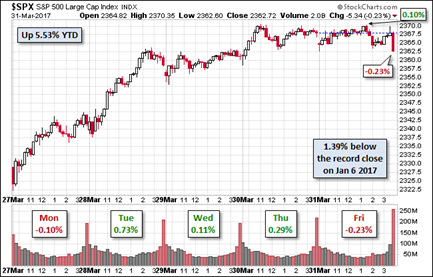
I always start my personal review of the week by looking at this great chart from Doug Short via Jill Mislinski. She notes the overall weekly gain of 0.80% and the quarter one increase of 5.5%. The biggest takeaway might be the general rebound from last week's market reaction to the failure of the ACA repeal.
Doug has a special knack for pulling together all the relevant information. His charts save more than a thousand words! Read his entire post for several more charts providing long-term perspective, including the size and frequency of drawdowns.
The News
Each week I break down events into good and bad. Often there is an "ugly" and on rare occasion something very positive. My working definition of "good" has two components. The news must be market friendly and better than expectations. I avoid using my personal preferences in evaluating news – and you should, too!
This week's news was slightly positive.
The Good
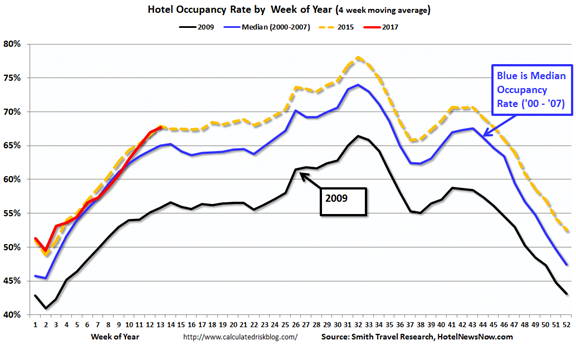
  • Hotel occupancy is strong. Calculated Risk reports interesting hard data from private sources. These are items you might not see elsewhere.
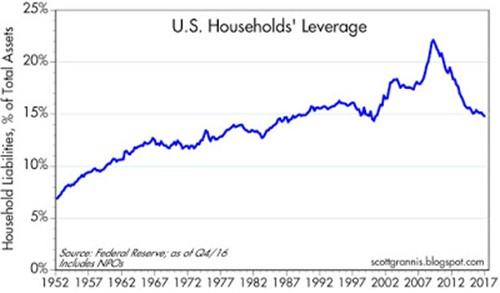
  • Household finances are on "solid ground" as explained by Scott Grannis. Debt levels as a percentage of disposable income are at 30-year lows. He provides an interesting chart of household leverage.
  • Serious delinquencies have declined to 1.19% (Fannie Mae via Calculated Risk). This is the lowest level in nine years.
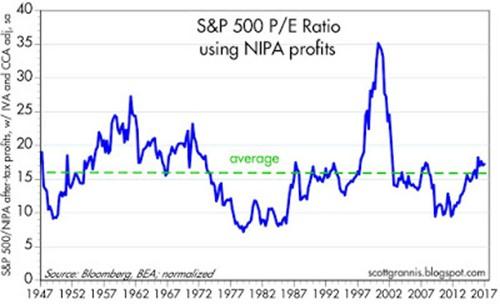
  • Corporate profits remain strong, increasing 9.3% year-over-year in Q416. New Deal Democrat has a good account of the trends, why National Income and Profit Accounts (NIPA) come so late, and how he estimates this series in advance. Scott Grannis has a similar report which also shows the relationship between NIPA profits and stocks. It is dramatically different from the popular valuation charts.
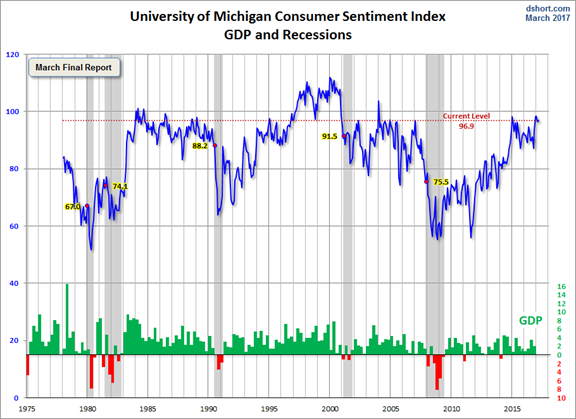
  • Michigan consumer sentiment remained strong, increasing to 96.9. Jill Mislinski has the update. It includes an interesting excerpt from the Survey of Consumers chief economist, Richard Curtin. He notes that expectations and partisanship are influencing the outlook. This bears watching. Jill also has this fine chart.
  • Q4 GDP revisions edged a little higher than expected to 2.1%
  • Pending home sales increased 5.5%. CNBC's Diana Olick has an interesting report, noting that sales would be much higher if there were more inventory. She has an interesting interview from Denver, where construction is 50% behind the pace needed. Builders blame the lack of labor, especially illegal immigrants frightened by recent policy changes. The builder interviewed stated that the jobs were not desirable for most U.S. workers.
    This report, if accurate and typical, has implications for homebuilders, Fed policy (labor market tightness), and immigration policy. You need to watch the video to see the key points.
The Bad
  • Personal consumption spending missed expectations. The increase was only 0.1% despite an income increase meeting expectations of 0.4% growth. Steven Hansen (GEI) has a thorough analysis with excellent tables and charts.
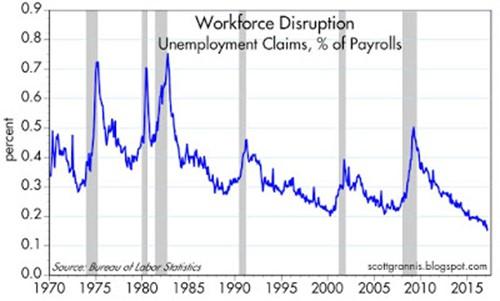
  • Jobless claims moved slightly lower, to 258K, but the four-week moving average moved higher. I am scoring this as "bad" because the series has moved a bit higher from the best levels. Scott Grannis helps us to keep this in perspective with this interesting chart of claims compared to the labor force.
The Ugly
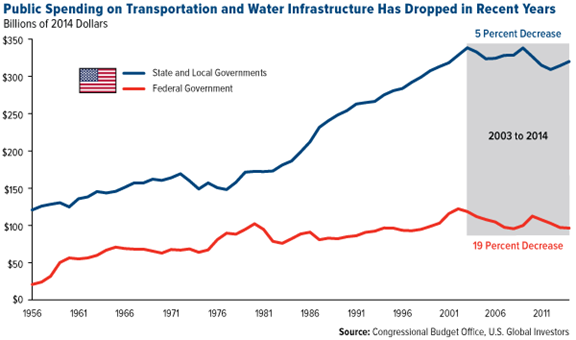
U.S. Bridges. (No, not the recent North American Bridge Championship, where Bill Gates had a nice win. While that particular event was limited to players with fewer than 10,000 masterpoints, it still included many experts. It was a nice victory, and his best career result). Turning back to actual structures, the American Society of Civil Engineers (ASCE) notes that 40% of bridges are more than fifty years old. Over the next twenty-five years the U.S. is short of needed spending by about $3 trillion.
The Silver Bullet
I occasionally give the Silver Bullet award to someone who takes up an unpopular or thankless cause, doing the real work to demonstrate the facts. No award this week, but nominations are always welcome. There are many bogus claims and charts out there! I wrote about headline spinning last week, and the misleading recession forecasts that resulted. We should all encourage astute analysts to help on this front!
The Week Ahead
We would all like to know the direction of the market in advance. Good luck with that! Second best is planning what to look for and how to react. That is the purpose of considering possible themes for the week ahead. You can make your own predictions in the comments.
The Calendar
We have a very big week for economic data, featuring the most important reports.
The "A" List
  • Employment report (F). Expectations are in the 180K range, down from last month's 235K.
  • ISM index (M). Continuing strength expected.
  • Auto sales (M). The concept of "peak auto" has some recent buzz, drawing attention to this private data.
  • ISM services (W). Wider scope than manufacturing, but a shorter history. Strength expected.
  • FOMC minutes (W). Will be scrutinized for hints about the pace of future rate hikes.
  • Initial jobless claims (Th). Is the series edging up from record low levels?
The "B" List
  • ADP employment change (W). A good independent read on job growth.
  • Construction spending (M). February data, but an important sector.
  • Factory orders (T). More February data of significance. Continuing strength expected.
  • Trade balance (T). Usually not a market mover, but will get extra attention this week.
  • Crude inventories (Th). Recently showing even more impact on oil prices. Rightly or wrongly, that spills over to stocks.
While the schedule is not as heavy as last week, FedSpeak will be featured on several days.
The Thursday meeting between President Trump and China's President Xi Jinping could be extremely important for economic policy and the markets.
Next Week's Theme
This is a big week for economic data. We could usually expect daily analysis of the news, focusing on the Friday employment data. A secondary theme might be the emerging change in Fed policy, with speakers and the release of minutes on Wednesday.

Tuesday, March 8, 2016

Wall Street Breakfast: Renewed Concerns About China As Exports Tumble

|
 Includes: AAPLBAESYBURBYCOLEXCGKNCFLMTMSFTNKE,

China's February trade performance was far worse than economists had expected, days after top leaders at the National People's Congress sought to reassure investors about the world's second-largest economy. Exports fell 25.4% from a year earlier, the biggest drop since May 2009, while imports slumped 13.8%, leaving a trade surplus of $32.59B. "It's easy to blame Chinese New Year distortions, but there is a much deeper malaise that is becoming apparent in the numbers," said Frederic Neumann, co-head of Asian economic research at HSBC.
Economy
Longer dated Japanese government bond yields declined to new depths overnight, with the 7-, 10-, and 30-year benchmark yields all setting new record lows. Although the JGB market figures are not unusual since the BOJ cut interest rates below zero, the scale of the rally for the 30-year bonds was pronounced, suggesting investors are scrambling for yield against a backdrop of poor economic data and deflationary pressures. U.S. treasuries gained with the Japanese bonds, as stock-market declines drove demand for the relative safety of sovereign debt. 10-year treasury yield -6 bps to 1.84%.
After a long wait for inflation to accelerate, Fed officials face a complex and possibly divisive debate over whether recent evidence of rising prices is strong enough to move ahead with planned rate hikes. In separate statements on Monday, policymakers at the core of that debate staked out starkly different views, with Fed Vice Chairman Stanley Fischer saying economic data now points to the "first stirrings" of inflation, while Fed Governor Lael Brainard countered that the evidence was not yet so clear cut.
Michael Bloomberg has announced that he will not mount an independent bid for the U.S. presidency because of fears that it would increase the chances of Republicans Donald Trump or Ted Cruz ending up in the White House. "That is not a risk I can take in good conscience," he wrote on Bloomberg View. "I love our country too much to play a role in electing a candidate who would weaken our unity and darken our future."
Wall Street bonuses are down for the second straight year, and recent market volatility and cutbacks suggest 2016 will be difficult as well. According to the New York State comptroller, the average bonus paid in the securities industry last year fell 9% to $146,200, while the bonus pool for employees who work in NYC shrank 6% to $25B. Thomas DiNapoli also noted that recent job gains might not be sustainable, given the early weakness in the financial markets and increasing provisions for bad loans to the energy sector.
German industrial production jumped by the most in more than six years in January, in a sign that strong domestic demand may be helping to underpin output even as external trade cools. Production, adjusted for seasonal swings, climbed 3.3% from the prior month after retreating a revised 0.3% in December. German firms had "a very good start" to the year, the economics ministry said, predicting a "moderate recovery" in industrial activity in the first quarter.
Does the market believe in Mario Draghi? The euro is not moving much before Thursday's ECB meeting, but investors may be looking at what happened in Japan. "The BOJ made their rates even more negative and what happened to the yen? It strengthened," said Ewen Cameron Watt, Chief Investment Strategist at BlackRock. Euro flat at $1.1013.
Cyprus has become the fourth eurozone nation to exit an EU-IMF bailout, as finance ministers gave the green light to leave its program without a follow-up fund. The Mediterranean country was forced into a €10B bailout in March 2013, due to a toxic combination of broken banks, a soaring deficit and an inability to access market financing. By contrast with Cyprus, Greece (the only eurozone country left in a rescue program) was caught yesterday in a new row between the EU and IMF regarding the strength of its bailout reform commitments.
European Union leaders have welcomed Turkey's offer to take back all migrants who cross into Europe from its soil by agreeing in principle to Ankara's demands for an extra €3B, visa waivers, and faster EU membership talks. However, other details remain to be worked out. European officials hope to reach an ambitious accord with Turkey at their next scheduled summit, on March 17-18.
Bank of England Governor Mark Carney is backing Prime Minister David Cameron's European Union deal, saying the agreement allows the central bank to do its job. "The settlement addresses the issues the Bank identified as being important, given the likely need for further integration of the euro area, to maintaining its ability to achieve its objectives," Carney told British lawmakers. Despite a positive assessment of the EU settlement, the governor said he would not make any recommendation about how to vote in the country's June 23 membership referendum.
Oil's 2016 roundtrip is nearly complete...WTI crude started the year at about $40 per barrel, and bottomed well below $30 in mid-February. After another 5.5% gain on Monday, the price returned to just a few pennies shy of $38. Brent crude, in the meantime, has touched $40 per barrel for the first time in 2016.
Stocks
Nike has suspended ties with tennis star Maria Sharapova after she tested positive for an illegal heart drug at the Australian Open. Sharapova said she's taken meldonium for over a decade, long before a 2016 ban by the World Anti-Doping Agency, which outlawed the substance as a performance-enhancer. How big is her contract? Sharapova brings in a reported $30M per year in endorsements, much of that from Nike (NYSE:NKE), with whom she has a reported $70M mega-deal.
A mystery investor has built up a stake of close to 5% in Burberry (OTCPK:BURBY), according to the FT, prompting Britain's best-known luxury fashion brand to arm itself against a possible takeover bid by seeking help from its financial advisors. A source close to the company said it had unsuccessfully attempted to reveal the client by asking HSBC, which is listed as the custodian for the position. Burberry shares +5.8% in London.
Nippon Telegraph & Telephone is expected to offer more than ¥400B ($3.5B) to buy Dell's Perot Systems in a move aimed at bolstering the Japanese company's presence abroad, Nikkei reports. NTT Data President Toshio Iwamoto will formally present an offer to Dell executives this week, and is expected to enter into exclusive negotiations on the purchase. While the price may change before a deal is concluded, the acquisition appears likely to go down as NTT's third-largest ever.
In the latest volley in its high-profile fight with Apple (NASDAQ:AAPL), the Justice Department has appealed a decision that protects the tech giant from unlocking an iPhone in a New York drug case. Prosecutors, who say Apple has unlocked at least 70 iPhones in the past, are relying on the same "All Writs Act" in a California court, where a judge ordered the company to unlock a device belonging to one of the San Bernardino shooters. The clash has intensified a long-running debate over how much law enforcement and intelligence officials should be able to monitor digital communications.
Exelon and Pepco are making a last-ditch proposal to save their planned $6.8B merger, outlining three options to prevent the loss of customer benefits. The utility companies are not offering Washington D.C. any more money, but say they would support efforts by regulators and politicians for a plan on how to distribute $78M they offered the city in exchange for its support. EXC-4.7%POM unchanged premarket.