Showing posts with label google. Show all posts

Sunday, February 19, 2017

28 Visual Tricks That Will Make You Doubt Your Own Eyes

Were you also surprised by this eye trick? Well, get ready to see a whole lot more! Just click the link below :


28 Visual Tricks That Will Make You Doubt Your Own Eyes
image: brainden.com


                            MORE: - http://www.mydailyviral.com/view/optical-illusions/?page=1

Sunday, February 12, 2017

3 Reasons To Buy Broadcom: Growth, Value And Prospects

Image result for broadcom

Summary

It is the first time that I buy a stock at an all-time high.
Broadcom's debt is something to watch, but probably it is temporary.
Broadcom is great value stock and a great growth stock at the same time.
The stock seems fairly valued or even undervalued.
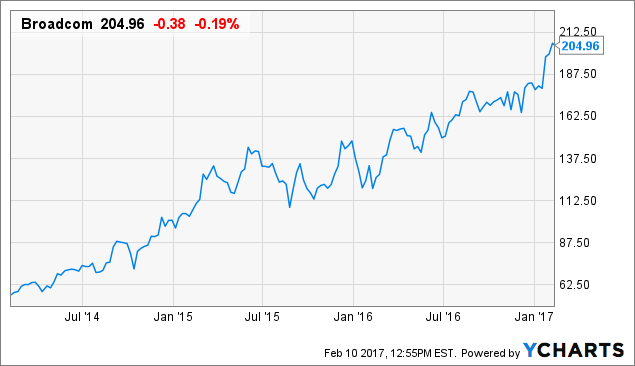
For the first time since I started investing, I have added a stock to my portfolio which is at its all-time high: Broadcom (NASDAQ:AVGO).
AVGO Chart
AVGO data by YCharts
Broadcom has got some safety issues, but I think they are controllable at the moment. The main reason I have added it to my portfolio is because it is a great combination of a value stock and a growth stock. It has a solid 2% dividend with a great dividend growth rate in the last few years and a huge potential to keep the dividend hikes in the double digits for years to come. Besides that, it has the potential to double in five years' time if you look at EPS and even in less than three years' time if you look at the free cash flow. In short: a great total return stock!
Safety
One of the first things I look at when I buy stocks is safety. Safety can be seen in the credit rating and in debt management. I buy for the long term and companies with junk status are too unstable for my taste to invest in for the long term.
Broadcom is in the very competitive semiconductor sector, but it is a diversified company. It has products in these five categories:
(Source: broadcom.com)
Its biggest client is Apple (NASDAQ:AAPL), with 20% of the revenues. This is a risk if Apple would completely stop the collaboration, but I don't see that happening any time soon. But still, it is a risk to consider.
Broadcom has a status of BBB- (S&P) and Ba2 (Moody's). This is investment grade, but just barely. That was one of the reasons I took a deep dive into the stock before I bought it.
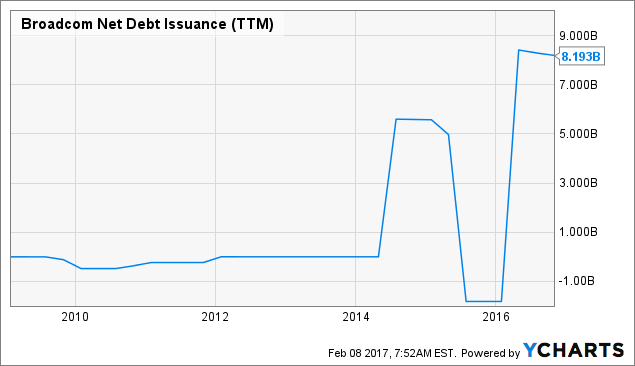
This is the evolution of Broadcom's debt:
AVGO Net Debt Issuance (<a href=
As you can see, Broadcom didn't have any debt (even more than $1B of cash) before the beginning of 2016. That was because of the acquisition of Broadcom by Avago, which then changed its name to Broadcom. The company paid $17B in cash and $20B in stocks for this acquisition, which explains the high debt. And this higher debt caused the rating agencies to give the new Broadcom the quite low credit ratings Ba2 (Moody's) and BBB- (S&P).
This low credit ratings didn't stop Broadcom to acquire Brocade (NASDAQ:BRCD) for (with the debt of Brocade included) $5.9B in an all-cash transaction. The deal is expected to close in October 2017 and again Broadcom's debt will go up. The credit rating of Broadcom is the only real point of worry that I have about Broadcom. This is what I will keep an eye on in the coming quarters and years. I don't want stocks with junk grade credit ratings in my portfolio.
This situation for Broadcom could be temporary, though. I think and hope Broadcom's management will lower the leverage in the following years. The Brocade deal was just too good not to close: it was a great diversification and I think Brocade was undervalued. Broadcom has already announced that it will divest the IP networking division of Brocade. I think the selling price of that division might be around $2B to $2.5B, which would already give Broadcom a kick-start to reduce its debt.
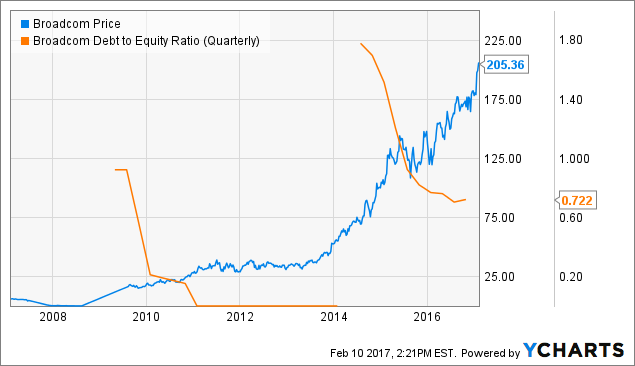
Why I think that the big debt situation may be temporary is that the FCF (free cash flow) of Broadcom is expected to grow by 88% in 2017 as a result of the acquisition, synergies and new growth. After 2017, FCF is expected to grow by 20% and more. If that high growth in FCF is used to pay down debt, there is nothing to worry about. And historically the company has already been in this situation:
AVGO Chart
AVGO data by YCharts
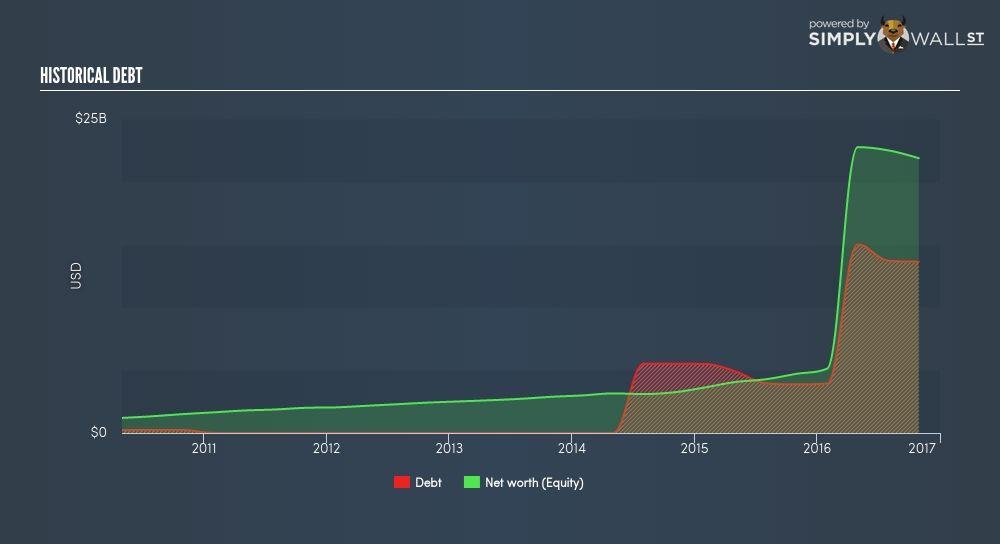
You see that Broadcom is already working to reduce its debt. Normally I want the debt equity ratio at maximum of 40%, but I think this criteria will be met by Broadcom pretty soon. Therefore I am prepared to be flexible.
Source: simplywall.st
So, you can see that Broadcom doesn't have a long history of high debt. It dates from the last years. This debt is still manageable. But again: something to watch closely.
Broadcom is a great value stock
I want either a good dividend or high growth or a mix of both in my portfolio. Broadcom may be one of those few stocks that combines both growth and value. Let's start with value.
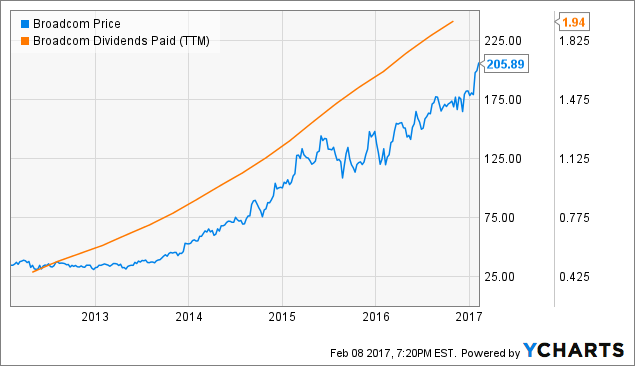
Broadcom's dividend rate is $4.08, which means a yield of 1.98%. For dividend investors, this already looks quite okay, but not really exciting. But yield doesn't say everything; the dividend growth rate is also very important if you are considering to keep a stock in your portfolio for quite some time. And there Broadcom's performance is outstanding: the 3-year dividend growth is 34.3% and even 40.7% over the last 5 years.
Now that is what I like for a dividend: high growth. The fact that Broadcom's yield is still only about 2% just means that the valuation went hand in hand with the huge dividend raises. You can see that on this graph:
AVGO Chart
The Chowder Rule says that if a stock has a dividend yield of less than 3%, its five-year dividend growth rate plus its dividend yield must be 15 or higher. Broadcom has a 40.7% dividend growth for the last five years. If you add up the 1.98% dividend and the expected big dividend growth in the years to come, then you see that Broadcom can easily pass the Chowder rule.
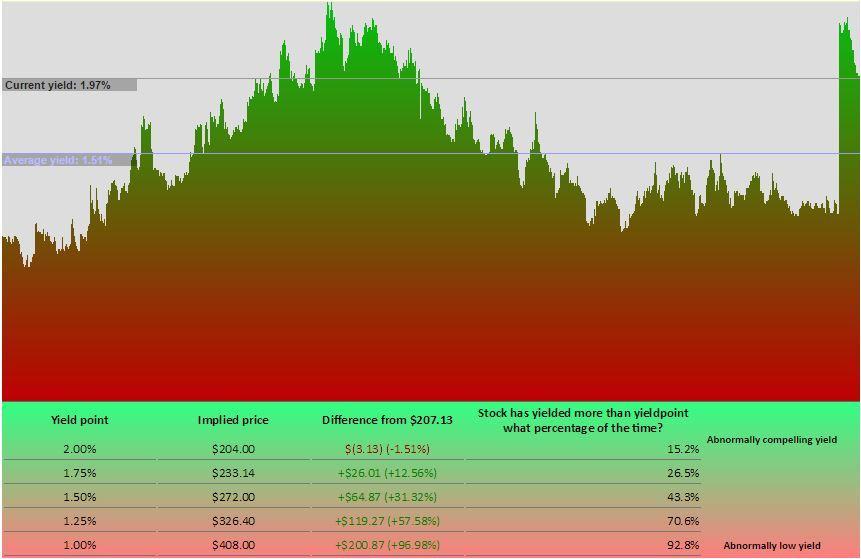
With the great site yieldchart.com, you can calculate how high the dividend is compared to the average of the last five years. Here is the graph:
Broadcom's dividend sits at 1.97% at this moment. As you can see on the chart of the last five years, historically this is quite high, despite the huge run the stock has had in the last year:

Tuesday, October 4, 2016

Google officially unveils $649 Pixel phone with unlimited storage; $129 Google Home


The phone starts at $649 and is available for preorder on Tuesday in the U.S., Canada, Germany and the U.K., the company said. Owners of the phone will get free unlimited storage for photos and videos at original quality.
It's the first phone made by Google "inside and out," the company said, and is part of an exclusive partnership with Verizon.
Rick Osterloh, senior vice president of hardware at Google, introduces the Pixel Phone by Google during the presentation of new Google hardware in San Francisco, Oct. 4, 2016
Beck Diefenbach | Reuters
Rick Osterloh, senior vice president of hardware at Google, introduces the Pixel Phone by Google during the presentation of new Google hardware in San Francisco, Oct. 4, 2016
Google believes that the next opportunity is building hardware and software together to empower artificial intelligence, an executive said at the event — a shift in strategy that aims directly at rival Apple.
They're in the hardware game for the long run, Rick Osterloh, senior vice president of hardware at Google, said at the event.
"Since I joined Google, one of the questions I get asked most often is, 'Why should we build hardware?'" Osterloh said. "We often joke that building hardware is, well, hard. People have strong emotional connections to the products they use every day. They are an important part of people's lives ... this is the right time to be focused on hardware and software."
The phones have smartphone cameras that were scored higher than the iPhone 7, according to third-party research cited by Google. It has a 12.3-megapixel rear-facing camera and big aperture, and comes along with software that selects from bursts of images and merges pictures in low light.
On the outside, it has a combination of aluminum and glass, an OLED display, a fingerprint sensor, a headphone jack and a USB-C charger. It's available in black, silver and blue.
Inside, it sports 32 GB or 128 GB of storage. The Pixel also charges up to seven hours of power within 15 minutes, installs software updates in the background and has live customer care built in.
In not-so-subtle terms, ‎Sabrina Ellis, director of product management at Google, also demonstrated how to transfer over data from Apple's iOS to Pixel.
The Pixel is the first phone with the Google Assistant, Osterloh said, as the company prepares for an "AI-first world." The phone is also made for virtual reality.
The company was largely expected to announce new handsets, and shares of Alphabet stock were flat during the event. Ahead of the event,Bloomberg reported that Google would unveil the Pixel and larger Pixel XL, two new smartphones that were conceptualized, designed, engineered and tested in-house.
In the past, Google has relied on co-branding efforts with its Nexus devices, which it does not have plans to continue, according the The Verge. But the Pixel, Bloomberg's Mark Gurman reported, is assembled by HTC in an approach "no different than Apple's partnership with iPhone builder Foxconn."
Tuesday's event revealed how the software will interact with hardware, where Google has traditionally been less focused than rivals like Apple. But during the company's July earnings announcement, Pichai made it clear that mobile is key to Google's future.
"Our investment in mobile now underlines everything that we do today," Pichai said.

Google Home and other devices

Mario Queiroz introduces the Google Home device during the presentation of new Google hardware in San Francisco, Oct. 4, 2016.
Beck Diefenbach | Reuters
Mario Queiroz introduces the Google Home device during the presentation of new Google hardware in San Francisco, Oct. 4, 2016.
Google also divulged more details on Tuesday of a highly anticipated smart home device, Google Home, that pits the company againstAmazon's $180 Alexa. 
The $129 Google Home device is available for preorder Tuesday and ships Nov. 4, and comes in several colors and with a six-month YouTube Red subscription.
"Our mission has always been to organize the world's information," said Rishi Chandra, a vice president at Google. "Over the past few years we've gone beyond the 10 blue links into providing direct answers to your questions. ... Now, with Google Home, we give you an easy way to access the knowledge of Google in a hands-free way."
The device plays YouTube Music, and of course, Google Play Music as well the Spotify, Pandora and iHeart Radio offerings that Amazon's Alexa has. Other features include a shopping list and morning agenda briefing.
Google Home, which has connectivity to other smart home devices like Nest and Chromecast, comes as voice is becoming the standard way to interact devices, Chandra said.
The company also announced a new virtual reality headset that connects wirelessly with the phone and connects to YouTube and Google Street View. The Daydream View headset, made of fabric, comes in slate, crimson and snow. 
Day
Source: Google
Day
The $79 headset will feature a virtual reality experience of J.K. Rowling's "Fantastic Beasts and Where to Find Them," Google said. Daydream View will also support educational programs, and will go on sale in November. 
Next, the company announced a Google Wi-Fi router, starting at $129 to ship in December. It is designed to be "visually subtle" and set for automatically optimizing your Wi-Fi network. It also comes with a companion app.
Also new from Google was a new version of its $69 streaming device, Chromecast Ultra, that will support new content from Google Play Movies that is four times better than standard high definition.

Google's strategy

The products may reveal how the company's artificial intelligence software push will reflect on its hardware. Hiroshi Lockheimer, a senior vice president at Google, positioned Tuesday's Twitter event as a potential turning point for the company.


Source :http://www.cnbc.com/2016/10/04/what-google-announced-at-todays-launched-event.html

Sunday, August 21, 2016

Here's how much Google has grown since going public 12 years ago


Alphabet, the second-largest market-cap stockcelebrated Friday the 12th anniversary of its initial public offering as Google.
CNBC looked at the company's growth over the years to see how exponential it's been.
Image result for google images
Aug. 19, 2004 — Google goes public at $85 a share, giving the company a market cap of $23 billion. Shares leapt 18.04 percent in the first day of trade, versus the 8.9 percent average first-day performance of this year's IPOs.
Since the IPO, those Class A shares, now traded under the ticker GOOGL, are 1,779 percent higher on a split-adjusted basis at $798.87 a share intraday Friday. That's a market cap of about $543 billion, just shy of Apple's roughly $588 billion market capitalization.

GOOGL performance since Aug. 19, 2004


The deal size for Google's IPO was $1.7 billion. In comparison, that of Facebook was $16 billion, almost eight years later in 2012.
April 12, 2012 — Google announces two-for-one stock split with creation of non-voting shares, called class C that trade under the ticker GOOG. The class A shares have limited voting rights.
April 3, 2014 — Class C shares begin official trading.
Aug. 10, 2015 — Google announces a restructuring plan to make it the subsidiary of a new parent company, Alphabet, which assumes the tickers of both existing share classes.
Annual revenue last year was nearly $75 billion, up from $66 billion in 2014 and more than 20 times annual revenue in 2004 of about $3.2 billion. Last year's profit of $16.3 billion compared with profit of less than 400 million the year Google went public.
CNBC's Bob Pisani and Gina Francolla contributed to this report.
By 

Source : http://www.cnbc.com/2016/08/19/google-alphabet-ipo-anniversary-growth-since.html

Wednesday, August 12, 2015

Why Google Became Alphabet

G is for Google and C is for Conglomerate. This is how the markets learned their alphabet yesterday.
Google Inc. (GOOGL), which reinvented the way the world accesses information, gave formal notice to Wall Street of its intentions to become a technology conglomerate by announcing a new parent entity – Alphabet Inc.,– that unites its widening interests and product lines. Apart from Google's core search business, the eight companies that comprise Alphabet span a diverse array of industries, from robotics, to life sciences, to healthcare and anti-aging.
In a blog post announcing the move, Larry Page, who is now CEO of the new entity, said Alphabet Inc., would help them take a long-term view and improve the “transparency and oversight” of their actions. The new entity, he wrote, was an “alpha-bet (Alpha is investment return over benchmark), which we strive for!”
Not much will change for investors in the reorganization. According to the SEC filing, each Google Inc. share will be swapped for an Alphabet Inc. share. Thus, the change has minimal consequences in terms of impact to bottom line and company direction.

That then begs the question: why did Google change its name to Alphabet?


The Wall Street Effect

When it debuted on the stock market, Google became Wall Street's darling. Its market capitalization increased by $27.2 billion – giving it a market cap bigger than Ford's (F) and General Motors's (GM) that first day of trading. That number was based on the market's assessment of the company's search business and turned out to be largely correct as Google's prowess in search powered its fortunes over the years
The arrival of the social media brigade, however, blindsided Google. Even as the company was coping with Facebook's (FB) onslaught on its core business, the disintermediation of Web search into mobile apps further eroded Google's bottom line. Google's foray into social media was a disaster, and the company has yet to earn substantial revenues from mobile. In lieu of developing its own product, the company has acquired new companies or announced new ventures in new industries. (See Also: Can Facebook Become The Next Google?)

Perhaps the thinking was that Google could pioneer other industries, just as it started the search industry.
However, the absence of numbers related to the cost and operational expenses of Google's new or acquired ventures has made Wall Street nervous. Company chairman defended the moon shots to investors at this year's shareholders meeting.
The move will help allay the market's fears by streamlining operations and providing investor visibility into the operations of Alphabet Inc.'s new ventures and acquisitions. It will help Alphabet Inc. prove to investors that it can deliver profits even as it explores new markets and avenues for future profits. The company's stock price jumped in record numbers after CFO Ruth Porat spoke about “transparency” in its latest earnings call.
Through reorganization as a conglomerate, the move also lessens the glare of antitrust scrutiny on Alphabet. This is because each company within the Alphabet umbrella makes products for a different industry. Bunching all of them together under the search engine umbrella would have invited greater attention from regulators due to the unique nature of Google's business. With the new corporate structure, Alphabet Inc., can always argue that each company within its organization has operations independent of the search engine.

nventing A New Company Within A Company

Google's founders – Larry Page and Sergey Brin – have always had a healthy disregard for the impossible. They imbued this thought process into their company's DNA and it made Google a fount of innovation within Silicon Valley, a geographic area where innovation is a byword instead of a buzzword.
But it's recent attempts at innovation have flopped. The company's attempts to reinvent itself as a hardware and Internet of Things player have also come under constant scrutiny by the media and Wall Street. Page, who returned as company CEO in 2010, lashed out against the criticism and called for a “safe place” for innovative companies to carry out experiments at Google I/O in 2013.
The separation between the Alphabet Inc,'s main business – search – and other companies provides the company with the “safe place” to carry out experiments. Based on an initial reading, each company within the Alphabet umbrella will be headed by a CEO, who will report into Page. This will allow the respective head to determine the best course of action without worrying about its effect on the search engine cash cow.
The move will also help avoid negative PR through direct association with the search engine business, which makes money by inferring user interests. For example, Google's acquisition of home security company Nest raised privacy concerns.
Besides this, it will also free up Page and Brin from administrative duties at Google and enable them to focus their skill sets and energies on building new products and services. In short, it will be like starting multiple new companies within an existing company all over again.

The Bottom Line

According to the author of Google's ten commandments, Larry Page and Sergey always had a bigger picture of technology's role in the world. “Larry's vision was always to be something like General Electric (GE), and Google was only his first proof-of-concept,” he is quoted in the New York Times.
The reorganization seems to be Page and Brin's attempt to streamline operations to focus energies on new ventures and evolve Google from a one-trick pony to a conglomerate.
By Rakesh Sharma

Source:lhttp://www.investopedia.com/articles/investing/081115/why-google-became-alphabet.asp#ixzz3ifCZbPhl 

Friday, June 5, 2015

4 Tech M&A Deals to Play While Google Decides if It Wants to Buy Twitter

NEW YORK (TheStreet) -- Forget whether Google (GOOGL) should buy Twitter (TWTR) -- there are plenty of other tech deals on the horizon.
On Wednesday, Chris Sacca of Lowercase Capital penned an 8,500-word blog post on the future of 140-character social network Twitter. In an interview with CNBC, he went as far as to say he believes it would be a great buy for Google. Sacca's comments, naturally, spurred quite a bit of buzz.
While a Google-Twitter acquisition would certainly be big news, there is little indication that a concrete transaction in the works. There are, however, a number of other big technology and telecommunications deals in the pipeline.
The industry has witnessed a number of big-name acquisitions in recent months, including Facebook's (FB) $19 billion buy of messaging app WhatsApp and online real estate platform Zillow's (Z) $2.5 billion purchase of competitor Trulia. And there is much more to come.
Looking for tech and telecom stocks? Here are four you may want to consider before they get scooped up. You probably want to take a look at their acquirers, too.
AOL
On May 12, Verizon (VZ - Get Report) announced plans to buy AOL (AOL - Get Report) in a deal worth about $4.4 billion. AOL CEO Tim Armstrong, who will remain with the company, told CNN that the combination will open new growth opportunities for both companies amid a shift toward mobile.
Verizon stands to inherit AOL's powerful video assets as well as its subscription business and programmatic advertising platforms. It will also pick up its portfolio of global content brands, including TechCrunch and Engadget. It could also get The Huffington Post, which AOL acquired in 2011, though whether that will happen remains unclear.
The deal is expected to close this summer, pending regulatory approvals. Verizon is set to pay $50 per share for AOL, which at market close Thursday was trading at $50.05. Shares are currently flat.

Must Read: How to Trade 5 Big Stocks for Big Gains
Broadcom


In late May, Avago Technologies (AVGO - Get Report) agreed to buy Broadcom (BRCM) for $37 billion, paving the way for the biggest technology acquisition ever. Together, the two will form the third-largest semiconductor supplier in the United States, and the combined company will have a $77 billion enterprise value.
The deal is nearly double the size of that announced by NXP Semiconductors  (NXPI) and Freescale Semiconductor (FSL) in March, for which the combined company is expected to be worth $40 billion.
Avago will pay $17 billion in cash and $20 billion in stock for Broadcom, valuing it at $54.50 per share -- slightly above Thursday's closing price of $54.22. Shares are at $54 Friday.
Altera

While a deal between Intel (INTC - Get Report) and Altera (ALTR) has been in the works for months, some suggest the Broadcom-Avago deal may have pushed along an announcement. Whatever the case, on Monday, Intel revealed it would buy Altera in an all-cash transaction valued at $16.7 billion.
Altera, a semiconductor company and chipmaker, fits into Intel's data center and Internet of Things segments. Intel will offer Altera's FPGA products (programmable chips to carry out specialized tasks) with its processors and will also make improvements to the design and manufacturing of Altera's products.
Intel expects to close the transaction within six to nine months and will pay $54 per share. At market close Thursday, Altera was priced at $51.44. Shares are flat Friday.

Must Read: 9 Stocks Whitney Tilson Likes a Whole Lot More Than Lumber Liquidators

DirecTV

AT&T's (T - Get Report) acquisition of DirecTV (DTV) has been in the works for over a year. The agreement has been approved by both companies' boards of directors, but the regulatory go-ahead is still pending.
Reports indicate that the Federal Communications Commission is likely to approve the deal -- provided AT&T make a few concessions. Namely, the telecom company must abide by the FCC's new net neutrality rules, which it has previously opposed.
If and when AT&T's DirecTV bid is approved, it will position the company to become a leader in content distribution across mobile, video and broadband platforms. The deal values DirecTV at $95 per share. At market close Thursday, it was trading at $92.21. Shares are at $91.75 Friday.

By Emily Stewart

Sunday, May 4, 2014

Baidu: A Wide-Moat Business With 40% Upside Potential

Disclosure: I am long BIDU. (More...)

Summary

  • Baidu will maintain its leading position in PC search and extend its leadership into the mobile search business.
  • Mobile payments, map services, online video and app distribution will be key revenue and earnings growth drivers in coming years.
  • Stock is trading at a 40% discount to fair value; ramping margins could be a long-term catalyst.
Baidu's (BIDU) core search engine business is expected to continue delivering solid revenue growth over the next several years, largely driven by China's rising Internet user base. Baidu recently entered the mobile segment by providing mobile payments, map services, online video and apps. These initiatives are not yet generating meaningful revenue, but I believe they will become long-term revenue growth drivers on the back of rising demand for mobile services.
Even with Baidu shares up more than 80% over the last 12 months, the stock is still trading at a substantial discount to its Internet peers. I believe this is unjustified given the company's robust growth, ramping margins and wide economic moat. Taking these factors into account, I believe Baidu is one of the best investment opportunities of 2014.

Business Overview

Baidu is the dominant Chinese search engine, with over 70% market share, and the second-largest search engine in the world behind Google (GOOG,GOOGL). The Baidu.com website is the most trafficked website in China, and the "Baidu" brand is ranked as the most valuable Internet brand in China. The company generates revenues primarily from pay-for-performance advertising ("P4P"). Its P4P platform helps connect millions of Internet search users to its more than 753,000 marketing customers who pay it a fee based on click-throughs for priority placement of their links in the search results. Baidu was founded in 2000, and listed on the Nasdaq in 2005.

Baidu Benefits From a Tremendous Network Effect

Baidu is the dominant Internet search engine in China, with over 70% search market share as of 1Q14. Some investors have been concerned that Baidu will eventually lose its market share advantage to competitors such as Qihoo 360 (QIHU) and Sogou (including Soso). Although rising competition is a risk one should consider, I still believe Baidu will remain the dominant Chinese search engine going forward, because the company benefits from a tremendous "network effect."
Figure 1: Baidu's Total Search Market Share (PC + Mobile)
Note: This market share estimate is an average based on various sources.
Source: M&E Research, Analysys International, iResearch, CNZZ and EnfoDesk
Baidu ended 2013 with more than 753,000 marketing customers, making it the largest Internet search engine in China by some distance. This customer base has grown at an impressive 41% per annum between 2003 and 2013, and will likely continue growing at double-digit rates for the foreseeable future. More customers have led to more information on Baidu's online platforms, and consequently, attract more search engine users. This creates a self-reinforcing network effect that is very difficult for its competitors to replicate, since it takes a fairly long time for other companies to achieve a user base of similar size. Moreover, millions of Internet users rely on Baidu's dominant online platform to connect with each other and share information and knowledge. It is highly unlikely for users to give up the massive network and information source by switching away from Baidu.
I believe the increasing Internet penetration in China will help widen Baidu's economic moat over time. First-time Internet users are more likely to choose Baidu as their preferred search engine, simply due to the fact that it is probably the one they are most familiar with. In my opinion, this gives Baidu an enormous competitive advantage. The Internet penetration rate in China has increased steadily from 6% in 2003 to just below 46% in 2013. However, this penetration rate is still low compared to developed countries. The Unites States, for example, has a penetration rate of nearly 80%. Over the long term, the growth in the number of Internet users in China will contribute toward the growth in the number of Baidu users. I believe this will further strengthen the company's network effect and widen its economic moat.

Figure 2: Internet Penetration Rate in China

Source: M&E Research and CNNIC

Mobile Business Will Be a Long-Term Growth Driver

The number of mobile Internet users in China has grown at 47% per annum between 2007 and 2013, and reached 500 million by the end of 2013. Still, considering China has a population of over 1.3 billion, this represents a mobile Internet penetration rate of only 37%. Although, with the continued rapid adoption of mobile devices in China, the number of mobile Internet users is likely to see further growth in coming years.
Figure 3: Mobile Internet Penetration Rate in China
Source: M&E Research and CNNIC
I believe Baidu is the strongest-positioned to benefit from the fast-growing mobile search market. According to the 2013 survey on "Internet User Search Behavior" by CNNIC, over 89% of mobile Internet users in China picked Baidu as their favorite mobile search engine, dwarfing its main competitors Qihoo 360 and Sogou (including Soso). This suggests that Baidu's mobile search will eventually achieve success similar to its PC search business.