
Summary
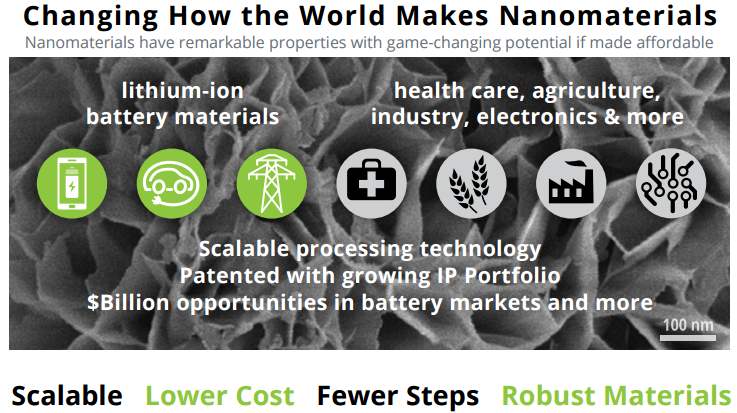
Developed a patented process and scalable manufacturing platform that is agnostic to different types of raw materials, creating a more robust product faster and cheaper than conventional methods.
Although the technology could apply to a variety of different materials, Nano One is currently focusing on the cost-effective production of nanostructured cathode materials for Li-Ion batteries.
Simple three-stage process with up to 75% fewer steps, less handling, lower capital costs, minimal waste solvents, 90-95% yield which could reduce costs up to 50% ($/kWh).
From a battery technology perspective, not much can be done to accelerate the rate of development – the real solution relies on improving the material constraints which Li-Ion currently faces.
Management has stated they have enough cash on hand through 2016 and are utilizing it to complete pilot installation, commissioning, optimization and full scale battery testing.
Simple question. "Can you make a battery last longer?" In short, yes however the answer is more complicated than one may initially think.It depends on how smart phone and electric car manufacturers choose to leverage the improvements; they may want it to last longer, charge faster or drive more features; they may want to extend their warranty, improve mileage or reduce the size of battery packs.
This is the battery conundrum. Batteries do not follow Moore's Law, where the number of transistors on circuit doubles about every two years. They do occur, however at a decidedly slower pace (~7-9% annually in terms of energy density). Why does everything in your life seem to get better, faster, and cheaper, but your smartphone still dies in the afternoon? Choices and limitations in commercialization - manufacturers can only do so much with the current state of the battery industry, hampered largely by price and a lack of efficacious technology.
This is where a manufacturing platform that is agnostic to different types of raw materials, creating a more robust product faster and cheaper than conventional methods is the differencing component of this next company which believes that it has the technology that could enable a new generation of batteries and advanced energy storage materials.
COMPANY OVERVIEW
Nano One Materials Corp. ("the company" or "Nano One") (OTCBB: DDXFF, TSX-V: NNO or FRA: LBMB) is a Vancouver-based technology company with a scalable industrial process for producing low-cost high-performance energy storage materials for batteries and a wide range of advanced nanostructured composite materials for products in the energy storage, specialty ceramics, pharmaceutical, semiconductors, aerospace, industrial, food, agriculture and communications markets. Nano One uses a novel three-stage process and is engineering equipment for high volume production and rapid commercialization. The technology is particularly suited to growth markets where the commercialization of advanced materials is inhibited by costly and entrenched industrial fabrication methods. Nano One has 2 US patents granted and more than 10 pending in the U.S. and foreign jurisdictions.
Figure 1: Technology Summary
Source: Nano One Fact Sheet
WHAT ARE NANOMATERIALS?
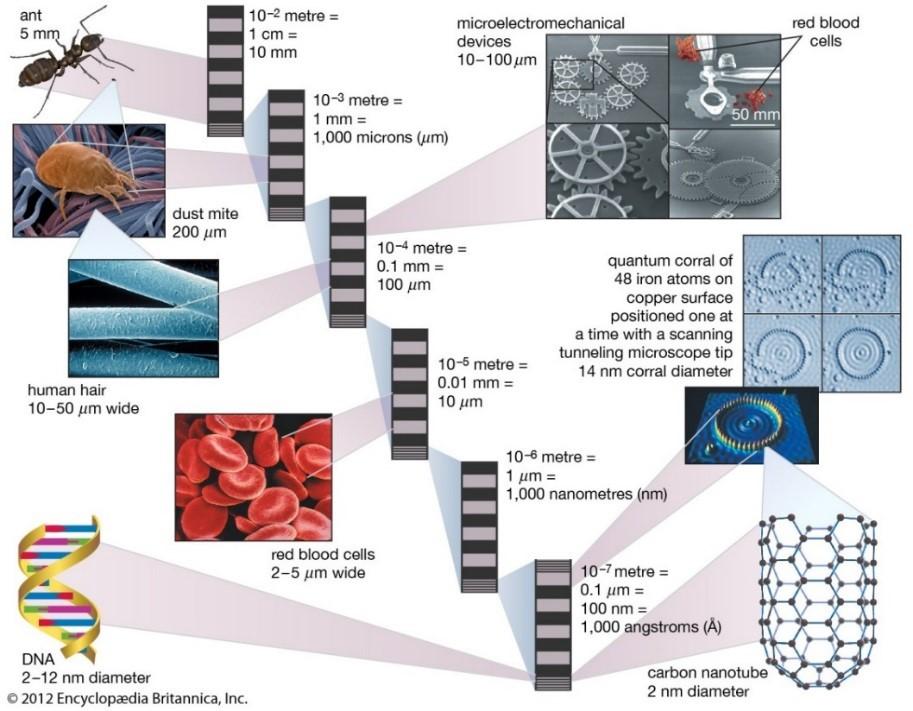
Nanomaterials are substances with structural features measured in nanometres, which is billionths of a meter or millionths of a millimeter, sized between molecular and microscopic. There can be nanometer-sized particles or crystals, or nanometer-sized structures within larger particles. Nanomaterials can be organic or inorganic; they can be made of metals, ceramics, semi-conductors, polymers or composites.
Figure 2: Scale of Nanomaterials
Source: Nano One
Nanomaterials are found in natural substances such as clays, gemstones, feathers and bones. For instance, they waterproof leaves, give iridescence to abalone shells, and provide grip for creatures like geckos to climb walls. If the properties of these materials can be harnessed, then the nanometer-sized features can effectively be programmed to behave in unique ways and have valuable optical, magnetic, electronic, mechanical and chemical properties.
Controlling the structure and size of these materials at the nanometer scale is too complex and too costly for most industrial applications. However, Nano One believes it has a manufacturing solution that will change the way nanomaterials are made and lead the industrial world into a new generation of affordable, high performance materials.
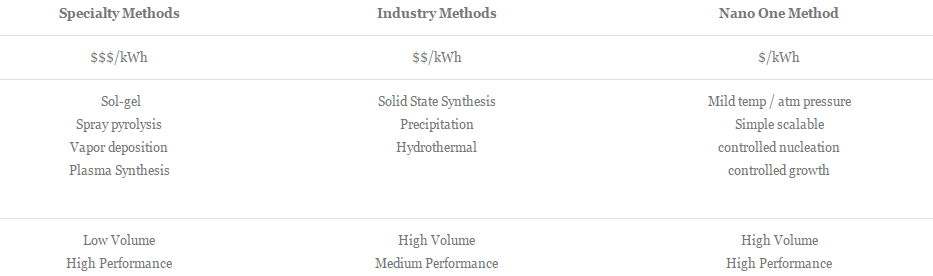
Figure 3: Made Affordable
Source: Nano One
The vast majority of today's materials are not nanoscale - to produce, they are generally too costly, complex and impractical for high-volume production of materials such as those used in batteries. The industry standard processes raw materials into fine or very fine powders by crushing, grinding, milling, blending, dissolving, precipitating, washing and filtering, sometimes in the presence of aggressive chemicals, high heat and pressure. For batteries, this impacts the structural integrity of the material, limiting complexity, uniformity, surface area, longevity, capacity, charging and cycling. These methods are widely used by industry and known as solid state, hydrothermal and co-precipitation.
Nano One's technology differs from these methods because it enables controlled assembly of inexpensive raw materials at mild temperatures under atmospheric pressures in fast acting, versatile conditions using simple, scalable and cost effective industrial equipment suited to high volume production.
MANUFACTURING BETTER BATTERIES
Although Nano One's innovative processing technology can be used to produce materials used in a wide range of markets, the first addressable market that the company has selected to pursue is for cathode materials that are used to store and discharge energy in lithium-ion rechargeable batteries.
There is growing demand in the lithium-ion battery market for more cost effective and higher performance energy storage solutions. Nano One believes that cost-effective production of nanostructured cathode materials can address pent-up global demand for better batteries and is around a $2-3 billion global market. Cathode materials are found in the lithium ion batteries that power consumer electronics, electric vehicles and industrial storage (to name just a few).
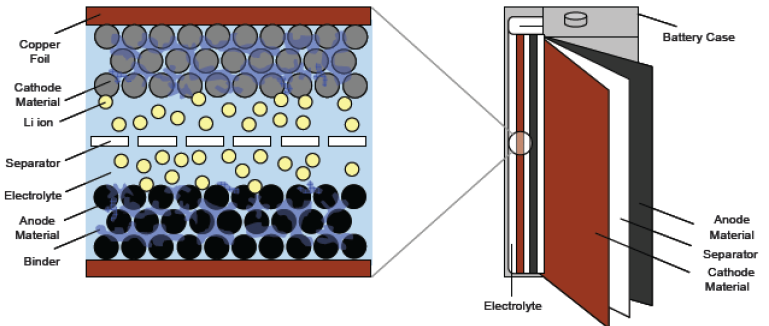
Lithium ion batteries have two electrodes, the anode and the cathode, that transmit lithium ions through an electrolyte with a porous membrane to separate the electrodes. The electrodes are thin foils coated with powdered materials that store and release ions during energy charge and power delivery. The anode material is most commonly made of graphite, while the cathode is of lithium and a matrix of other metals that can include cobalt, manganese, nickel, aluminum or iron in the form of oxides, phosphates, silicates and others.
Figure 4: Basic Structure of a Lithium-Ion Battery
Source: Taiyou Research
The Challenge
Cathode powders have great potential to change battery performance and also account for a quarter of the cost of a typical battery cell. The challenge with any advanced material is to boost performance and reduce cost. For batteries, this means reducing the cost of raw materials and processing while boosting capacity, charge and cycle life.
Cathode powders have great potential to change battery performance and also account for a quarter of the cost of a typical battery cell. The challenge with any advanced material is to boost performance and reduce cost. For batteries, this means reducing the cost of raw materials and processing while boosting capacity, charge and cycle life.
Some of the more promising cathode materials being developed in labs around the world are using processes with between 50 to 100 steps and production cycles of 4-7 days. Nano One's technology can use lower grade raw materials and could complete a production cycle in a day using a three stage process with up to 75% fewer steps. There is less handling, lower cost capital equipment, no waste solvents, 90-95% yield, many fewer failure points, higher safety and flexibility to run different material formulations in a controlled and sealed environment.
The Upshot
Nano One's technology could reduce costs by up to 50% ($/kWh) delivering robustly structured cathode materials that last 2-3 times longer, store more energy and deliver more power. For electric vehicles, this could translate into fewer battery cells, less weight, less cost extended range, longer lifetime or better warranties. For consumer electronics, this could mean greater storage, faster charging or more power.
Nano One's technology could reduce costs by up to 50% ($/kWh) delivering robustly structured cathode materials that last 2-3 times longer, store more energy and deliver more power. For electric vehicles, this could translate into fewer battery cells, less weight, less cost extended range, longer lifetime or better warranties. For consumer electronics, this could mean greater storage, faster charging or more power.

Source: Nature.com
LITHIUM ION BATTERY ("LIB") MARKET OVERVIEW
While Nano One can apply its scalable industrial process to upgrade a wide range of advanced nanostructured composite materials for products in the health care, electronics, industrial, food, agriculture, industry, catalyst and textile markets, its initial target market is energy storage for batteries.
There are a lot of underlying reasons that forecast a much greater adoption rate for energy storage systems, particularly lithium ion batteries in the years to come:
- Batteries are the unappreciated hero of electronic devices (mobile phones, laptops, tablets, smartphones, power tools, etc.)
- Global warming and climate change concerns have focused a spotlight on electric vehicles (NYSE:EV)
- Rising transportation demand, upstream costs and security over supply of oil have precipitated an urgent need for new sources of energy
- Green energy has made power grids more unstable, but energy storage systems (NYSE:ESS) can help
Why Lithium Ion?
Lithium Ion batteries offer capacity, charging, weight, and form-factor benefits all of which are attractive to EV manufacturers. Although costs are currently high, pricing will fall as battery and EV manufactures invest iningenious manufacturing processes rather than ingenious leaps in battery chemistry in order to meet the surging consumer EV demand and usher in the new electric age.
Lithium Ion batteries offer capacity, charging, weight, and form-factor benefits all of which are attractive to EV manufacturers. Although costs are currently high, pricing will fall as battery and EV manufactures invest iningenious manufacturing processes rather than ingenious leaps in battery chemistry in order to meet the surging consumer EV demand and usher in the new electric age.
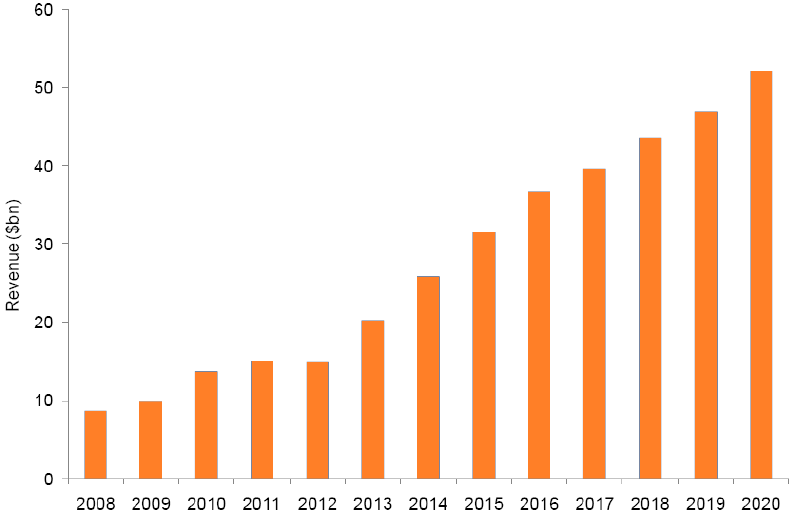
According toTaiyou Research, lithium-based batteries are the most popular advanced batteries for use in portable consumer electronics, and EV manufacturers. However, this was not always the case for several years spanning the initial stages of the EV market due to the high cost associated with this battery type compared to its nickel-based counterpart. With the fall in prices of lithium after 2005, auto manufacturers started widely using it in their batteries which has expanded its application demand significantly (although prices for these vehicles are still relatively quite high).
Figure 5: Revenues of the Global Lithium-Based Battery Market ($USD Billion), 2008 - 2020
Source: Taiyou Research
Lithium Prices: Supply & Demand
While the excitement for lithium is born of strong growth in technologies requiring lithium (mainly electric vehicles and energy storage), the real reason for investor excitement boils down to one issue: price. As arecent article in The Economist points out,
"Amid a surge in demand for rechargeable batteries, companies are scrambling for supplies of lithium… Lithium prices have spiked alarmingly of late and this gives us pause as historically any parabolic price spike typically ends in tears for investors. That said, while prices could soften somewhat, strong demand and increasing questions around supply lead us to believe that lithium price downside is limited."
