Showing posts with label Small cap stocks. Show all posts

Thursday, September 14, 2017

5 Best Artificial Intelligence Small Cap Stocks To Buy

Image result for artificial intelligence

We have selected five best artificial intelligence small-cap stocks to buy, as an alternative to bigger tech companies that are also engaged in the AI space. Many tech giants, like Amazon.com, Inc. (NASDAQ:AMZN), Alphabet Inc. (NASDAQ:GOOGL), Facebook Inc. (NASDAQ:FB), Tesla Inc (NASDAQ:TSLA) and others, are engaged in developing some sort of artificial intelligence, but they rely on revenue from their main business and can be too expensive for a smaller investor to generate meaningful returns from them, even though they are much less risky investments. Small-cap companies engaged in AI can be more volatile, but also have more potential to grow and generate more value, as a result.
Artificial Intelligence is a term that has been around since 1950s. It is defined ass a system that allows a machine to imitate some cognitive functions like learning and problem solving. A decade or so ago, people usually associated Artificial Intelligence with either some theoretical examples or examples present in pop-culture, like the evil superintelligence system Skynet in the Terminator franchise, which wanted to wipe out the humanity.

The Princeton Whiz Retirement Solution

Princeton grad and fintech CEO launches free tool to match you with the best financial advisor in your area

Nowadays, however, AI systems, while still in their infancy, are widely used and we interact with them day-to-day in order to simplify some of our personal or professional tasks. Of course, this doesn’t mean that if a fully-developed AI system is introduced and is tasked with the protection of mankind, it will quickly go through Twitter feeds and comment sections and will come to the conclusion that the best way to save the humanity is by exterminating it. During a speech at MIT a couple of years ago, Elon Musk called AI “our biggest existential threat”, adding that “there should be some regulatory oversight, maybe at national and international level, just to make sure that we don’t do something very foolish.”

Elon Musk is not the only one concerned about the potential threat of AI. An article written in 2014 by Stephen Hawking, Stuart Russell, Max Tegmark, and Frank Wilczek, says that a success in creating an artificial intelligence could be the biggest event in human history, but might also be the last, unless humankind learns how to avoid the risks.
Meanwhile, artificial intelligence systems that are being developed now are doing their job at being our servants. There are virtual assistants on our phones, computers and tablets that help us with some daily tasks. Some automotive companies are engaged in developing AI systems that can drive vehicles by themselves, thus minimizing the probability of road accidents and making it easier to commute. AI systems are used in the data processing, improving online services, providing information that people need (or that the system thinks people need). AI systems have even entered in the healthcare space, where machine learning is used to identify diseases by scanning lots of information related to various diseases, and so on.
AI has even made its way in the financial world, where systems and algorithms are used to identify patterns, analyze data and make transactions at much faster speeds than humanly possible. At the same time, it offers the possibility for investors to put their money in a new, high-growth and exciting industry. The AI industry is expected to be worth $16 billion by 2022, growing at a compound annual rate of nearly 63%. This huge inflow of money means that investors have lots of opportunities to get some exposure to the industry.
As stated earlier, investors can buy shares of tech giants that have lots of cash to invest in developing their own AI systems and pursuing acquisitions in the space. For example, here are seven Artificial Intelligence Companies to Invest in Now. There are also many AI-focused startups, although investing in a startup is more difficult than in a publicly-traded stock. There are even AI-focused ETFs that offer investors exposure to a basket of stocks. Some ETFs incorporate stocks of the aforementioned tech giants that spend lots of money on R&D in the AI space, while others target companies that are purely engaged in AI systems. ROBO Global Robotics and Automation Index ETF (NASDAQ:ROBO) and Global X Robotics & Artificial Intelligence ETF (NASDAQ:BOTZ) are two ETFs from the latter group. However, in this article, we are going to discuss five small-cap companies that are engaged in the artificial intelligence industry. In addition, we are going to see what is the smart money sentiment towards these stocks.

1. iRobot Corporation (NASDAQ:IRBT)

Market Cap: $2.60 Billion
Image result for iRobot Corporation
iRobot Corporation (NASDAQ:IRBT) is a company that was founded in 1990 by three MIT graduates and is known for its consumer robots for inside and outside the house. It’s most well known product are autonomous vacuum cleaners Roomba, but the company also makes autonomous floor moppers Braava, and swimming-pool cleaners Verro. However, iRobot Corporation (NASDAQ:IRBT) is also engaged in developing robots for military use. It has developed autonomous robots that can be used in bomb disposal, transporation, and surveilance. In addition, it is currently working on its SWARM artificial intelligence project that is engaged in developing algorithms to control swarms of individual robots. Among the funds we track at Insider Monkey, there were 15 investors long iRobot Corporation (NASDAQ:IRBT) at the end of June, up from 13 funds a quarter earlier.

2. Brooks Automation, Inc (NASDAQ:BRKS)

Market Cap: $1.80 Billion
Related image
Brooks Automation, Inc (NASDAQ:BRKS) specializes in equipment that can be used for automation, vacuum and instrumentation. Its systems are used in the semiconductor industry, where there is need for high-precision automation and a cleaned and controlled environment. It also offers solutions to create an airless environment for the manufacturing of various products that require a vacuum and cryogenics that have applications in various industries, including life sciences, for which Brooks Automation, Inc (NASDAQ:BRKS) provides cryogenic storage solutions, automated compound management and biological sample management systems. Among the investors tracked by Insider Monkey, 23 funds held shares of Brooks Automation, Inc (NASDAQ:BRKS) at the end of June, up from 21 funds at the end of March.

3. AeroVironment, Inc. (NASDAQ:AVAV)

Market Cap: $1.14 Billion
Image result for AeroVironment, Inc.
California-based company AeroVironment, Inc. (NASDAQ:AVAV) is one of the top suppliers of drones and other unmanned aerial vehicles (UAV) for the US government. The company has  developed a number of solar-powered UAVs used by NASA and military UAVs to be used in surveillance. AeroVironment, Inc. (NASDAQ:AVAV) is also engaged in providing products for clean energy and efficient vehicles. Only five investors from our database held shares of AeroVironment, Inc. (NASDAQ:AVAV) at the end of the second quarter.

4. Mazor Robotics Ltd – ADR (NASDAQ:MZOR)

Market Cap: $1.06 Billion
Image result for Mazor Robotics Ltd
Mazor Robotics Ltd – ADR (NASDAQ:MZOR) is an Israeli company that provides robotics solutions for the health care sector. It manufactures a robotic guidance system that can be used for spine surgery. Its flagship product, Renaissance, is cleared by the US Food and Drug Administration to be used for spine and brain surgery and is used in 28 hospitals in the US (54 hospitals worldwide). Renaissance works by creating a 3D virtual blueprint of a surgery and the system guides tools and implants to the required location with an accuracy of 1.5 millimeters. There were six investors tracked by Insider Monkey bullish on Mazor Robotics Ltd – ADR (NASDAQ:MZOR) at the end of June.

5. Accuray Incorporated (NASDAQ:ARAY)

Market Cap: $350 Million
Image result for Accuray Incorporated
Accuray Incorporated (NASDAQ:ARAY) is another healthcare company that develops systems for radiation therapy and radiosurgery platforms. It offers a number of products, such as the CyberKnife Systems, TomoTherapy Systems , and the Radixact Delivery Treatment Product. The CyberKnife Systems are used for the treatment of various types of cancer and tumors. The system tracks, detects, and corrects for tumor and patient movement in real-time during a procedure. During the second quarter, the number of funds from the Insider Monkey database long Accuray Incorporated (NASDAQ:ARAY) declined by five to 10.
These five best Artificial Intelligence small cap stocks to buy are not fully grown, holding a relatively small number of products in their portfolio and some are not so much engaged in the AI space as in the automation. However, they have the potential to expand their product offerings and might move to developing more complex systems that will be closer to sporting the same “cognitive” functions that are associated with Artificial Intelligence.
By Alexandr Oleinik

Tuesday, August 15, 2017

5 SMALL-CAP STOCKS FOR THE REST OF 2017

Image result for MACOM Technology Solutions

The much-heralded "Trump Trade" has started to unravel. Despite our new President's best efforts, the economic reality of implementing policies has begun to weigh on market sentiment. 
Despite 2017 being a successful year for the stock market so far, investors are scrambling to locate the next hot sector and stock. It seems new highs in the major indexes are being hit on an almost daily basis without a significant pull back. At this point, professional investors are asking just how much more upside the market can offer.
The small-cap sector, however, has not kept up with the rest of the market this year. While the S&P 500 is higher by 9%, the small-cap-based Russell 2000 is only higher by about 1%.
Small caps with solid fundamentals riding on developing trends may represent an untapped bastion of upside potential.
5 Small-Caps Poised For Gains
1. MACOM Technology Solutions (Nasdaq: MTSI)

Shares of this analog semiconductor company plunged into the deep value zone on a third-quarter miss, setting up an ideal buying opportunity for forward-looking investors.
Boasting a market cap of just under $3 billion, this Lowell, Massachusetts-based technology company specializes in telecom optical components and data centers. MACOM's primary sources of revenue are split approximately 70/30 between these two segments, respectively.
By focusing on the slowdown in China, bearish investors are not considering the highly bullish factors that make MACOM a strong 'buy' candidate. The stock plunged over 35% from $66 per share to nearly $40 on weakened Chinese demand for telecom optical components. Fourth-quarter projections also missed expectations, with forecasted revenue predicted between $165 million to $174 million and profit projected at $0.45 to $0.50 per share against consensus expectations for $205 million and 76 cents per share.
First, the Chinese slowdown due to inventory glut is temporary and should improve over time. Next, MACOM's data center business soared by 300% in the last quarter, while overall revenue rose by nearly 37% and gross profit was higher by 25% during the same time frame. 
As super-sized internet companies like Amazon and Facebook demand faster and faster data, Macom's optical offerings are the ideal solution. In addition, the Internet of Things' burgeoning demand for radio frequency chips should continue to power revenues long into the future. 
2. Myriad Genetics (Nasdaq: MYGN)
Shares of this small-cap genetic testing company just broke out above $27, setting up an ideal buying opportunity for momentum-based investors. The stock price has rallied higher since February to nearly $28 from lows in the $15 range.
The company focuses on hereditary genetic testing for ovarian and breast cancer via the BRCA gene. Myriad held a patent on BRCA that was nixed by the Supreme Court in 2013. Despite this setback, the company maintains an 80% market share in this niche. Myriad's business edge includes the fact that its test is clinically validated and is far more detailed than the competition. 
At the same time, the company recently acquired a firm specializing in diagnosing anti-anxiety and depression medication compatibility. Nearly 10 million Americans are diagnosed with one of these conditions annually. The company is barely scratching the surface of this extremely lucrative opportunity. In fact, the potential of this new market easily surpasses the company's core business. 
Myriad recently posted fiscal fourth-quarter results, beating estimates while reporting 86% of business is tied to long term contracts. The company represents a great opportunity in the long run.
3. TherapeuticsMD (NYSEMKT: TXMD)
Here's another small-cap biotech company that has set up to be an ideal break-out buy candidate. Shares have been channeling tightly between the 50- and 200-day simple moving averages in a holding pattern waiting for drug approval from the FDA. 
TherapeuticsMD specializes in hormonal-based drugs that are bioidentical to the naturally occurring hormones. Focused on treating the symptoms of menopause, the drug was scheduled to be approved in May 2017, and is now expected to be approved shortly. The company's other product, a treatment for hot flashes caused by menopause, is forecasted to be approved in 2018.
The edge the company has in its niche is the bioidentical nature of the drugs. Other treatments require separate prescriptions or compounding of medications. But current legislation does not allow compounding if an FDA-approved similar treatment available. This opens up a tremendous opportunity for TherapeuticMD.
Investors interested in buying this stock should set an order to buy on a breakout above the 200-day SMA and hold for the long run.
4. Red Rock Resorts (Nasdaq: RRR)
Red Rock Resorts operates 22 Las Vegas and Native American-owned casino complexes. Net revenues were higher by nearly 15% in the second quarter year-over-year. 
However, the acquisition of Boulder Station and Texas Station leases sent net income lower for the quarter. This sent shares plunging below the 200-day simple moving average towards $21.50 per share. An ideal dip-buying opportunity has developed at the lower stock price. 
The company is undertaking a major renovation project that is digging into short-term profits. However, the improved properties will bring significant value enhancements, creating a strong opportunity.
5. Acxiom (Nasdaq: ACXM)
Acxiom specializes in data and analytics for marketing. The company specializes in helping online and traditional advertisers increase their return on investment by becoming more efficient. 
The stock has suffered this year with a price drop of over 14%. A loss of $0.02 per share and revenue of $212.5 million posted the latest quarter came in under analyst expectations. Full-year earnings are projected to be 80 cents per share, with revenue in the range of $920 million to $930 million, which if achieved should lift the price. 
The stock has dipped from around $27 per share to nearly $23 per share, setting up a great dip-buying opportunity. 
Risks To Consider: Volatility is an inherent characteristic of the small-cap sector. Volatility can be both a positive and negative for an investor. Stop loss orders and proper position sizing is particularly critical when investing in small-cap stocks.
Action To Take: Consider adding one of more of the small cap stocks listed above to your investment portfolio
By David Goodboy

Thursday, August 10, 2017

5 Small Cap Value Stocks to Buy Now

Image result for ZAGG Inc.

UCTT SRI MHO TSQ ZAGG
Every week, Tracey Ryniec, the editor of Zacks Value Investor portfolio service, shares some of her top value investing tips and stock picks.
2017 is the year of the large cap growth stocks. That has left value investors in the wilderness, especially small cap value investors.
Small cap value has, historically, outperformed growth, but not this year.
Small Cap Value Down in the Dumps
Year-to-date, the iShares Small Cap Value ETF (IWN) is down about 1%. But the small cap growth ETF (IWO) is up 9.3% during that same time. That’s a huge 10% swing.
But that means that small cap value stocks are actually on sale. Value investors have an opportunity to add to their positions at attractive valuations.
Tracey ran a screen to find small cap value stocks with P/Es under 15, P/S ratios under 1.0 and a Zacks Rank of #1 (Strong Buy) or #2 (Buy). Despite the narrow parameters, the screen gave her 15 quality stocks to choose from.
What are you waiting for? These small cap stocks have value and several even have dynamic growth.

1.    
 Townsquare Media (TSQ - Free Report) is a media, entertainment and digital marketing company that owns radio stations and websites. It trades with a forward P/E of 9.6.5 Small Cap Value Stocks to Buy Now
2.    Ultra Clean Holdings (UCTTFree Report) develops critical systems for the semiconductor and flat panel industries. Revenue was up 75.8% last quarter. It has a forward P/E of just 12.1.
3.    Stoneridge Inc. (SRI - Free Report) makes electronic components for the auto and truck industries including driver information systems, sensors, and tracking devices. It’s cheap, with a forward P/E of 11.5.
4.    M/I Homes (MHO - Free Report) is one of the small homebuilders. It saw record revenue, homes delivered and new contracts in the second quarter. The homebuilders are dirt cheap. MHO has a forward P/E of just 8.4.
5.    ZAGG Inc. (ZAGG - Free Report) makes screen protection, mobile keyboards and owns Mophie, which is one of the top selling battery cases for mobile phones. Sales are expected to rise 21% this year. It has a P/S ratio of just 0.6.
For investors, small cap stocks can be riskier than large cap stocks, due to their volatility, but the payoff can also be greater. These are just a few names that have solid fundamentals.
By Tracey Ryniec

Monday, July 24, 2017

High Dividend Small Caps

Image result for High Dividend Small Caps stocks

Summary

This article examines the long-run performance of a strategy focused on low-volatility, high-dividend, small-cap stocks.
I have proven in past articles that this strategy in large caps has generated absolute and risk-adjusted outperformance versus the broader market.
The current vehicle replicating this index is currently too small and illiquid for me to invest.
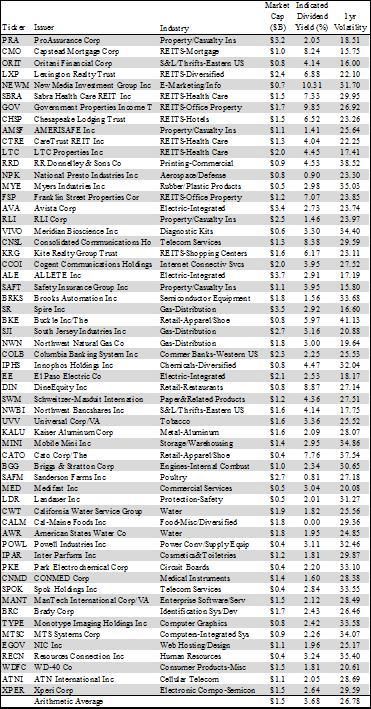
The article lists the current 60 constituents of the index for readers to analyze potentially building their own portfolio.
Finally, the article discusses other lower-volatility and dividend growth small-cap strategies.
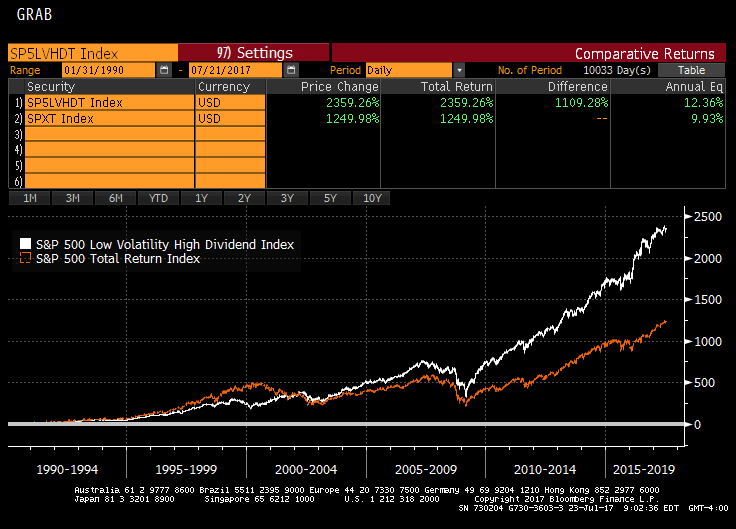
One of my favorite smart beta strategies selects from among the 75 highest dividend-paying S&P 500 (NYSEARCA:SPY) constituents, building a portfolio out of the 50 with the lowest realized volatility over the past year. As I showed in "A High Dividend Strategy That Works", this S&P 500 Low Volatility High Dividend Index, which is replicated by the PowerShares S&P 500 High Dividend Low Volatility Portfolio ETF (NYSEARCA:SPHD), has strongly outperformed the broader S&P 500 (SPY) over a sample period dating back to 1990.
Buoyed by the success of SPHD, which returned over 22% in 2016 including reinvested dividends, PowerShares has launched a small-cap cousin of that large-cap index. That index selects from among the 90 highest dividend-paying S&P 600 (NYSEARCA:IJR) constituents, building a portfolio out of the 60 with the lowest realized volatility over the past year. The index is weighted by dividend yield and includes sector caps.
The replicating fund, the PowerShares S&P SmallCap High Dividend Low Volatility Portfolio (BATS:XSHD) is a nascent fund launched in December 2016. It has only gathered $7 million of assets but continues to be a fund referenced to me by many readers on Seeking Alpha. This article will seek to examine whether this high-dividend, low-volatility segment of the small-cap universe generates alpha.
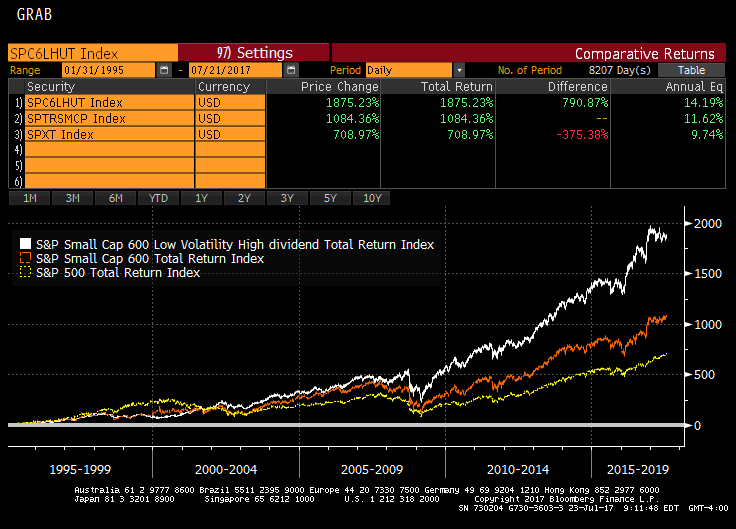
The chart below graphs the S&P 600 High Dividend Low Volatility Index versus the S&P 600 and the S&P 500.
In backcasted index data back to early 1995, the S&P 600 High Dividend Low Volatility Index appears to show promise versus the broader S&P 600 and its large-cap cousin, the benchmark S&P 500.
How does this small-cap strategy generate this outperformance? As I showed in "Smart Beta Over Generations: Size," small caps have historically outperformed - with a notable exception. High-volatility small caps have historically generated negative returns. Volatility can be a way to screen for the potential for financial distress, and using volatility as a screen has kept this index away from stocks that pay high dividend yields simply because the market is questioning the future of the firm through a low share price relative to its dividend.
Despite this tremendous long-run performance, at this point, I do not believe the XSHD is investable. Given the very low assets under management, tracking error is elevated. Year to date, the fund has underperformed its index by 53 bp - a figure that is outsized relative to the 30 bp expense ratio. While the creation/redemption process in exchange-traded funds can offer investors another path towards liquidity, the creation unit size of 50,000 shares ($1.2 million) is likely too large for retail investors and about 15% of total AUM. Investors wishing to enter and exit the fund are likely to be met with wide bid/ask spreads given the low trading volumes.
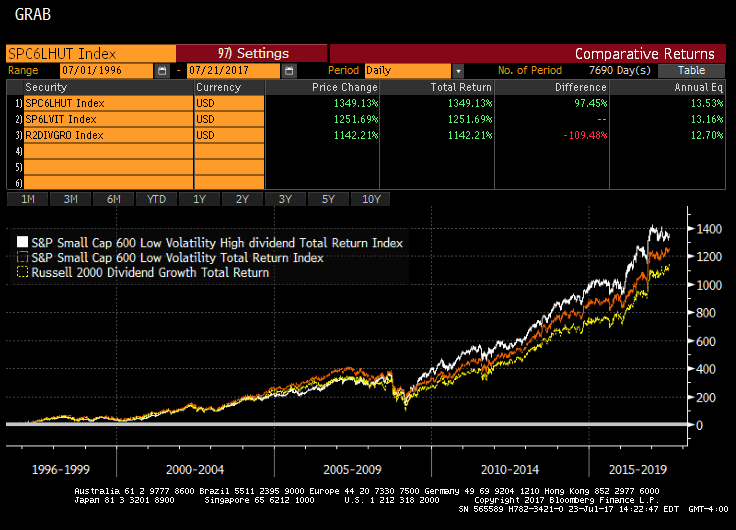
In previous articles, I have examined two strategies that share some similarities with the underlying index for XSHD. The S&P SmallCap 600 Low Volatility Index (NYSEARCA:XSLV) focuses on the 120 lowest-volatility constituents of the S&P 600. The Russell 2000 Dividend Growers(NYSEARCA:SMDV) focuses on companies in the Russell 2000 (NYSEARCA:IWM) that have increased their dividends for at least 10 straight years.
All three index strategies have delivered strong returns. For perspective, the S&P 500 generated only 8.37% annualized returns over that time span. I believe the S&P 600 Low Volatility High Dividend strategy has merit, but do not think there is an appropriate replicating vehicle at this point. For Seeking Alpha readers interested in further examining the underlying constituents of the strategy, I have tabled the current holdings of XSHD below. As one can see, the fund is currently heavily tilted towards REITs and Financials and materially underweight Energy.
I will continue to monitor XSHD as the fund matures. As it scales and becomes more liquid, it my be an interesting portfolio complement.
Disclaimer: My articles may contain statements and projections that are forward-looking in nature, and therefore inherently subject to numerous risks, uncertainties and assumptions. While my articles focus on generating long-term risk-adjusted returns, investment decisions necessarily involve the risk of loss of principal. Individual investor circumstances vary significantly, and information gleaned from my articles should be applied to your own unique investment situation, objectives, risk tolerance and investment horizon.
Disclosure: I am/we are long IJR, SMDV, XSLV, SPY, SPHD.
By Ploutus

Monday, July 17, 2017

Russell 2000 Update - AK Steel Holding Corp. (AKS) Gets Lift

Image result for AK Steel Holding Corporation
Jul 14, 2017
Friday was another good day in stocks keeps the bears at bay for the time being. Even with some excellent earnings coming from a few of the big bank stocks today though, financials are getting beat up to close out the week. However, the S&P 500 seems to be gunning for its all-time high again, but whether or not it can get her done we'll see.
There continues to be a rotation of sorts over the last few weeks, where basic materials and commodities seem to be picking things up - along with healthcare and biotech - while tech stocks continue to somewhat lag a bit. It's going to be real interesting to see what happens when those big tech names start to report later this month.
As for small caps in general and some of our currently featured stocks, the Russell 2000 still seems to want to trade in an extremely wide range, but the longer this goes on the more it bodes well for the entire small cap space. It's a classic tip to Will O'Neill's Tea Cup and Handle charting patter, which suggests the long-term possibility of a breakout to the upside in small caps at some point down the road.
It's not as if there isn't value in the small cap space right now, but nobody really knows at this point if the Russell is going to finally break out, or simply start moving lower again.
We're finally getting some nice movement in AK Steel Holding Corporation (NYSE: AKS) after a number of days moving lower. All good now, but it's definitely going to need to find its way back above about $7 bucks if the stock is going to suggest even more upside ahead.
That's the last time it started selling off again, but if what I'm seeing with AKS does continue and with Trump's plans to put a tariff hammer lock on steel imports from abroad, AKS could end up being a beneficiary of sorts. It's not one of the stronger steel companies out there right now, but for investors who like sub $10 stocks, it's one worth having a look at.
Last, before we roll into the weekend, I showed you on thursday the recent move Senseonics Holdings, Inc. (NYSE: SENS) made a few days ago. Well, we got another move back to the upside today and based on what seems to be happening there, all it's going to take is one more big day and the stock could be ready to make an even bigger move.
It's really important to remember when it comes to really small stocks like SENS, there's usually always big short positions in those stocks, but it doesn't mean short sellers have it any easier than buyers do. What I'm saying is if the stock starts to really rally, those short sellers are going to have to cover.
As a matter of fact, it's usually the dumber short sellers that short something when it's way too low that end up getting their butts handed to them. The smart short sellers short high and cover low - just like smart investors buy low and sell high - or buy high and sell higher.
We'll see what happens with SENS. However, I wouldn't want to be short based on what the stock has been doing over the last few days.
See ya'll Monday.
Warmest regards,
SmallCap Network

Source: https://goo.gl/9MgmUC

Monday, April 3, 2017

3 Revolutionary Drugs for Chronic Pain


Flexion Therapeutics, Cara Therapeutics, and Nektar Therapeutics have entirely new ideas for how to treat chronic pain, and those ideas may reshape the market.


Flexion Therapeutics (NASDAQ:FLXN), Cara Therapeutics (NASDAQ:CARA), and Nektar Therapeutics (NASDAQ:NKTR) may soon offer patients suffering from chronic pain a better option than opioids. Here's how these companies plan to reshape the way doctors treat the 39 million Americans with chronic pain.

Tackling knee pain

Flexion Therapeutics' Zilretta is under review by the Food and Drug Administration (FDA) as a new approach to treating knee pain caused by osteoarthtritis, and positive results from trials suggest it could eventually replace corticosteroid injections for millions of patients.
A man rubs his knee because of chronic knee pain.
IMAGE SOURCE: GETTY IMAGES.
The FDA will issue a go/no-go decision on Zilretta on Oct. 6, and data from studies may be compelling enough for a green light. In trials, Zilretta patients enjoyed a median 50% reduction in knee pain, and, more importantly, that pain relief was maintained throughout a three-month period. If Zilretta's effectiveness holds up in the real world, there's a good chance it will win support with doctors and patients because pain relief from corticosteroids typically wears off within weeks -- long before the next scheduled quarterly injection.
Roughly 5 million people currently receive corticosteroid shots because of their pain, and management thinks Zilretta could fetch $2,000 per patient per year. If this estimate is on target, it won't take a lot of market share for Zilretta to be a top seller. 
Recently, rumors have surfaced that acquisition-hungry Sanofi SA (NYSE:SNY) is kicking Flexion Therapeutics' tires. It wouldn't shock me if those rumors are true. Sanofi has attempted to buy Medivation and Actelion in the past year, so it's clearly on the hunt for acquisitions. Importantly, Sanofi already markets Synvisc-One -- a hyaluronan injection used to treat knee pain -- which generates $400 million per year, so it's already got the sales force in place to turn Zilretta into a winner. 

Outperforming opioids

Cara Therapeutics thinks CR845's ability to relieve pain with less risk of addiction could allow it to capture a big share of the 24 million pain prescriptions written for opioids every year.
Instead of targeting mu-opioid receptors in the nervous system like opioids, CR845 relieves pain at the source by targeting kappa-opioid receptors in the periphery of the body. Because CR845 is designed not to pass easily through the blood-brain barrier, it delivers less of a euphoric high than opioids.
CR845 is being studied in hip and knee pain in osteoarthritis patients, and management just reported data showing that it can help reduce chronic itch in dialysis patients.
The potential to elbow market share away from opioids and deliver greater relief to dialysis patients is exciting, but more trials are required before Cara Therapeutics can file for FDA approval of CR845. Because more work needs to be done, it may be a while before this drug makes it to market. Nevertheless, this company's opportunity is big, and that makes tracking its progress worthwhile.
https://www.amazon.com/?tag=shoprite0597-20&camp=1&creative=4269&linkCode=ez

Improving the standard

Like CR845, Nektar Therapeutics' NKTR-181 may eventually reduce pain patients' need for opioids. But, unlike CR845, NKTR-181 still targets mu-opioid receptors in the nervous system to deliver pain relief.
However, it does so selectively. And it's specifically designed to cross the blood-brain barrier slowly to reduce euphoria. By more precisely targeting the receptors and limiting euphoria, it may deliver similar relief to opioids with less of a risk of abuse.
Last week, the company announced results from a trial testing NKTR-181 for chronic back pain, and that trial's data didn't disappoint. NKTR-181 reduced pain relative to a placebo, and it did so without causing opioid-like levels of euphoria.
Those findings sent Nektar Therapeutics shares soaring, but the company hasn't announced its plans to file for FDA approval yet. Instead, management is searching for a bigger peer to partner with on the drug. Assuming it secures a deal, an FDA filing should come shortly thereafter, with an official regulatory decision coming 10 months later.
Todd Campbell

Thursday, March 16, 2017

Algae Dynamics (ADYNF) - The Story Is Getting Better and Better

Image result for small cap stocks

This morning, Algae Dynamics (ADYNF) announced it had signed a memorandum of understanding with Avanti Rx Analytics that calls for Avanti to test, extract, purify and export cannabis oil as part of the groundwork for developing marketable cannabis products.
A quick refresher is in order.
We first introduced Algae Dynamics to you back on January 17th, pointing out how although its history was as an algae and algae-oil provider (for health products), it was getting into the cannabis business as well.
Image result for Algae DynamicsIt wasn't terribly clear exactly what that meant at the time, though it was exciting all the same. Since then, we've learned exactly what Algae Dynamics had in mind. As it turns out, the medical benefits of cannabis can be enhanced by the simultaneous use of algae oil, and if I'm understanding the science right, vice versa. The development of combo products is the ultimate goal here, and there are several directions the company could go with it.
It needs partners to do the R&D work to develop an algae/cannabis product, of course, and it's found two good ones in the meantime. On February 24th it announced a deal with the University of Waterloo to research the potential of algae/cannabis drugs to combat cancer, and just earlier this week it announced it was going to be working with the University of Western Ontario to develop algae/cannabis drugs to treat a variety of mental illnesses. In both cases the company will end up with full ownership -- and no royalty-payment requirements -- of any intellectual property created as part of the studies.
The two schools need material to work with and test though, which is why this morning's news isn't terribly surprising. That is, it's tapping the aforementioned Avanti Rx Analytics to take care of that task.
It's a bigger deal than it may seem on the surface.
As you might imagine, even the regulatory red tape for medical cannabis is rather tricky to navigate, and those licenses aren't just handed out to anyone. Avanti isn't just anyone though. The company is a Health Canada-approved GMP (good manufacturing practices) and OCDS (open contracting data standard) contract drug developer, which means the government has already done its due diligence on the company and says it can be entrusted with often-debated cannabis.
If you need an outfit to help with the legal and legitimate development of a cannabis-based drug, Avanti Rx Analytics is it. It's encouraging to see just how quickly Algae Dynamics is progressing with its R&D... a lot faster than we were expecting.
With all of that being said, the most interesting thing about Algae Dynamics isn't the news, but the chart.
Take a look. While ADYNF took an uncharacteristically big dive early this morning, it's more than rebounded in the meantime. That chart pattern, which looks like a hammer, is indicative of a transition from a net-selling environment to a net-buying one. The volume spike underscores the notion that the tide has turned, with most of the unconvinced owners being washed out today, clearing the decks for a rebound
The clincher for a hammer-shaped reversal bar is a move above the hammer day's high on the following day. Given everything we know about the company and everything we've seen on the chart though, we're inclined to interpret this bullish clue at face value.
Source:http://www.smallcapnetwork.com/