Showing posts with label 3D printing. Show all posts
Showing posts with label 3D printing. Show all posts
Saturday, February 18, 2017
These students are 3D printing body parts
Engineering students at a Texas high school are using 3D printing technology to help people in need. Prosthetics are normally expensive but the students can print their designs for about $100 a hand. A senior in the engineering program explains how much this means to her.
Source: http://www.cnbc.com/2017/02/18/these-students-are-3d-printing-body-parts.html

Sunday, October 18, 2015
Want to know the most disruptive tech trend?
What are the big emerging trends in technology?
Depends on where you live. Cloud computing and artificial intelligence will continue to be hot for Chinese consumers, but 3-D printing will be all the rage in Europe, technology executives say.

Henrik5000 | E+ | Getty Images
From bitcoin to the "Internet of Things," trend watchers are faced with a dizzying array of "disruptive" consumer technologies. The most indispensable consumer trend over the next three years, it turns out, depends on your region, according to a new study by audit, tax and advisory firm KPMG, who surveyed top executives at technology firms in 17 countries in August and September on topics like cybersecurity, data and analytics and biometrics.
Fifteen percent of those surveyed thought health-care technology would be the most disruptive consumer technology in the United States over the next three years, while in Europe, 3-D printing topped the chart at 12 percent. Cloud computing and artificial intelligence each gained 15 percent of votes for the most disruptive technology in China, according to the 832 business leaders surveyed from start-ups, mid-size to large enterprises, venture capital firms and angel investors.

Sunday, June 7, 2015
Why Organovo Stock Is a Top Biotech Stock to Buy in 2015
You see, Organovo Holdings Inc. (NYSEMKT: ONVO) is part of one of the most exciting biotech industries on the market. It's called 3D bioprinting, and the applications are huge.
Here's a closer look at the 3D bioprinting market and why it's providing us with such a great investment opportunity.
Organovo Stock and the Potential of 3D Bioprinting
 Bioprinting refers to Organovo's process of developing functional human tissues that are used in drug development, biological research, and as therapeutic implants for degenerating tissues and organs.
"Organovo makes the tissue with an exciting new technology called 3D Bioprinting, which identifies key architectural and compositional elements of a target tissue," Money Morning Bioscience Investing Specialist Ernie Tremblay said. "It then creates a design that can be utilized by a 'bioprinter' to generate that tissue in the laboratory."
This allows doctors and researchers to provide "personalized medicine" to their patients. Instead of a "one-size-fits-all" treatment for thousands of patients, these work differently for every patient based on his or her needs.
"Personalized medicine could provide real-life 'magic bullets' for diseases like cancer, multiple sclerosis, lupus, and inflammatory bowel disease (Crohn's and ulcerative colitis)," he continued.
And the applications stretch far beyond diseases.
"This field also holds the promise of miraculous treatments for severe spinal injuries, joint and bone repair, and organ replacement," Tremblay said.
There is some serious money flowing into personalized medicine, too. According to the Alliance of Regenerative and Personalized Medicine, cell therapies have already generated $900 million in revenue. At the end of 2014, more than 160,000 patients had received treatment.
Organovo is at the forefront of that market, and it already has these important partners…
Why We Recommend Organovo Stock Now
ONVO has agreements with numerous institutes and private companies like the United Therapeutics Corporation, the Knight Cancer Institute, and the Michael J. Fox Foundation, among others.
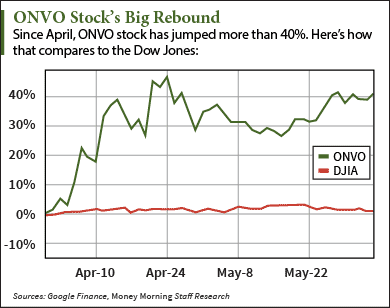
And the best part about Organovo stock is its low price. Even after climbing 41% in the last two months, the stock still trades near $5 per share. That means ONVO still has plenty of upside.
Organovo is still small, with a market cap just over $400 million. It's a development-stage company, so it does come with a little bit more risk. But the upside is huge.
"The possibilities for using this company's products in both medical research and in clinical applications represent limitless income potential – and, I believe, an extraordinary opportunity for the long-term investor," Tremblay said.
The Bottom Line: Personalized medicine and 3D bioprinting offer tremendous potential to patients and investors. More than $900 million has already poured into the market, and that's just the start. Our favorite play on the market is Organovo stock. It's a development-stage company with plenty of upside.
By ,
Source: http://moneymorning.com/2015/06/05/why-organovo-stock-is-a-top-biotech-stock-to-buy-in-2015/
Tuesday, June 17, 2014
MakerBot Replicator Mini Review: 3-D Printing Comes Home
Will a New 3-D Printer Make Enough to Keep You Busy—and Justify the Early-Adopter Price?
When MakerBot's Replicator Mini arrived, Personal Tech Columnist Geoffrey A. Fowler made combs, bracelets, even one-man Mount Rushmores, to answer home 3-D printing's existential question: 'What exactly are we supposed to make?'
Do you remember the first thing you ever printed out? I made a family newsletter, birthday cards and signs on a program called The Print Shop. What made a printer useful at home was self-evident: It made anyone a publisher.
Do you remember the first thing you ever printed out? I made a family newsletter, birthday cards and signs on a program called The Print Shop. What made a printer useful at home was self-evident: It made anyone a publisher.
Now we're entering the era of machines that can fashion ideas into tangible objects.
For industrial uses, 3-D printing's promise is already well-known. It's capable of producing custom heart valves and jet engine parts. But now it's getting personal: A company called MakerBot just started selling a 3-D printer that's easy to use and costs less than $1,400.
The 3-D printer has arrived at home—what you'll print with it isn't as obvious.

Is a 3-D printer like an infinite dollar store on your desktop? (You'll never have to buy a comb again!) Is it a factory for lost Lego pieces and IKEA parts? I've been using two models from MakerBot, including the new entry-level Replicator Mini, on a quest to figure out why anyone might need one.(See how 3-D printers work.)
I printed dozens of plastic doodads—bottle openers, little chains that materialize already linked, even a Mr. Snuffleupagus toy. Yet I haven't yet found a killer practical application that makes a 3-D printer a must-have household appliance. You'll be disappointed if you're hoping to justify the price of a MakerBot Mini with fewer trips to Target.
But what the Replicator Mini has going for it is a combination of hardware and software that makes 3-D remarkably accessible. MakerBot wisely realized that few of us have 3-D design expertise. So it augments its printer with an iTunes-like store for downloading printable objects, an app—also called PrintShop—to design your own items and an active community that keeps giving you reasons to make things.
A number of other upstart companies are starting to sell inexpensive 3-D printers, including 3D Systems ' $1,000 Cube 3 and XYZprinting's $500 da Vinci. But MakerBot's Replicator Mini is 3-D printing's biggest step yet into the mainstream because it succeeds in enabling pretty much anyone—tinkerers, children and parents playing Bill Nye —to create.

The MakerBot Replicator Mini, shown with toys it can print. F. Martin Ramin/The Wall Street Journal, Styling by Anne Cardenas
The Replicator Mini still has rough edges, and given the hype around 3-D printing, it's worth resetting expectations. It's a shrunk-down version of the rapid-prototyping machines used by engineers and architects. You can print things up to the size of a coffee mug—3.9 inches square and 4.9 inches tall.
You're also limited in material to plastic about as rigid as a soda bottle cap. You feed the printer spools of a nontoxic plastic called PLA that smells like pancakes when it melts. (Really—it's derived from corn.)
The printer works like a very precise glue gun, heating up the plastic to more than 400 degrees, then squeezing out intricate patterns.
The Replicator Mini will keep you blissfully uninvolved with most of the printing mechanics. It sits on your Wi-Fi network, taking instructions from a computer or iPad. It's more reliable than previous models and has done away with annoying steps like leveling the plate where objects are printed.

3-D Printer Sales in 3-D: Have a 3-D printer? Download and print our chart. Or just check out our interactive model.
The Replicator Mini's moving parts bark loud enough to wake you in a small house, though the company says an update should lessen the noise. Watching it lay out lines of plastic is a Zen experience—but a pocket comb takes an hour. (See the Journal's first 3-D chart.)
The Replicator Mini streams live video to its app of the action inside the printer. That's more than a gimmick: 3-D printers can go haywire if their plastic supply gets stuck or an object gets loose. My pile of earlier printer failures includes a jetpack-wearing bunny with truncated ears.
One thing I'd like to change immediately about the Replicator Mini is the hassle of loading its plastic, called filament. MakerBot and third parties sell it spooled like wire, and you have to insert the loose end into a heating nozzle, known as an extruder. The extruder that came with my Replicator Mini was clogged.
MakerBot sent me another, which worked fine until I tried to change colors, and it got clogged, too. MakerBot says I may have yanked my filament too quickly, leaving a chunk of plastic in the extruder. Clogged extruders are covered by a six-month warranty. The company, which first trumpeted its printer in January but just started shipping it, is working on a software update for the loading and unloading process that should address the problem. I got back up and running with yet a third extruder, but MakerBot needs a better solution.

An elephant toy built by the MakerBot Replicator Mini F. Martin Ramin/The Wall Street Journal, Styling by Anne Cardenas
The upside is that MakerBot designed these $350 extruders to be removable and upgradable. That's helpful if they break, but it also ensures the printer will be able to work with other materials in the future.
Once you set up the Replicator Mini, you're hit by 3-D printing's existential question: Now that I can make anything, what should I make?
I started with practical items—a lemon juicer, a comb, mostly models shared gratis on MakerBot's Thingiverse online community. But you run out of small household items pretty quickly.
And don't expect printing costs to be cheaper than those Target runs, either. Two pocket combs cost $2.69 online. Printing two on a Replicator Mini requires a free pattern, two hours of print time and about $1.65 worth of plastic, sold by MakerBot for $18 per half-pound spool. You'd need to print close to 3,000 combs to recoup the $1,375 printer price.
The value of a 3-D printer is the breadth of things it can create with just a few mouse clicks. In its online store, MakerBot sells unique toys and patterns it has made in-house, along with licensed content like Uglydoll and Sesame Street sets. (My Snuffleupagus pattern cost $1.29.)

A Tyrannosaurus rex toy made by the MakerBot Replicator Mini. F. Martin Ramin/The Wall Street Journal, Styling by Anne Cardenas
MakerBot eases you into designing your own 3-D objects with the PrintShop iPad app. The early version I used guides you through simple steps to make goofy gifts like a brick of extruded text, a bracelet or a ring. Doing this with anyone under the age of 12 will instantly make you the coolest person in the world. It isn't yet as useful as the 2-D Print Shop from the '80s, but you can see where it's headed.
MakerBot is fostering a community of third-party apps, too. The first that can print directly to the Replicator Mini, Modio, lets you design and make little robots.
What surprised me most was how easy it was to take my creativity a step further, thanks to a growing world of software that can use the MakerBot as its final destination.
Autodesk, the professional design company, makes a free app called 123D Catch that lets you use your phone's camera to capture a 3-D model—you just walk around your subject in a circle. An Autodesk employee made a 3-D model of me; after less than an hour playing with my 3-D mini-me in another Autodesk app called MeshMixer, I printed a bust of myself with tiny detachable sunglasses.
The point is: 3-D models are suddenly a part of my life. Printers like the Replicator Mini could do for computer-aided design what YouTube did for video editing. Professionals and enthusiasts had been doing it for years, but YouTube gave many more of us a reason to try it. Today, plenty of folks don't think twice about editing and sharing a video from their phones.My current obsession is figuring out how to print my friends' heads as custom Chia Pets. I have until Dec. 25 to crack the code.
3-D printers will undoubtedly get cheaper and better. But getting a Replicator Mini now will give you a front-row seat to new experiences we're just starting to imagine.
source:http://online.wsj.com/articles/makerbot-replicator-mini-review-3-d-printing-comes-home-1403021932
Write to Geoffrey A. Fowler at geoffrey.fowler@wsj.com and on Twitter @geoffreyfowler
Subscribe to:
Posts (Atom)