Showing posts with label Consumer confidence. Show all posts

Friday, November 25, 2016

Wall Street Breakfast: Black Friday In Full Swing

Image result for black friday


 Includes: ALIOY, AMZN, ATSG, BA, BHP, BTI, DB, DBOEY, DLAKY, EADSY, 
Black Friday isn't as big as it once was due to earlier holiday deal hysteria, but it's still a very significant day for retail. The National Retail Federation expects 137.4M Americans to hit stores at some point over the weekend, and around 74% of that population already went shopping on Thanksgiving Day. That's about on par with last year's figures as online sales become a bigger part of the holiday. Adobe even expects Black Friday web purchases to top $3B for the first time, up 11.5% from 2015.
Economy
Despite a minor pullback overnight, the dollar continues to climb past more of last year's peaks against the euro. Only the March 2015 high of $1.0457 is now standing in the way of a push towards parity that banks are again saying is on the cards. The greenback is currently worth more than 7.5%against a basket of major trading partners than it was three months ago.
Japan's core consumer prices marked their eighth straight month of annual declines in October, illustrating the sheer scale of the BOJ's struggle to beat deflation and stagnant growth with diminishing policy options. The nationwide core consumer price index, which includes oil products but excludes volatile fresh food costs, fell 0.4% from a year earlier, keeping policymakers under pressure.
German news roundup: Business morale was unchanged in November as Ifo's business climate index remained steady at 110.4, while it was confirmed that the country's final GDP halved its growth rate to 0.2% in Q3. Meanwhile, European Parliament President Martin Schulz is stepping down in January to run in next year's elections in Germany, where he is seen as a potential rival to Chancellor Angela Merkel.
Consumers and businesses increased their spending in Q3 as the U.K. economy registered a resilient performance following the Brexit vote. Household spending rose 0.7% from the second quarter and business investment increased 0.9%, according to the Office for National Statistics. Growth overall was unrevised at 0.5%, with trade providing the strongest contribution.
Faced with a rapidly sliding currency in the wake of the U.S. presidential election, the Turkish central bank raised interest rates yesterday for the first time in almost three years. The lira bounced higher after the decision, which included a 0.5 percentage point rise in its benchmark one-week rate to 8%, but reversed course swiftly, hitting a record low. The currency now stands at 3.42 to the dollar, down 15% this year and over 9% in November alone.
"Turkey could open its gates for migrants to Europe if pushed by the EU," warned President Tayyip Erdogan, a day after European lawmakers voted for a temporary halt to EU membership talks with Ankara. MEPs overwhelmingly backed the decision citing Turkey's post-coup purges, the closure of numerous media outlets and the possible restoration of the death penalty.
A new peace accord was signed Thursday between Colombia's FARC rebels and President Juan Manuel Santos, who said he would seek congressional ratification instead of a popular referendum that was rejected in October. But his political opponents have promised a fight in congress and are considering the viability of collecting signatures for a petition calling for another plebiscite.
Crude prices are little changed as uncertainty ahead of a planned OPEC-led crude production cut and thin liquidity due to Thanksgiving kept traders from making big bets on markets. OPEC is due to meet on Nov. 30 to coordinate a cut, potentially together with non-OPEC member Russia, but there is also disagreement within the producer cartel as to which member states should cut and by how much.
Stocks
Johnson & Johnson has approached Actelion (OTCPK:ALIOY) about a potential takeover in a bid to boost its pharma business, Bloomberg reports. Europe's largest biotech firm has two pulmonary arterial hypertension drugs which J&J (NYSE:JNJ) would love to get its hands on, but deliberations are still at an early stage. Shares in Actelion are up around 13% so far this year, valuing the company at around $17B.
Nasdaq is planning a new trading option for investors to rival IEX Group, the startup that won regulatory approval in June to launch a market with a "speed bump." In a letter to the SEC, Nasdaq (NASDAQ:NDAQ) proposed a so-called extended life priority order attribute, which would benefit long-term investors who may not be monitoring minute changes in market prices.
The finance chief of Deutsche Boerse is warning that global rivals would become dominant if the German group's planned $28B merger with the London Stock Exchange (OTCPK:LNSTY) was blocked by European regulators. "The Americans will sit down together with the Chinese to regulate the market," Deutsche Boerse's (OTCPK:DBOEY) Gregor Pottmeyer said at an industry event in Frankfurt.
Wells Fargo has asked a U.S. District Court to order dozens of customers who are suing the bank over the opening of unauthorized accounts to resolve their disputes in private arbitrations instead of court. The motion is in response to the first class action lawsuit filed against Wells (NYSE:WFC) since it agreed to pay $185M in penalties and $5M to customers for opening up to 2M accounts in their names without permission.
In a letter sent to financial watchdogs, a group of U.S. lawmakers has reportedly warned that President-elect Donald Trump could provide special protection for Deutsche Bank (NYSE:DB). Some House Democrats say he will have "ample opportunity to influence policy decisions," including the DOJ's proposed $14B fine, and claim the German institution is the only major Wall Street bank that has continued to lend to Trump Inc. DB -1.5% premarket.

Sunday, February 28, 2016

Weighing The Week Ahead: Can U.S. Economic Strength Support Stocks?


Summary

Image result for stock market
Equity markets have rebounded from recent lows, ending the "official" correction.
Recent economic data have been better than the end of 2015.
This week features an avalanche of data -- all of the most important reports.
Will economic strength translate into stock market strength?
Election stories will be a wild card.
This week's economic calendar is loaded with all of the most important data. In addition, Super Tuesday might provide a defining event to the political campaign. Oil remains volatile, and Fed Speakers are on the loose. Despite the political stories, I expect the punditry to be asking:

Can the strengthening U.S. economy support the rebound in stocks?

Prior Theme Recap

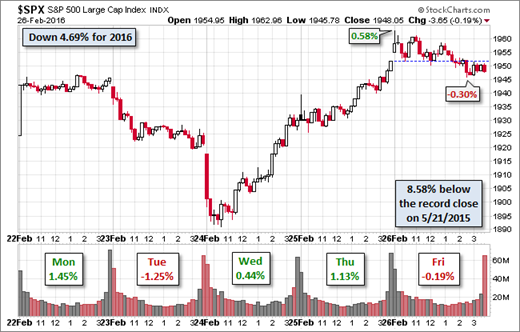
In my last WTWA (two weeks ago) I predicted a focus on the biggest market worries. That guess was not very successful, since the market immediately began a nice, two-week rally. The list of topics was still good preparation, since stories quickly turned to "what could derail the rally?" As Doug Short notes, Friday's market did not respond even when "an avalanche of economic data surprised to the upside". Once again, a modest decline in oil prices accompanied a modest decline in stocks. You can see the story in Doug Short'sweekly chart. (With the ever-increasing effects from foreign markets, you should also add Doug's World Markets Weekend Update to your reading list).
Doug's update also provides multi-year context. See his full post for more excellent charts and analysis.
We would all like to know the direction of the market in advance. Good luck with that! Second best is planning what to look for and how to react. That is the purpose of considering possible themes for the week ahead. You can make your own predictions in the comments.

This Week's Theme

Earnings season continues, and the political stories will be dominant, at least through Tuesday's elections and Wednesday morning's news. In a non-political season, this week would be all about the economy. We have more of the important reports squeezed into a single week (helped by Leap Year?) than we have seen in many months.
Recent economic news suggests improvement, at least in the U.S. At some point, a better economy will lead to better earnings and more support for stock prices. By the end of the week I expect politics to be a sideshow with focus on the economic data. Market observers and pundits will be asking:

Can economic improvement provide a foundation for equity markets?

Background

  1. Doug Short's observations about Friday's trading highlight the ambivalent response to "good news."
  2. Q1 GDP is tracking higher, as much as 2.5% according to the Atlanta Fed's GDP now reports. (James Picerno looks at this source and others).
  3. Are first quarters a "one off" over the last few years? Brian Gilmartin writes:
    Has anyone else noticed how volatile the first quarter has been the last 3 years ?
    In 2014, it was Russia driving tanks into Ukraine, the Venezuelan devaluation and profit-taking after the 32% increase in the SP in 2013.
    In 2015, it was falling crude oil, falling commodities, West Coast Port slowdown, strong dollar and even weather in February '15.
    In 2016, the volatility is the result of Financial stock volatility, European bank worries, negative interest rates, etc.
    Not one of the last three Q1's seems to be driven at all by the US economy and worries therein. Jobless claims remain strong.
    So what gives? What is it with the first quarter every year?
    I don't know, but it is always something.

Viewpoints

I expect the following to be the principal positions, with the usual vigorous support for each, ranging from bearish to bullish.
  • The reported data are flawed - a fluke, faked, subject to poor seasonal adjustments, etc. The economy is much weaker than the government claims.
  • Good news for the economy just means that the Fed will tighten sooner. Only central banks have kept the market afloat.
  • It is all about oil. Oil prices are the best economic barometer.
  • Positive economic news will reduce recession fears, helping many stock sectors.
  • Stronger economic news will lead to higher earnings estimates.
As always, I have my own opinion in the conclusion. But first, let us do our regular update of the last week's news and data. Readers, especially those new to this series, will benefit from reading the background information.

Last Week's Data

Each week I break down events into good and bad. Often there is "ugly" and on rare occasion something really good. My working definition of "good" has two components:
  1. The news is market-friendly. Our personal policy preferences are not relevant for this test. And especially - no politics.
  2. It is better than expectations.

The Good

On balance the news was very good last week, despite the market reaction.
  • Initial jobless claims remained low at 272K.
  • Q4 GDP was revised higher. This is backward looking, of course, but the revision to 1% growth suggests that the base for 2016 was a bit better.
  • Existing home sales remained strong and beat expectations - 5.47M versus 5.3M. (Calculated Risk)
  • Durable goods reversed nicely from the recent slump - up 4.9% overall and 1.8% on the core (ex-transportation).
  • Low oil prices are starting to show benefits. 
    • Gas prices continue to fall. $1/gallon coming this summer? (Oilprice.com)
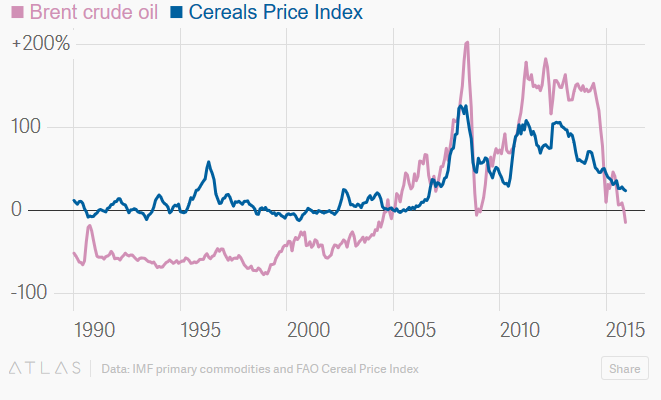
    • Reduced food costs around the world. Quartz has the story and plenty of charts showing the relationship. Christopher Groskopf calls it a "huge hidden upside."
      While the global economy's biggest players are reeling, there is a less visible group of people who stand to benefit tremendously: those without enough to eat.
      The security of the world's poor is inseparable from the price they pay for food, especially the grains that constitute most of their diet. Oil prices are a significant factor in determining the price of other commodities, including food. Tractors and other farm machinery require fuel, as does the manufacture of fertilizer. Once crops are harvested, oil prices dictate the transportation costs to get them to market, whether that's down a highway or over an ocean.
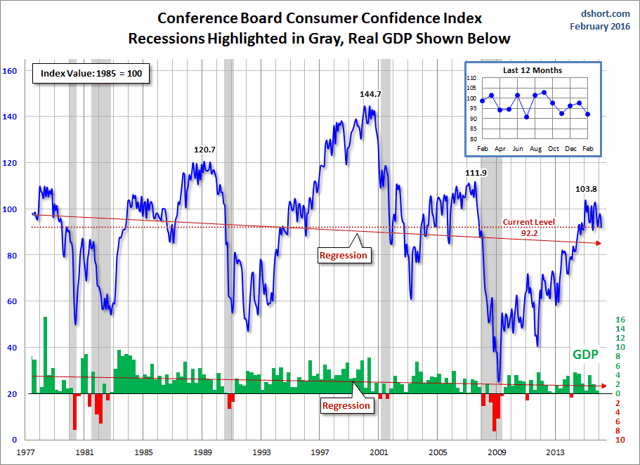
  • Michigan sentiment improved over January and slightly beat estimates. (But see Consumer Confidence below).
  • Personal income and spending both surprised with 0.5% growth. This is good news for housing and the consumer sectors. Maybe the improved employment picture and lower gasoline costs are finally having an effect.

The Bad

Some of the news was negative.
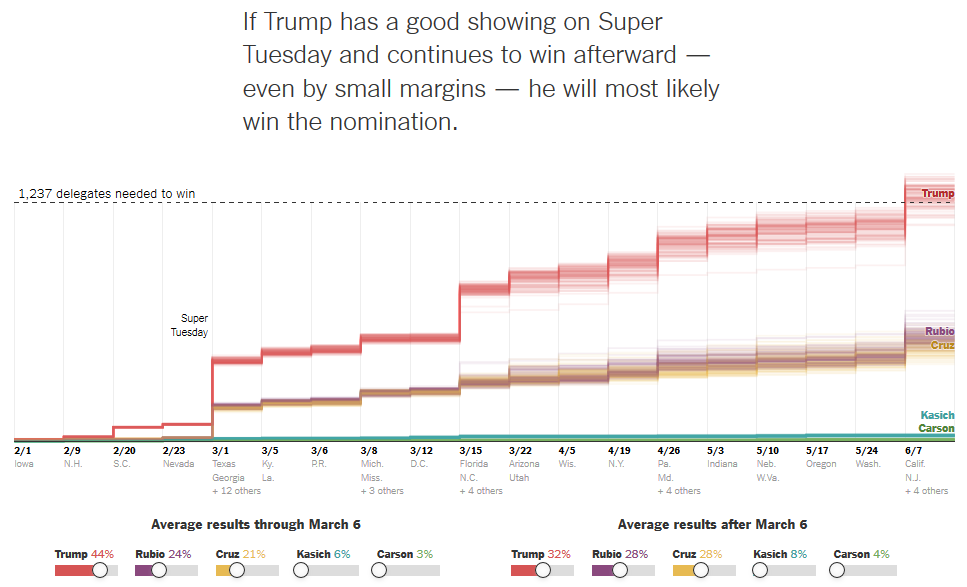
  • Leadership worries. Early primary results have favored "outsider" candidates. In my 2016 preview I said that it was far too soon to draw conclusions about the Presidential election. Things are shaping up faster than I expected. Most observers note that markets prefer establishment candidates and stable leadership. We can and should each express our own viewpoints and vote our consciences, but our personal choices may not be "market friendly." TheUpshot has an interesting interactive GOP simulator. You can plug in your own assumptions and use it to follow the news this week. They lead off with a favorable Trump scenario: