Showing posts with label Snapchat IPO. Show all posts

Friday, March 3, 2017

Opinion: How to trade Snap — if the stock goes to $10 or $100

       The company, for now, is not for investors but for traders

The short-term direction for Snap’s shares is driven by momentum, psychology and market mechanics, not fundamentals.
Snap, the parent of Snapchat, is the hottest initial public offering of the year. The company’s shares were listed this week at $17 and recently traded at $27.
So investors are naturally asking me: How do I trade Snap SNAP, +0.52% ? Will Snap become successful like Facebook FB, -0.01% ? Will Snap’s stock shoot up like Twitter’s TWTR, -0.13% only to fizzle? Since Snap is marketing itself as a video-camera company, is a comparison to GoPro’s GPRO, -4.64% IPO appropriate?
Let me first share with you how we are trading Snap for the short term at The Arora Report. Then I’ll compare Snap to those three companies, and give you my take on Snap as a long-term investment.

–– ADVERTISEMENT ––

How to trade Snap
The annotated chart shows The Arora Report’s calls on Snap. (Please click here for the annotated chart.) The posture that The Arora Report has taken is to trade the stock but not invest in it at this time. We have “just in case” defensive stops in place and are taking profits on half of the position and continuing to hold the remainder for a little longer to see if momentum drives the stock higher.
Here is the post we made available to our subscribers more than one hour before Snap started trading Thursday: “Snap IPO priced at $17 per share. The preliminary opening indication is $22. Consider stops on one-third in the zone of $19.23 to $19.38, on another third $18.63 to $18.68, and on the remaining third $16.87 to $16.97. Consider scaling out one-half of the position in the following target zones: $23 to $24.73, $26 to $26.73, and $28 to $28.43.”
Since it’s a trading position, today we have raised stops on one-half of the longer-term position to $23 to $23.38, and the remaining to $19.11 to $19.38.
Comparison to GoPro
GoPro at its core is a hardware company that markets itself as a content company. Its IPO was hotter than Snap’s. The stock shot up several fold in price and then crashed, and it now trades for under $10. Just like GoPro, Snap is marketing itself as a video-camera company, but it is different in that, at its core, it’s an advertising company. When GoPro came public, I did not hesitate to slap a $10 target on it at a time when the stock was popular and soaring. You can see my reasoning here.
When GoPro rocketed, we short sold it (in other words, bet on a decline) and ultimately generated good profits.
One analyst has already put a $10 target on Snap, citing bigger competitors, huge expenses ahead and sky-high valuations. Other analysts are more bullish.
Comparison to Facebook
Snap, as I said, is an advertising company — just like Facebook and AlphabetGOOG, -0.19%  Bulls contend that Snap can succeed just like Facebook. However, investors must note a big difference: Facebook had a wider appeal from the beginning, whereas Snap so far has appealed to a limited demographic of younger people.
At The Arora Report, we bought the Facebook IPO, took profits on the very first day and exited the trade. We bought it again at $49.92, have stayed steadfastly bullish on it, and still hold it. Please see “Market correction suggests Facebook may be the next Apple” and “Facebook ad prices double; will the stock also?”
Comparison to Twitter
Unlike Snap, Twitter had a much wider use when the IPO came about. Twitter has become a staple among journalists and politicians. Donald Trump has used Twitter effectively to become the president of the United States.
Twitter has not been able to enlarge its user base at the rate the market had expected. Twitter has also not been able to effectively monetize its users. At this time, indications are that Snap is also likely to suffer from those two issues.
At The Arora Report, we bought Twitter at the IPO, rode most of the upside and exited it before the big decline, generating handsome profits.
We have recently entered a Twitter position again.
My take on Snap
My long-time readers know well that my core principle is to be brutally honest with investors. I often tell investors what they do not want to hear. I follow the ZYX Change Method to analyze stocks. According to the ZYX Change Method, the uncertainty surrounding Snap at this time is so great that the stock is simply not analyzable as an investment with a high degree of confidence for the long run. The stock can easily go down to $10 or shoot up to $100. The short term is another story, as it is not driven by fundamentals but by momentum, psychology and market mechanics.
Our plan on Snap
We will be carefully looking for signs of wider adoption of Snap beyond its core demographics. If Snap starts gaining traction outside its core demographics, we will initiate a small investment position. On the other hand, if Snap does not gain traction on a wider scale, we will consider scaling in a short sale to profit from a potential decline.
By Nigam Aurora

Thursday, March 2, 2017

Snap soars about 50% out of the gate


Snap started trading at $24 a share on the New York Stock Exchange on Thursday, rising 41.2 percent from its pricing at the open.
About 100 million shares changed hands in the first 30 minutes of trading — by far the most active stock on the NYSE — after it opened shortly before 11:20 a.m. on Thursday in New York. The stock last traded around $25 a share, up about 48 percent, around 3 p.m. ET.
The company, trading under the ticker SNAP, priced its 200 million share public offering at $17 a share on Wednesday. The IPO was 12 times oversubscribed, sources said.
The opening price of $24 puts the company's market capitalization at about $33 billion, about the size of Marriot and Target. Twitter's market cap is about 11 billion, while Facebook's is about $395 billion.
The young ephemeral photo messaging company posted a $515 million loss last year. Nonetheless, investors have bet on its quickly growing revenue and visionary leader, 26-year-old co-founder CEO Evan Spiegel.
Snapchat co-founders Bobby Murphy, left, and CEO Evan Spiegel sign a guest book at the New York Stock Exchange as Snap celebrates its IPO, Thursday, March 2, 2017.
Mark Lennihan | AP
Snapchat co-founders Bobby Murphy, left, and CEO Evan Spiegel sign a guest book at the New York Stock Exchange as Snap celebrates its IPO, Thursday, March 2, 2017.
Spiegel arrived at the stock exchange on Thursday morning to ring the bell, with supermodel fiancee Miranda Kerr in tow, documenting with pictures on the app.
The Venice, California-based company, which serves augmented reality and cinematic advertisements to its young adult audience, could be a bellwether as other start-up giants, such as Airbnb and Uber, mull a public offering.
Snap enters the public market a day after the three major U.S. stock indexes posted their best session of the year.
Here's how the company stacks up so far to other big techIPOs, according to CNBC analysis of data from FactSet and Renaissance:
  • Facebook went public on May 18, 2012, priced at $38 per share. It gained only 0.61 percent in its debut closing at $38.23. 
    -Deal Size: Almost $16 billion
  • Twitter went public on Nov. 7, 2013, priced at $26 per share. It gained 72.69 percent in its debut closing at $44.90. 
    -Deal Size $1.82 billion (shares used to calculate do not contain the overallotment)
  • Alibaba went public on Sept. 19, 2014, and priced at $68 per share. It gained 38.07 percent in its debut closing at $93.89. 
    -Deal Size $21.77 billion (not including overallotment or green shoe)
  • LinkedIn went public on May 19, 2011, and priced at $45 per share. It doubled in its debut, gaining 109.44 percent to close at $94.25. 
    -
    Deal size $352.8 million


Source:http://www.cnbc.com/2017/03/02/snapchat-snap-open-trading-price-stock-ipo-first-day.html

Wednesday, March 1, 2017

Wall Street Breakfast: Snap Pricing On Stage Tonight

Image result for snapchat l

 Includes: AAPL, AMTD, AMX, AMZN, BAYRY, BJK, BRK.A, BRK.B, CRM


Image result for snapchat spectaclesSnap will price its IPO after today's market close in the most eagerly awaited tech offering since Alibaba (NYSE:BABA) went public in 2014. Reports suggest pricing could be $1-$2 above its $14-$16 marketing range, which would result in a valuation of $19.5B-$22.3B from listing on the NYSE. In September, the company changed its name to Snap (Pending:SNAP) from Snapchat to reflect its intent to branch out into myriad products, like Spectacles and a recently reported drone.

Click button on the left bar to purchase SnapChat spectacles
Economy
U.S. futures are flying higher following Donald Trump's first address to Congress. The President pledged to overhaul the immigration system, improve jobs and wages for Americans, and promised "massive" tax relief to the middle class and tax cuts for companies. He also plans to ask Congress for $1T in infrastructure investment - guided by "Buy American and Hire American" - and laid out some principles for an Obamacare replacement.
Rate hike probability keeps rising... San Francisco's John Williams said yesterday that an interest hike will be under "serious consideration" in March, while New York's William Dudley feels the case for tightening "has become a lot more compelling." All eyes are now on today's speech from Fed Governor Lael Brainard, who has been one of the most vocal advocates on the board for a slower interest-rate path.
Activity in China's manufacturing sector expanded in February, according to twin surveys, continuing the recovery seen since the second half of last year. The official PMI, compiled by the government's National Bureau of Statistics, found activity rising to a three-month high of 51.6, up from 51.3 in January. The unofficial Caixin PMI - which has a greater representation of private enterprise - rose to 51.7 vs. 51.0 on a seasonally adjusted basis.
Two former officials and a retired judge have won the right to compete to become the next leader of Hong Kong, a job that requires balancing the demands of Communist Party rulers in Beijing and growing calls for democracy at home. Former civil service chief Carrie Lam grabbed the most nominations out of a 1,200-strong committee stacked mostly with Beijing loyalists. The same committee will pick the next leader in a secret ballot on March 26.
In a press conference minutes ago, Francois Fillon confirmed he will continue in the race to become the next French president. The announcement came after he postponed his visit to the Paris Agricultural Salon, an important fixture on the campaign trail, and followed reports that his campaign manager stepped down. Fillon has been summoned by investigating magistrates over a "fake work" scandal, an inquiry he criticized as a "political assassination."

Stocks
An outage at Amazon Web Services' S3 storage service disrupted internet traffic across the U.S. on Tuesday, showing the increasing power cloud companies are having over large portions of the web. "For S3, we believe we understand root cause and are working hard at repairing," AWS said in its most recent tweet. Despite the major disruption, Amazon (NASDAQ:AMZN) shares only dropped about half a percent yesterday on the news.
Apple has some products other than the iPhone on the horizon that are "essential to Apple's (NASDAQ:AAPL) growth," CEO Tim Cook said at the company's annual shareholder meeting. The tech giant is investing a "fair amount" into R&D, including "future stuff [he] can't talk about." Cook didn't go into details, but lauded investors for thinking long term, especially Warren Buffett's Berkshire Hathaway (BRK.A, BRK.B).
At the Economic Club of Washington, General Motors (NYSE:GM) CEO Mary Barra said the automaker was exploring opportunities with PSA Group (OTCPK:PEUGF), but didn't talk about a sale of Opel, which has lost money for 16 straight years. Some reports in Europe have suggested GM could have a deal with PSA as early as next week, but Barra declined to discuss a timetable.
CEO Travis Kalanick said he would seek leadership advice after a run of troubling news involving UBER, capped by a recent video of him berating one of the ride-hailing service's drivers. In a note to employees, Kalanick vowed to "grow up" and said he was "ashamed" of the behavior captured by Fawzi Kamel's dashboard camera. "This is the first time I've been willing to admit that I need leadership help and I intend to get it."
Fidelity blew up the online brokerage sector yesterday after cutting stock and ETF trading commissions to $4.95 from $7.95, following Schwab (NYSE:SCHW), which slashed its commissions to $6.95 from $8.95 in early February. Hit hardest was TD Ameritrade (NASDAQ:AMTD), which tumbled 10.5%, and immediately announced a cut in its commissions to $6.95 from $9.99. Other downward movers: E*Trade (NASDAQ:ETFC) -7.3%; Schwab (SCHW) -3.2%; Interactive Brokers (NASDAQ:IBKR) -2.6%.
Deutsche Boerse's chief executive said it was regrettable that LSE (OTCPK:LNSTY) had decided not to sell its trading platform MTS, all but ending a planned merger, but the German group could continue on its own. "We feel very well prepared as a company for the future," DB's (OTCPK:DBOEY) Carsten Kengeter declared, adding that "it's pointless to me to speculate on what the reasons behind our merger partner's decision were."
Gambling revenue in Macau surged almost 18% to 23B patacas ($2.9B) in February as more visitors came to the Chinese territory over the national new year holiday. Macau's gambling revenues have also been rising over the past seven months, buoyed by the opening of multi-billion dollar casinos by Sands China (OTCPK:SCHYY) and Wynn Macau (OTCPK:WYNMY). Related tickers: BJK, MPEL, MGM, OTCPK:MCHVF, OTCPK:MCHVY, OTCPK:GXYEF, OTCPK:SJMHF, OTCPK:SJMHY
Bayer's gain is Covestro's pain... Shares in Covestro (OTCPK:CVXTY) tumbled as much as 8.5% overnight after Bayer (OTCPK:BAYRY) placed 22M shares of the plastics company, which nearly tripled since the spinoff of the business. The sale will allow Bayer to reduce its debt pile and help fund the takeover of Monsanto (NYSE:MON), however, the placement at €66.5 a share is well below Covestro's closing price on Tuesday.
Looking to boost profitability over the next two years, Hershey (NYSE:HSY) plans to eliminate 15% of its global workforce, or around 2,700 jobs. The Pennsylvania chocolatier and other food makers have struggled in recent years with changing eating habits in the U.S. and slower economic growth in emerging markets. Hershey hopes the move will help it reach an adjusted operating profit margin as high as 23% by the end of 2019.
The chief executive of Unilever, the consumer goods group that recently rebuffed a $143B takeover proposal from Kraft Heinz (NASDAQ:KHC), was paid 20% less last year than in 2015, taking home €8.4M. The decrease follows a change in targets from long-term incentive schemes. Unilever's (UN, UL) Paul Polman has often said he would work for free and is "embarrassed" by the amount he is paid.
Mexico's telecoms regulator has discussed forcing Carlos Slim to legally separate part of his fixed-line unit Telmex from the rest of the company, a move that would intensify antitrust rules against the business. On Monday, its board voted on whether to toughen, maintain or loosen rules against America Movil (NYSE:AMX) and Grupo Televisa (NYSE:TV), and sources told Reuters they expected the proposal was on the table.
Shares of Time climbed almost 5% during extended trading after Bloomberg said the magazine company asked a number of suitors to submit their final acquisition offers by next week. According to the report, five parties have expressed interest in purchasing the firm. Two potential TIME buyers are Meredith Corp. (NYSE:MDP) and an investor group led by Edgar Bronfman Jr., while one of the other three bidders is a publicly traded company.
YouTube has unveiled a web-TV service that will offer a package of over 40 broadcast and cable channels for $35 a month, making the tech giant the latest entrant in a race to win over millions of consumers who are shifting away from traditional TV. The new service, dubbed YouTube TV (GOOG, GOOGL), is set to launch in the next few months.
Sinclair Broadcast Group has approached Tribune Media (NYSE:TRCO) for discussions about combining the companies, Reuters reports. Such a tie-up would create a sizable local broadcast station owner, with a combined market cap of about $6.6B. Aside from a straight merger, Sinclair (NASDAQ:SBGI) could be interested in parts of Tribune, such as its CW stations or the WGN America cable network. TRCO +4.5% premarket.
Tuesday's Key Earnings
Cheniere Energy (NYSEMKT:LNG) -1.8% missing earnings estimates.
Etsy (NASDAQ:ETSY) -4.4% AH following a Q4 loss.
Palo Alto Networks (NYSE:PANW) -20.4% on weak guidance.
Salesforce (NYSE:CRM) -1.4% AH giving a soft outlook.
Seadrill (NYSE:SDRL) -14.2% after a Chapter 11 warning.
Target (NYSE:TGT) -12.2% plagued by its brick-and-mortar model.
Valeant Pharmaceuticals (NYSE:VRX) -13.9% cutting guidance.
Today's Markets 
In Asia, Japan +1.4%. Hong Kong +0.2%. China +0.2%. India +0.8%.
In Europe, at midday, London +0.9%. Paris +1.4%. Frankfurt +1.3%.
Futures at 6:20, Dow +0.4%. S&P +0.5%. Nasdaq +0.6%. Crude +0.2% to $54.12. Gold -0.7% to $1244.70.
Ten-year Treasury Yield +7 bps to 2.43%
Today's Economic Calendar
Companies reporting earnings today »


Tuesday, February 14, 2017

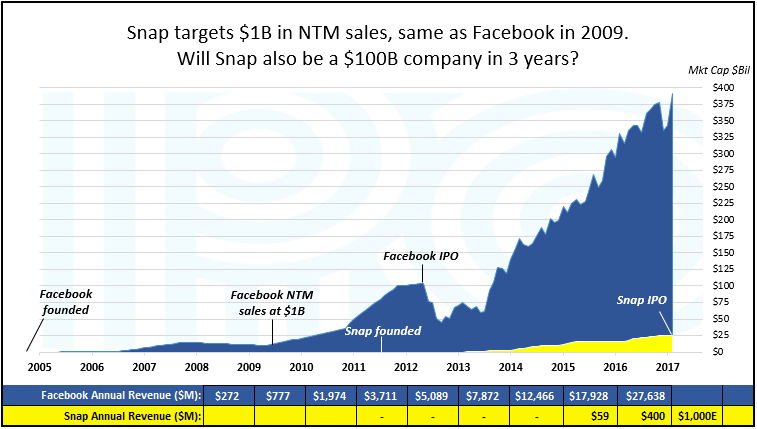
Snap Has A Rumored Valuation Of $25 Billion. Could It Be $100 Billion In A Few Years?

Related image

Snap (Pending:SNAP) hopes its estimated 2017 sales of about $1 billion, up 150% from 2016, will be enough to justify a rumored $25 billion price tag. That valuation hinges on investors' confidence that it can increasingly monetize a fast-growing user base (check out Snap's key stats), following in the footsteps of rival Facebook while avoiding the pitfalls that plagued Twitter.
In the middle of 2009, Facebook (NASDAQ:FB) was on track for $1 billion in sales over the next 12 months, and three years later it went public at a valuation of $104 billion. Now that Snap is nearing the $1 billion mark, public investors who think it's the next Facebook may buy into Snap's $25 billion valuation on its potential for a 300% return over three years.

About this article:

Expand


Monday, December 26, 2016

Corralling the Unicorns: Nasdaq and NYSE Work to Court the Next Blockbuster IPO

TheStreet talks to representatives from the exchanges to explore what they are doing to entice companies, especially ahead of a number of big potential tech listings.

Related image

The four-year-old parent company of Snapchat - Snap Inc. has held meetings with potential investors in the weeks leading up to its much-anticipated initial public offering, the Wall Street Journal reported Monday. The meetings came after the company confidentially filed paperwork on Nov. 15, with Morgan Stanley (MS) and Goldman Sachs Group (GS) as the lead underwriters, for an IPO that could value the company at as much as $25 billion.
Snap was eligible to file its paperwork for IPO confidentially due to the 2012 Jumpstart Our Business Startups Act, which allows companies with annual revenue below $1 billion to have the option to file an initial draft of their IPO prospectus with regulators at the Security and Exchange Commission and make necessary adjustments before unveiling it publicly.


Snap's likely $25 billion IPO, the biggest since Chinese e-commerce giant Alibaba Group (BABA) made its IPO debut at a $168 billion valuation in 2014, is expected to revitalize what has been a dismal year for tech IPOs. Statistics from data provider Dealogic shows that only 103 companies have listed their shares in the U.S. in 2016, raising a total of $21.8 billion.
As talks of Snap's highly coveted IPO have finally come into fruition, the social media company's decision on where it will lis is also something to watch as the rivalry between America's largest exchanges presses on. (no details on the exchange were given in the Journal's report and Snap did not immediately respond to requests for comment) 
Editors' Pick: This article was originally published on Nov. 16 and has been updated to reflect recent news about Snap's IPO plans.
Although Nasdaq has remained favorable with tech companies, the rivalry between Nasdaq and the NYSE has only become fiercer over the years as more than 60% of tech companies have chosen to list on the NYSE over the last four years compared to when in 2006 it only had 12% of all tech IPOs . Companies like Twilio (TWLO) , Square (SQ) , Line (LN) and GoDaddy (GDDY) have run counter to preconceived notions to join Twitter (TWTR) , Yelp (YELP) , Box (BOX) , and Oracle (ORCL) on NYSE. The race between the two exchanges continues to heat up.
Snap, the parent of popular instant photo-messaging app, Snapchat, which boasts more than 150 million active daily users is expected by many to choose the Nasdaq as its listing site just as former tech darling Facebook (FB)  had done. But as many experts say, the choice is less of a foregone conclusion as the New York Stock Exchange has implemented a number of changes over the past few years and presents a number of benefits over the Nasdaq. Still, Nasdaq is no slouch and the competition will certainly take place to land one of the most high profile listings in recent history.
So, how do companies choose which exchange to list on and what benefits do each provide? How did the Nasdaq become the defacto destination for tech companies and how is the NYSE competing with its uptown brethren? There are a number of reasons.
Although Nasdaq has had a higher number of tech IPOs, the ones that succeeded in raising the vast majority of capital to help companies grow, expand their businesses, pay down debt or provide meaningful liquidity events for investors have almost exclusively listed on the NYSE, according to John Tuttle, Global Head of Listings at the New York Stock Exchange. Year-to-date, companies that have listed on the NYSE have raised $11.3 billion from 33 IPOs while Nasdaq won 81 of the 111 IPOs this year (73% win rate) raising $9.4 billion.
"The majority of companies on Nasdaq are actually quite small. If you look at the median market cap, if you look at all of the companies listed on the stock exchange, and all of the companies listed on Nasdaq, the median cap for companies listed on the NYSE is roughly $2.4 billion, for Nasdaq it's under $300 million," said Tuttle. 
Back in the 80s and 90s, the NYSE focused on older and more established blue chips companies, its stringent and restrictive rules disqualified many of the then up-and-coming tech companies.
"In 1983 the tech companies were just starting to grow. They weren't big enough to pass the listing requirements on the American and New York [stock exchanges]. By the time they were big enough to switch, the rule had changed and Nasdaq effectively convinced them that. They now offered the same trade info as the other exchanges so switching wouldn't get them much," said Daniel Weaver, professor of finance at Rutgers Business School.
"I have taken three technology companies public, all of them on Nasdaq. Over the past decade, Nasdaq has consistently demonstrated their alignment with Coupa's core values of ensuring customer success, striving for excellence, and focusing on results. Thus, the partnership is a natural fit," said Todd Ford, CFO at Coupa Software (COUP) , which went public in October raising about $133 million.
"We've been in the Silicon Valley for 25 years. If you look at the companies that are listed in the Western region that I oversee, the market cap of all those combined companies is $4 trillion," said Jeff Thomas, Vice President and Head of Western Region Listings at Nasdaq.
Nasdaq has continued to attract technology-focused companies since its inception in 1971 as the world's first electronic stock exchange. According to recent statistics from the Nasdaq, 82 percent of technology IPOs have listed with Nasdaq so far this year, with 91 percent of them being venture-backed new listings.
"Many tech companies like the aura associated with the many successful tech companies that listed on Nasdaq and never left, such as Apple (AAPL) , Alphabet (GOOGL) , Facebook, Microsoft (MSFT) , and Amazon (AMZN) , the top 5 market cap stocks," said Jay Ritter, finance professor at the University of Florida.
Although it is hard to pick a clear-cut exchange winner in the tech IPO space of 2016, as a strong pipeline of big tech names like Uber, Airbnb, Pinterest, Spotify and Dropbox are expected to come to the public market, the race between Nasdaq and NYSE to win over and seat those companies is not going to slow down anytime soon.
Alphabet, Apple and Facebook are holdings Jim Cramer's Action Alerts PLUS Charitable Trust Portfolio. Want to be alerted before Cramer buys or sells GOOGL, AAPL or FB? Learn more now.

Source :https://www.thestreet.com/story/13861757/1/corralling-the-unicorns-nasdaq-and-nyse-work-to-court-the-next-blockbuster-ipo.html