Showing posts with label Economic outlook. Show all posts

Monday, April 24, 2017

Weighing The Week Ahead: Time To Rebuild The Wall Of Worry?

Summary
Economic and earnings news remain positive; the market has responded.
Attention is turning to concerns like a possible government shutdown, the delays in the Trump agenda, and the French election.
Crash predictions abound.
A good supply of widely-known worries is bullish.  When we seem to be out of problems, that is the time to worry!
There are plenty of good stock and sector ideas.
Image result for businessman using binoculars
As some market worries have been put to rest, there is a growing appetite for new ones. Pundits who say that things look OK are not very exciting. Last week we saw a shift in attention. Despite healthy earnings and good economic data, I expect pundits to be asking:
What should investors be worried about?
Personal Note
No WTWA next weekend. If something major happens, I’ll post some thoughts. Would readers find it helpful to have an update of the indicators even when I am away?
Last Week
Last week the economic news was good, but mostly ignored.
Theme Recap
In my last WTWA I predicted a week focused on geopolitical risks. Despite some attention to earnings, economic data, and the latest Trump Administration pronouncements, that proved to be a reasonable guess.
The Story in One Chart
I always start my personal review of the week by looking at a chart of market performance for the week. There was little change for the week. The Thursday rebound was attributed to comments suggesting quicker movement on a tax reform package. If we measure the gain from the prior week’s close it is about 0.80%.
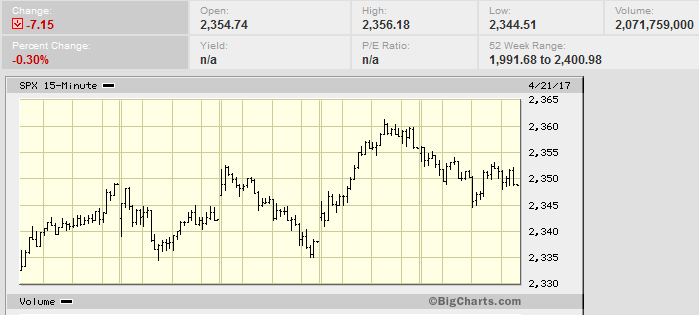
Whatever the news, the net market effect was (once again) very small.
The News
Each week I break down events into good and bad. Often there is an “ugly” and on rare occasion something very positive. My working definition of “good” has two components. The news must be market friendly and better than expectations. I avoid using my personal preferences in evaluating news – and you should, too!
Once again, the economic news last week was good. The market got a little boost.


Image result for mother's day giftsImage result for mother's day gifts
Shop AMAZON For Mother's Day Gifts: https://goo.gl/bv4TND
The Good
  • Trucking data is improving despite the mixed headline data. Steven Hansen (GEI) explains.
  • Mortgage delinquencies declined to an 11-year low. (Calculated Risk).
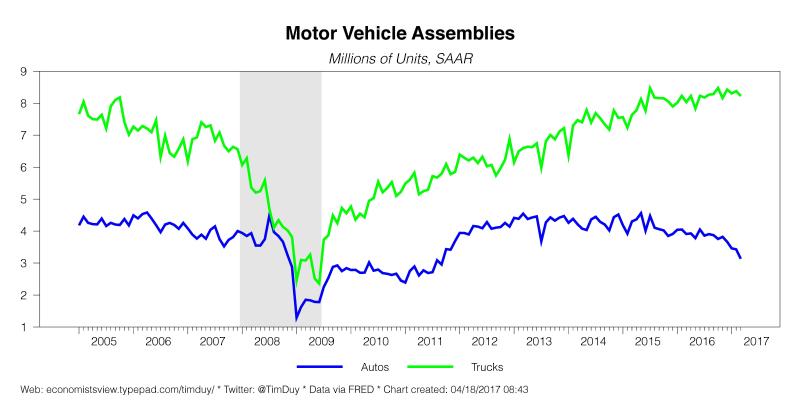
  • Industrial production rose 0.5%. Eddy Elfenbein notes the weakness in factories and the strength in utilities. Tim Duy also takes a closer look, noting the weakness in autos and the strength in utilities. He also cites the American interest in larger cars.
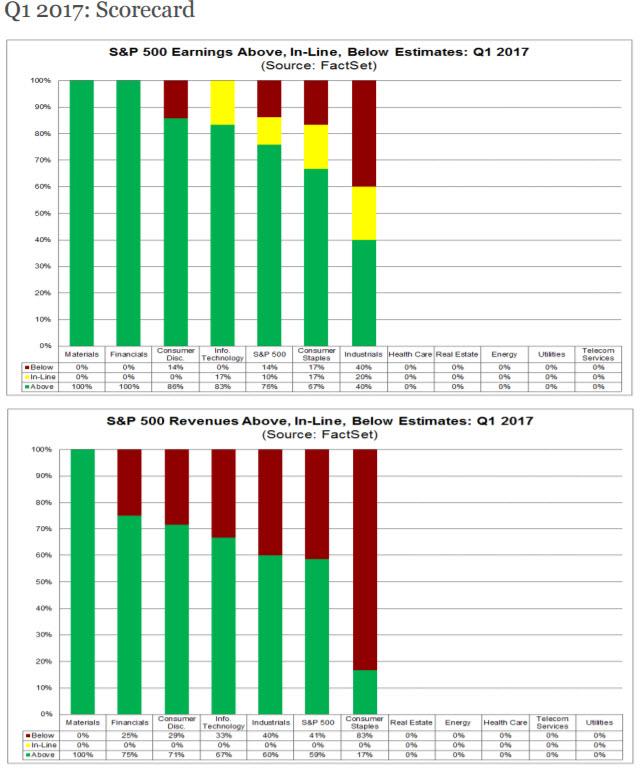
  • Q1 Earnings. FactSet notes that reports are beating the historical metrics. Brian Gilmartin calls attention to the lag in energy stocks. Here is the key quote from John Butters:
To date, 6% of the companies in the S&P 500 have reported actual results for Q1 2017. In terms of earnings, more companies (76%) are reporting actual EPS above estimates compared to the 5-year average. In aggregate, companies are reporting earnings that are 6.7% above the estimates, which is also above the 5-year average. In terms of sales, more companies (59%) are reporting actual sales above estimates compared to the 5-year average. In aggregate, companies are reporting sales that are 0.2% above estimates, which is also above the 5-year average.
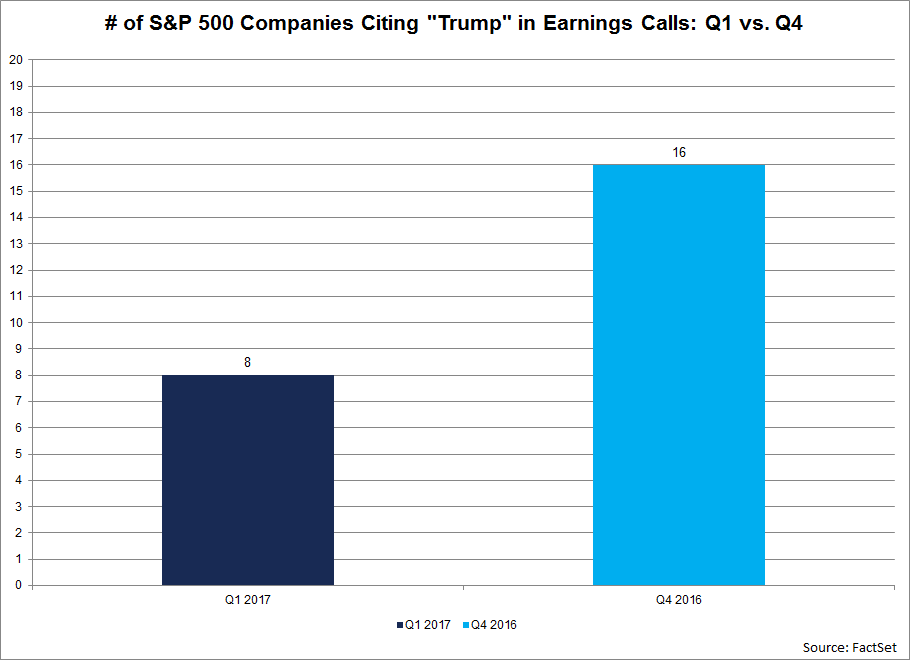
And fewer companies are citing President Trump as a factor. It is a small sample so far, but interesting to watch.
  • Philly Fed remained strong with a reading of 22. This is especially good for a diffusion index, which measures month-over month changes. We cannot expect the pace of increases to be maintained. Few understand this and fewer mention it.
  • Initial jobless claims rose to 244K, which some may see as bad. Most follow this noisy series via the four-week moving average, which moved lower.
  • Existing home sales were up 4.4%. Calculated Risk notes that warmer weather was a factor. Bill also expects increasing inventory, which will help future sales.
  • Chinese economic growth was 6.9%, beating expectations. (FT)
The Bad
  • Hotel occupancy rates declined by 4.6%. Calculated Risk reports and notes the possible effect of a shift in Easter from March in 2016 to April in 2017.
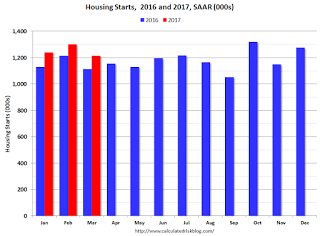
  • Housing starts declined from February, but increased 9.2% over last year’s easy comparison. Overall, starts are up 8.1% YTD. Calculated Risk is sticking with a forecast of a 3% to 7% gain for the year. Check out the post for a solid discussion of this difficult series.
The Ugly
Following up on an item from last year, cell phone use by drivers is nearly universal. Sensor data show that the phones are used in 88% of trips.
Blowing up a soccer team’s bus to make money on the team’s stock options is also ugly.
The Silver Bullet
I occasionally give the Silver Bullet award to someone who takes up an unpopular or thankless cause, doing the real work to demonstrate the facts. No award this week, but nominations are always welcome. There are many bogus claims and charts out there!
This week I was especially disappointed with coverage – even by mainstream media – of the IMF report on world financial risk. From most of the stories you would never know that risk had decreased. One major source even reposted a typical ZH piece – no links, poor writing, extensive quotes without citations, etc. Sadly, many more people read this than the original report or any unbiased accounts.
The Week Ahead
We would all like to know the direction of the market in advance. Good luck with that! Second best is planning what to look for and how to react. That is the purpose of considering possible themes for the week ahead. You can make your own predictions in the comments.

Tuesday, February 14, 2017

Deutsche Bank's 2017 Outlook Weighs Trump's Upside Against Brexit Downside

A stimulus package from U.S. President-elect Donald Trump will boost growth in the U.S. and beyond, Deustche Bank economists say, with Brexit paring some of the benefits for Europe.


For politicos, 2016 was a tale of two populist shocks: Republican real estate mogul Donald Trump's victory in the U.S. presidential race and Great Britain's decision to leave the European Union.
In 2017, the fallout from those two votes will play a pivotal role in determining economic growth in much of the western world, according to assessments from Deutsche Bank (DB) economists. A stimulus from President-elect Trump and the Republican-controlled Congress should drive expansion by U.S. businesses and consumers, which will, in turn, benefit U.S. trading partners. 
In Europe, however, the benefits of that growth will be pared somewhat by confusion about how and when Great Britain's departure from the 28-member bloc will take place.
"The key thing for Europe, as you all know too well, unfortunately, is political uncertainty," Torsten Slok, Deutsche's chief international economist, said in a conference with reporters Thursday in New York. Still, he said, "sentiment is coming back with Trump, and sentiment is very important for the outlook because we're hoping it will unleash the animal spirits."
Indeed, markets in the U.S. have already surged since the Nov. 8 election, with the Dow Jones Industrial Average and the Standard & Poor's 500 each reaching record highs.
"The Trump election was a game-changer," said Joseph Lavorgna, chief U.S. economist for Deustche. "It brought fiscal policy back into focus. Consensus had determined, and I think rightly so, that that was significantly paralyzed."
In government circles, fiscal policy refers to attempts to boost the economy through government stimulus, typically via tax cuts or spending on infrastructure such as highways and bridges. Such measures were virtually sidelined due to Congressional wrangling with Democratic President Barack Obama for six of his eight years in office.
Republicans took control of the House of Representatives in 2010, two years after Obama was elected, and regained the Senate four years later.
While it's still difficult to say what contours a stimulus might take, "you have to assume it will be something of some scale, simply because Republicans have both houses," Lavorgna said. "That's something Reagan didn't have when he was inaugurated in 1981 and Bush 43 didn't have when he was inaugurated in 2001."
Ronald Reagan, the 40th U.S. president, and George W. Bush, the 43rd, both pushed economic stimulus programs early in their terms. Reagan's was intended to end the economic malaise of the 1970s and Bush's to curb the effects of the dot-com bubble bursting.

"There's a lot of room for compromise and for there to be a lot less gridlock," Lavorgna said. "If you overlay that, at least tonally, with what will probably be a somewhat more friendly regulatory backdrop, you can see how the animal spirits of the cycle change and how this really does alter the outlook."
The growth-friendly policies most likely to be green-lighted under Trump and a Republican Congress are tax cuts, probably based on the outline in House Speaker Paul Ryan's blueprint, and easing some of the federal regulations that were tightened under the Obama administration, Bank of America (BAC) economists said at a conference last week.
Ryan's plan, published in June, suggested cutting personal-income tax brackets from seven to three and capping rates at 33% instead of the current 39.6%. Corporations would fare even better, with rates lowered to 20% from the current 35%, the largest reduction in U.S. history.
That won't eliminate the overhang of generally slower growth in western economies than in the past three decades, however, a trend that consulting firm McKinsey & Co. has said is largely due to an aging population and declining productivity gains.
And while the stimulus will probably help overseas companies that supply U.S. businesses and consumers, it won't eliminate the political challenges in Europe, where the central bank has approved negative interest rates to encourage banks to lend.
STOCKS TO BUY: TheStreet Quant Ratings has identified a handful of stocks with serious upside potential in the next 12-months. Learn more.
There, "2017 looks set to be a year to be endured rather than enjoyed, at least for the first half, when the heavy political calendar and related uncertainty" is likely to curb growth, Deutsche chief economist Mark Wall said in a note to clients on Wednesday.
Great Britain appears likely to start the process of leaving the European Union as soon as March, and "an economic cost seems unavoidable," Wall said. The clearer the cost, however, "the more salutary the warning to others tempted to exit. It will be some time before we know if the EU gets the balance right."
That could be of crucial importance in France, one of Europe's three biggest economies, where presidential candidate Marine Le Pen of the National Front is promising a referendum like Britain's on leaving the European Union.
Elections are also scheduled in Germany and the Netherlands, and an early election is possible in Italy, "each with different concerns over the influence of right-wing populists," Deutsche economist Patricia Wruuck said in a Wednesday note.
"Trump's win could further embolden nationalism in Europe, fueling fragmentation and bedeviling concise responses to Europe's challenges," she added.
The risks to the region's economy shouldn't be overstated, however. Its businesses are in much better shape than generally realized, Slok told reporters Thursday.
"There is an under-appreciation of the strength of Corporate Europe and the strength of the European economies simply because it's overshadowed so much by the political challenges that continue to be such a headwind," he said. "That doesn't mean political challenges are going to create recession."

By James Langford

Source: https://www.thestreet.com/story/13927630/1/deutsche-s-2017-outlook-weighs-trump-s-upside-against-brexit-downside.html