Showing posts with label Investment Opportunity. Show all posts

Tuesday, October 3, 2017

Pressure BioSciences, Inc. Issued First Two Patents on Widely-Applicable, High Pressure-Based Ultra Shear Technology

Image result for Pressure BioSciences, Inc

Company Believes UST Can Be Used to Create or Improve a Broad Range of Medical, Consumer, and Industrial Products through the Preparation of High-Quality Nanoemulsions and Safe “Clean Label” Food

SOUTH EASTON, MA., (Uptick Newswire – October 2, 2017) – Pressure BioSciences, Inc. (OTCQB: PBIO) (“PBI” and the “Company”), a leader in the development and sale of broadly enabling, pressure cycling technology (“PCT”)-based sample preparation solutions to the worldwide life sciences industry, today announced they have been issued two utility model patents in China: No. WO2016160667-PBI (“System for High Pressure, High Shear Processing of Fluids”) and No. WO2017044590-PBI (“Ultrahigh Pressure Compact Valve with Throttling Capability”). The patents have also been filed in many other countries worldwide.
UST is a novel technique based on the use of intense shear forces generated from ultra-high pressure valve discharge. UST is driven by pressure levels greater than 20,000 psi. The Company believes that UST has the potential to play a significant role in a number of commercially important areas, including the formulation of high quality stable nanoemulsions and the preparation of extended shelf-life “clean label” food.
For more information about the Company’s PCT platform, the newly-issued UST patents, and the potential use of UST in the formulation of nanoemulsions and the preparation of clean label food, please click on the following link: www.investorcalendar.com/event/20351.


About Nanoemulsions
Emulsions are mixtures of two or more liquids (e.g., oils in water) that cannot be blended into each other without the addition of chemicals called emulsifiers (e.g., surfactants). Emulsions are used in multiple products in everyday use, including food, medical products, pharmaceuticals, nutraceuticals, cosmetics, industrial lubricants, and even cannabis oil extracts (e.g., CBD). Scientific studies indicate that improved absorption, higher bioavailability, greater stability, lower surfactant levels, and other advantages can be achieved with nanoemulsions when compared to standard macro- and micro-emulsions.
Dr. Nate Lawrence, Vice President of Marketing and Sales at PBI, commented: “Because of their clear advantages over more traditional emulsions, nanoemulsions are currently the focus of numerous research programs worldwide. Nanoemulsions are creating much excitement and expectations across a number of important market segments, including nanomaterials manufacturing, medical imaging, drug delivery, nutraceuticals, cosmetics, and food. Unfortunately, cost-effective, highly-stable nanoemulsions with minimal or no use of surfactants are difficult to produce.”
Dr. Lawrence continued: “We believe that aqueous nanoemulsions could dramatically increase absorption and bioavailability of non-polar, water-insoluble molecules like Vitamin A, Vitamin C, CBD and other extracts of cannabis plant material, and a host of other similar molecules. Consequently, the ability to efficiently make high quality, aqueous nanoemulsions with minimal or no use of surfactants could potentially lead to the safe and effective oral delivery of stable medical products for many molecules where absorption and bioavailability are issues today.”

About “Clean Label” Food
Today’s health-conscious consumers demand food that is safe, tastes good, and looks appealing while being minimally processed, highly-nutritious, microbiologically safe, and free of chemical emulsifiers and preservatives. Consequently, food processors are seeking and embracing new, minimally or non-thermal technologies that can provide extended shelf-life, while meeting “clean label” requirements and consumer expectations. The current clean label food market has been estimated at approximately $62 billion in the USA and $165 billion worldwide (Nunes, 2016). A number of clean label foods are currently processed using high-pressure treatments, including many juices (e.g., Starbuck’s Evolution line), seafood, meats, baby food, and fruits/vegetables. In 2015, the worldwide market for high-pressure processed (“HPP”) food was estimated at $10 billion (Toops, 2016).
Dr. Edmund Y. Ting, Sr. VP of Engineering at PBI, a pioneer in the development of HPP and a co-inventor of UST, said: “HPP is very effective in reducing food-borne pathogens and extending shelf-life in pre-packaged foods (e.g., juices and ready-to-eat meats), thus eliminating the need for chemical additives. However, HPP remains a batch process that is not capable of continuous flow, cost-effective production of low-acid food such as milk, liquid cheese, and mayonnaise, especially if they are to be shelf stable.”
Dr. Ting continued: “UST uses ultra-high pressures to generate intense shear forces under controlled temperature conditions to produce nanoemulsions with significant reductions in food-borne pathogens, perhaps reaching sterilization. Evidence suggests that under such extreme conditions, even bacterial spores can be inactivated. This leads to the potential for continuous production of extended shelf-life or room temperature stable, low-acid liquid foods. Thus, because of its importance worldwide, our initial focus will be to evaluate UST for the production of high-quality dairy products and beverages with superior consumer appeal and shelf life.”


About Pressure BioSciences, Inc.
Pressure BioSciences, Inc. (“PBI”) (OTCQB: PBIO) develops, markets, and sells proprietary laboratory instrumentation and associated consumables to the estimated $6 billion life sciences sample preparation market. Our products are based on the unique properties of both constant (i.e., static) and alternating (i.e., pressure cycling technology, or “PCT”) hydrostatic pressure. PCT is a patented enabling technology platform that uses alternating cycles of hydrostatic pressure between ambient and ultra-high levels to safely and reproducibly control bio-molecular interactions. Our primary focus is in the development of PCT-based products for biomarker and target discovery, drug development and design, bio-therapeutics characterization, soil & plant biology, forensics, and counter-bioterror applications. Major new focal market opportunities are emerging in the use of our patented, scalable, high-efficiency Ultra Shear Technology (“UST”) to create stable nanoemulsions of otherwise immiscible fluids (such as oils and water), and to prepare homogenized, extended shelf-life or room temperature stable, low-acid liquid foods that cannot be effectively prepared using existing, FDA-approved, high-pressure processing (“HPP”) technologies.
Forward-Looking Statements
Statements contained in this press release regarding PBI’s intentions, hopes, beliefs, expectations, or predictions of the future are “forward-looking” statements within the meaning of the Private Securities Litigation Reform Act of 1995. These statements are based upon the Company’s current expectations, forecasts, and assumptions that are subject to risks, uncertainties, and other factors that could cause actual outcomes and results to differ materially from those indicated by these forward-looking statements. These risks, uncertainties, and other factors include, but are not limited to, the risks and uncertainties discussed under the heading “Risk Factors” in the Company’s Annual Report on Form 10-K for the year ended December 31, 2016, and other reports filed by the Company from time to time with the SEC. The Company undertakes no obligation to update any of the information included in this release, except as otherwise required by law.
For more information about PBI and this press release, please click on the following website link:
www.pressurebiosciences.com
Please visit us on Facebook, LinkedIn, and Twitter

Investor Contacts:
Richard T. Schumacher, President & CEO
Nathan P. Lawrence, Ph.D., VP of Marketing and Sales
Pressure BioSciences, Inc.
(508) 230-1828 (T)


SOURCE: Pressure BioSciences, Inc.

Tuesday, September 5, 2017

Here's Why Insmed Incorporated Is Skyrocketing

Here's Why Insmed Incorporated Is Skyrocketing

What happened

Investors in Insmed (NASDAQ: INSM) are having an incredible start to the short trading week. Shares of the rare disease focused biotech are up 110% as of 11:15 a.m. EDT, after the company announced upbeat top-line results from its phase 3 Convert trial.

So what

The Convert trial was designed to measure the effect of adding Insmed's drug Amikacin Liposome Inhalation Suspension (ALIS) to guideline-based therapy (GBT) in patients who have treatment-refractory nontuberculous mycobacterial (NTM) lung disease caused by mycobacterium avium complex.
Data from the 336-patient trial showed that ALIS was able to meet its primary endpoint. Specifically, the study showed that adding ALIS to guideline-based therapy eliminated evidence of NTM lung disease by month 6 in 29% of patients. That was a statistically significant increase when compared to the 9% of patients who received GBT alone.
Related image
This data was so encouraging that Insmed plans on pursuing accelerated approval for ALIS. The therapy has also already been granted both "breakthrough therapy" designation and fast-track status by the U.S. Food and Drug Administration.
Insmed's CEO Will Lewis stated:
We consider these compelling top-line data to be a remarkable accomplishment in a rare disease state with no currently approved therapies. We are particularly encouraged by the consistency of these data when compared with our Phase 2 study results and look forward to additional data as the CONVERT study continues over the next two years.
Given the upbeat clinical news, it is easy to understand why investors are cheering today.
Image source: Getty Images.

Now what

The only potential wrinkle in the data related to the drug's safety. The dropout rate for patients who used ALIS and GBT was 19.6%, which was a fair bit higher than the 9% dropout rate observed in the GBT group alone. Management stated that safety issues "were predominately mild or moderate in nature and generally declined after the second month of treatment."
To give investors more context on this issue, Dr. Paul Streck, Insmed's chief medical officer, offered this commentary:
The current guideline-based therapy to which we were compared in this study is not approved for the treatment of this disease, but is generally regarded as the best available option for these patients. Our drug candidate, ALIS, delivers high levels of an aminoglycoside directly to the lung macrophages and pulmonary tissue where the infection resides, and we believe this accounts for the significant impact on conversion that the drug demonstrated in these trial results.
All in all, today's clinical update clearly provides investors with reasons to be bullish on the future of Insmed. Risk-loving investors might want to consider putting this small-cap biotech on their watchlist.
10 stocks we like better than Insmed
When investing geniuses David and Tom Gardner have a stock tip, it can pay to listen. After all, the newsletter they have run for over a decade, Motley Fool Stock Advisor, has tripled the market.*
David and Tom just revealed what they believe are the 10 best stocks for investors to buy right now... and Insmed wasn't one of them! That's right -- they think these 10 stocks are even better buys.
Click here to learn about these picks!
By Brian Feroldi

Thursday, July 13, 2017

Leading Companies in the Development of Robotics and AI

Image result for robotics and artificial intelligence

We believe that robotics and artificial intelligence (AI) is a transformational technological development with the potential to disrupt a range of industries over the coming decades. To further explore this theme, we took a deeper dive into examples of companies leading in four categories targeted by the Global X Robotics and Artificial Intelligence ETF (BOTZ):
  1. Industrial Robotics and Automation
  2. Non-Industrial Robotics
  3. Unmanned Vehicles and Drones
  4. Artificial Intelligence
Industrial Robotics and Automation: FANUC Corp.
Industrial Robotics
Image result for Industrial Robotics and Automation
While many believe robotics has only recently become a viable technology, some firms have been involved in the space for decades. FANUC, for example, has been a prominent player in the robotics and automation industry since the early 1970’s. The firm focuses on industrial automation and is one of the chief suppliers of robotic machinery to the Japanese and US automobile industries.1 The company largely focuses on developing computerized numerical control (CNC) systems, which are robotic machines that can be fed specific instructions and then execute on those instructions with a high degree of accuracy and efficiency. An example of these instructions could be to lift up a piece of sheet metal from a stack, press it into a specific shape, and weld it to a car frame.
FANUC’s commitment to enhancing the industrial manufacturing process through robotics technology is deep within the firm’s own DNA; FANUC not only sells robotic tools to customers, but also employs those same robots in its own manufacturing process. FANUC is a forerunner in the “lights out” manufacturing process wherein its own robots build the products the company sells. The company’s factory operates without humans; there isn’t even a need for lights or an HVAC system.
Non-Industrial Robotics: Intuitive Surgical
Non-industrial robotics
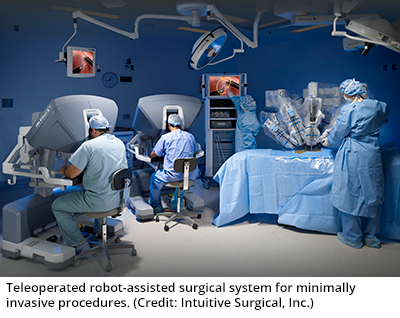
Image result for Non-Industrial Robotics: Intuitive SurgicalWe view robotics & AI as a transformational theme because its disruptive force is not limited to industrial manufacturing. Health care is one non-industrial segment that is rapidly adopting robotics technology. Companies such as Intuitive Surgical are pioneering robotic-assisted surgery in an effort to improve patient outcomes. The firm builds robotic devices used in minimally invasive surgeries including wristed instruments that can bend and rotate further than a human hand. These robotic devices enable surgeons to operate with enhanced vision, precision, and control, which can lead to less damage to patients’ nerves, quicker healing, and smaller scars versus the more traditional ‘human-only’ way of performing selected surgeries.2
A study published in European Urology revealed that prostate cancer patients who underwent robotic-assisted surgeries had fewer cancer cells, lost less blood, and spent less time recovering in the hospital. Since 2000, the da Vinci robotic surgical system has now been used in more 3 million surgeries.3
Unmanned Vehicles and Drones: Parrot SA
Drones and Unmanned Vehicles
Although militaries remain the predominant users of drone technology, commercial usage is accelerating as firms incorporate drones into parcel delivery, agriculture, inspections, and emergency response. According to the FAA, commercial drone usage is expected to grow 10-fold from 2016 to 2021.4
One prominent player in the space is Parrot, which develops drones, software, and accessories for both amateurs and professionals. While early adopters of unmanned aerial vehicles (UAVs) included business-to-consumer (B2C) flight enthusiasts and photographers, Parrot has become increasingly focused on the business-to-business (B2B) market. The company has found that UAVs mounted with HD cameras can effectively monitor production and yield on farms, inspect buildings, pipelines, and power lines, and generate 3D models of buildings and interiors.5
Artificial Intelligence: Faro Technologies Inc.
Artificial Intelligence (AI)
Artificial intelligence (AI) is an essential component to the advancement of robotics technology. AI allows robots to not just execute on human or pre-planned inputs, but also to operate in an unstructured environment and make decisions. In order to carry out these tasks, an essential component of AI is ‘robotic vision’ or the ability for machines to image and process their surroundings. One firm dedicated to advancing this space is Faro Technologies, which develops high precision imaging devices and software. The application for this technology is virtually boundless; it can create 3D models and measurements of large environments or small goods, compare parts and structures for quality assurance, or rapidly prototype items.6
This software has become particularly popular among factories using the imaging software for automated inspections and calibrations. The software has also found applications in construction for surveying purposes as well as public safety for investigating fires, crime scenes, and accidents.7
Click here to learn more about the Global X Robotics & Artificial Intelligence ETF (BOTZ).

Tuesday, July 11, 2017

China's Xiaomi plans to flood the world with 2,000 stores within three years


Image result for xiaomi phone

  • Xiaomi Senior Vice President Wang Xiang says the company wants 2,000 new stores within the next three years
  • "You will see us in almost every country," Wang said
  • After some hiccups, things seem to be turning around for the company: On Friday, Xiaomi said it posted a record high with more than 23 million smartphone shipments in the second quarter
BEIJING, China — Chinese tech firm Xiaomi plans to flood the world with 2,000 new stores within the next three years, a company executive told CNBC.
Half of those shops will be opened overseas with partners and the other half will be owned and operated by Xiaomi in China, and it's all part of the company's big ambitions to keep growing abroad, said senior vice president Wang Xiang, who oversees the firm's global strategy. In the next few years, "we will definitely be a global player," he said.
"You will see us in almost every country," Wang projected.
Beijing-based Xiaomi started out selling low-cost smartphones and exploded as one of the world's leading vendors within a handful of years. It even set a Guinness World Record for selling the most number of phones ever in a single day — 2.12 million units.
Since then, the firm has added products, including smart fitness bands, smart scooters, smart air purifiers, and more, splashing out to more than 40 countries and regions. The brand, which primarily sells direct to customers via online channels, or via distribution partnerships, has become so popular in China that at times it's easy to forget that the start-up only launched in 2010.


  • Xiaomi Senior Vice President Wang Xiang says the company wants 2,000 new stores within the next three years
  • "You will see us in almost every country," Wang said
  • After some hiccups, things seem to be turning around for the company: On Friday, Xiaomi said it posted a record high with more than 23 million smartphone shipments in the second quarter
It's a company that's also taken a cue from Silicon Valley company culture. Xiaomi's young employees buzzed around headquarters on Monday, surrounded by tons of stuffed Mi bunnies — the firm's cute white rabbit icon — perched on shelves and desks. Walls were dotted with reprints of iconic works by artists including Vincent van Gogh and Camille Pissarro. One staffer traveled in the office via Xiaomi's own smart scooter, as people streamed in and out of the canteen chatting about work and weekend plans, and screens showed photos of members of the Mi soccer club.


Big global expansion plans

This year, Xiaomi has already expanded into countries including Russia, the United Arab Emirates and Egypt, and is even manufacturing devices locally in India and Indonesia. Next year, the company is looking to focus more on Southeast Asian nations such as the Philippines and in eastern Europe, Wang said.


And although Xiaomi's low-cost offerings — the RedMi 4A phone is 599 yuan ($88) in China — perhaps make more sense in developing markets, the company also wants to make inroads in places like western Europe.
Image result for the RedMi 4A phoneAside from building brand awareness abroad, Wang said Xiaomi has a peculiar problem with its affordably-priced phones and products. "If you buy a product from any shop with a low price, normally … your expectation is quality may not be good, but we want to prove you don't need to spend a lot of money to buy a high quality product," he said, deeming that "the most difficult challenge for us."
That's where the push to open more shops come in — "seeing is believing," Wang said. "You have to let the people try the product first." Brick-and-mortar stores may seem a departure from Xiaomi's e-commerce strategy, but the company says they've been a huge success in creating a seamless online-to-offline experience for customers.

Internet of things

Xiaomi also wants to get its popular portfolio of products to customers outside of China in hopes of leading the "internet of things," linking devices like smartphones to every day objects like televisions and coffee makers. Think lamps that shut down when you fall into a deep sleep or a rice cooker you can turn on before you get home. Xiaomi boasts it's paving the way as it already has 60 million devices connected to its online ecosystem.
To help with that, the firm last week announced it would cross-license patents with Nokia, a move that helps both companies develop new products. The deal gives the tech firms access to so-called standard essential patents — key ones that allow products to comply with an industry standard. Last year, Xiaomi inked a similar deal with Microsoft, buying up 1,500 patents.
The Nokia deal is a protective measure to "defend ourselves once we go into many, many more countries, according to Wang. "The key, actually, is to get more design freedom," he said. With "the patents we acquired, our engineers can design many, many more products more efficiently."
Despite the big international push, Xiaomi hasn't announced its revenues or the split between global and domestic sales. It is, after all, still a private company, and Wang declined to comment on any IPO plans. But the firm has been quick to tout its success in India, where sales hit $1 billion last year.

Bumpy road to the top

Xiaomi's exponential growth, though, has seen hiccups along the way. Supply chain issues have plagued the company — at first, Xiaomi wasn't able to ramp up production to meet customer demand.
But then, the firm's phone sales started slipping as it lost market share to competitors like Huawei and cheaper brands Oppo and Vivo — something industry analyst firms like Canalys have said happened before Xiaomi was able to find stronger growth with its other products.
On top of that, company executive Hugo Barra, who had been lured away from Silicon Valley, announced that he would leave the company and move back to the U.S. at the beginning of the year.
But it does seem things are turning around. On Friday, Xiaomi said it posted a record high with more than 23 million smartphone shipments in the second quarter of this year.
"Our recovery follows a year of setbacks that collectively signify the most challenging period in our company history," Xiaomi founder Lei Jun wrote in a letter to employees. But despite all of that, the firm is staying the course with big goals — to hit 100 billion yuan in sales this year, and to ship 100 million smartphones next year.
By Sophia Yan

Source: https://goo.gl/YhGDwX

Also Read :How to Buy Into Xiaomi Without Buying Its Stock. /   https://goo.gl/dXEPY5


Friday, July 7, 2017

Beyond The Marijuana Index: MJIC CEO Talks Company's Desire To Be 'Amazon Of Weed'

Image result for MJIC Inc

MJIC Inc., the company behind the much-discussed Marijuana Index*, tracks U.S. and Canada-traded weed stocks and has been used as the base for the main cannabis ETFs out there. However, the media seems to have emphasized only one of the company’s multiple business segments.
Chatting with cannabis industry insiders, Benzinga realized MJIC’s business had changed a lot in recent months. In speaking with CEO Sturges Karban, a Harvard University alum and seasoned corporate finance veteran, the refined strategy the executive team has been implementing becomes clearer.

The ‘Philosophical’ Framework

MJIC started as an investment business, a venture capital firm focused on the cannabis space. Nonetheless, the past couple of years have witnessed a migration toward what Karban has defined as a “full-blown operating business that fits squarely inside of the industry to help professionalize it.”
The legal marijuana industry nowadays is mostly a compliance business. Unsurprisingly, this has been one of MJIC’s priorities as well. “In making the decision to transition from being an investor to being an operator, one of the things that we decided (as a matter of policy and principle) was we would just absolutely not compromise our compliance,” the CEO told Benzinga. And, MJIC does not apply that standard to how it operates its own business but also sets it as a prerequisite for anyone that wants to transact with the company.

Bezos Style

When Karban took over as CEO at MJIC, he had a vision for the company: It would become the Amazon.com, Inc. AMZN of cannabis. What he projected was a first-of-its-kind omnichannel approach to the industry that ultimately creates, not just a commercial platform, but also a community — “an identity destination that is more than just a pragmatic instrument for daily life.”
Image result for MJIC Inc“What we are building toward is an infrastructure, a strategy, a platform and a community that essentially will look a lot like the Amazon of legal cannabis, starting in the state of California and then coloring in the map state by state,” he said.
In other words, the company is looking to be able to service and support every vertical in the supply chain, from B2B wholesale to on-demand consumer deliveries — always with a laser-focus on compliance.
“We want to offer a truly comprehensive, value-added package that goes beyond just logistics and moving stuff around in trucks up and down the state.”
While MJIC seems to be taking many steps in the right direction, becoming “the Amazon of weed” is certainly an ambitious goal.
Many of the pieces are already in place; only some infrastructural details remain to be filled, the CEO said. “We started this with an analytical review of what we already own in our portfolio, the services business that we had built out in the transition period between being an investment company and an operating company,” he said. So, the first question was, which of the assets already owned by MJIC supported the infrastructure they were looking to build?
The first differentiator the management team identified was the media business, which allowed them to “help support and promote client products and services as their distributor.”
The other legacy asset MJIC held, which execs believed would help support an aggressive expansion into distribution, was the compliance business. “That services offering has both a commercial and regulatory value proposition,” Karban said. “It’s commercial because we are constantly on top of what is happening at all 482 municipalities in California, so we have an informational advantage in terms of where licensing is heading. But, most importantly, from a regulatory perspective ... We understood the importance of compliance.”

Filling In The Blanks

Once the core assets had been pinpointed, MJIC started looking into how to fill out an infrastructure that could support the transformation of its virtual platform into a physical one — from a logistics, fulfillment and delivery perspective.
So, the company started making strategic acquisitions.
First came Rolling Paper Depot: a proprietary, national e-commerce platform focused on unregulated products like lighters and rolling papers. After that, it was Hippie Butler, a personalized subscription business with similar products. With these two businesses, the e-commerce and subscription boxes were checked.
Finally, MJIC purchased Speed Weed, one of the largest local, on-demand delivery businesses in Southern California, which also offered a statewide overnight courier service for large B2B hauls.
“If you look at all of those channels kind of aggregated into one platform, there is a centralized community around it and an access point to it that we are building on a proprietary technological basis,” Karban noted. “That gives you the reach into everything, every channel. It’s complete and end-to-end, from cultivation all the way to consumer."
“So, we are bringing that functionality, the ability to lawfully move products in whatever form it is, from whatever place it needs to go in California, across any vertical, and across any channel, supported by media, compliance, and financial services. That’s the package that we’re offering to people and that we have in place today.”

The Middleman

Although MJIC wants to become a full-service company, its core business focus is placed on distribution. “Of all the different verticals that compromise the supply chain, distribution is ultimately going to be the organizing force of the industry because all of the others are kind of siloed in what they do,” Karban explained. “Distribution is a strategic place here because that is ultimately the force that organizes it, connects all of those different stakeholders.”

Source: MJIC
This is where the company aspires to be like Amazon: In wants to insert itself into the lives of its customers, both on the business side and on the consumer side, making itself both instrumental and indispensable to them.
Some of the major companies included in the North America Marijuana Index are:
  • GW Pharmaceuticals PLC- ADR GWPH
  • Axim Biotechnologies Inc AXIM
  • Terra Tech Corp TRTC
  • APHRIA INC COM NPV APHQF
  • AURORA CANNABIS IN COM NPVACBFF
  • CANOPY GROWTH CORP COM NPV TWMJF
  • Cannabics Pharmaceuticals Inc CNBX
  • Kush Bottles Inc KSHB
  • Scotts Miracle-Gro Co SMG
  • Insys Therapeutics Inc INSY
  • Zynerba Pharmaceuticals Inc ZYNE

By  Javier  Hasse