Showing posts with label Alibaba. Show all posts

Friday, November 11, 2016

Wall Street Breakfast: Alibaba Can't Find Its Match

 Includes: AAPLAMZNAZNAZSEYBABACBSCHATCMEDISF

Alibaba has set new records for its annual Singles' Day event as sales reached $1B in the first five minutes and hit $14.3B about two-thirds of the way through the day, already tying with last year's total. The world's biggest retail event features 6M products from 30,000 brands sold by 40,000 merchants and is closely watched for clues on the health of China's economy and its largest online retailer - Alibaba (NYSE:BABA).
Economy
The Dow closed at a new all-time high on Thursday as investors continued to embrace the Trump Trade, putting the index within striking distance of 19,000. But is the recent rally build to last? That's the question traders are now asking. While shares were heavily mixed across the globe in overnight action, U.S. futures are now starting to fade.

Central banks from India to Indonesia have stepped in to stabilize their currencies on deepening concerns that Donald Trump will pursue policies that spur capital outflows from developing economies and weaken their exports. Meanwhile, the dollar is on course for its best week in a year, racking up another round of gains against the yuan and peso and steadying just off the previous day's highs against the euro and yen.
While stock markets will remain open today for Veterans Day, bond investors - who can use some rest after being pummeled over the past few sessions - will have the day off. Underpinned by the view that Trump may need to dig deeper into America's coffers, yields on the 10-year Treasury note have risen 33.5 basis points this week, marking the largest stretch of yield gains since June 21, 2013.
Donald Trump's transition team is racing to form his cabinet as more names were floated for some of the biggest jobs in the president-elect's administration. Possible candidates: Jeff Sessions, Rudy Giuliani, Newt Gingrich, Chris Christie, Reince Priebus, Jeb Hensarling, Mike Huckabee, Sarah Palin, Carl Icahn, Ben Carson, Peter Thiel and Jamie Dimon. An initial website for the transition went online on Wednesday, but Trump has yet to name a chief of staff.
Brazil has been plunged into a fresh bout of political uncertainty after lawyers for former president Dilma Rousseff presented evidence suggesting her successor, Michel Temer, accepted bribes from a construction company. If the court rules that occurred, it could reverse her entire ticket's win. That would mean Temer, a member of the Brazilian Democratic Movement Party, would also be removed from office.

Stocks
Disney said it expects modest earnings growth next year and an even more robust rise in 2018, sending the stock up in after-hours trade after an initial fall. The assuring message came after the media company reported weaker-than-expected earnings in Q3 - hit by a drop in ad sales and subscribers at its struggling ESPN unit. New deals with Hulu and AT&T/DirecTV (NYSE:T) could also help Disney (NYSE:DIS) attract elusive millennial customers.
Allianz beat expectations in the third quarter, posting a 37% rise in net profit to €1.86B. Europe's largest insurer saw improvements across all its businesses, including bond fund manager Pimco, which logged net inflows for the first time in three years. Quarterly operating profit also beat forecasts, rising 18% and helping Allianz (OTCQX:AZSEY) reaffirm its full-year target.
Wells Fargo is changing the way it handles whistleblower complaints following allegations it retaliated against employees who called an ethics hotline to report sales abuses. CEO Tim Sloan announced the change at a gathering of about 2,000 employees in Des Moines, Iowa, as part of a "conversations tour" he and other Wells (NYSE:WFC) executives are making to try and restore employee morale after the bank's recent scandal.
CME Group CEO Phupinder Gill will retire at the end of the year, according to a statement issued by the world's largest futures market operator, with executive chairman Terry Duffy taking on his role after he leaves. The surprise departure was announced just a year after Gill extended his employment contract with CME to 2019.
Saying it was too easy to spend their parents' money, Seattle District Judge John Coughenour has set up a year-long process to reimburse customers whose children made Amazon (NASDAQ:AMZN) in-app purchases without permission, but rejected an FTC request for a $26.5M lump sum payout. The agency already settled similar cases against Apple (NASDAQ:AAPL) and Google (GOOGGOOGL). All three companies now require a password for in-app purchases or an opt-in to enable purchases without a code.
"I was never a great proponent of the split of the two companies," said Shari Redstone, vice chair of the board at CBS and Viacom (VIAVIAB). "Scale will matter to your advertisers, who more than ever have to reach the consumer on a number of platforms." A decade ago, Sumner Redstone decided to divide the two into separate companies, and while CBS has thrived, Viacom has wrestled with falling ratings and declining ad sales.
The FCC has sent a letter to AT&T (T) to express concerns over the company's practice of exempting its own streaming video services from data usage caps for its wireless customers and demanded answers by Nov. 21. AT&T began the practice known as "zero rating" with the DirecTV video app in September and plans to do the same for its over-the-top service DirecTV Now when it launches
later this month.

Saturday, August 13, 2016

Alibaba’s stock has best-ever 2-day run after analysts ‘strong buy’ call

Shares of Alibaba Group Holding Ltd. shot up to a 1 1/2-year high in active trade Friday, after the China-based e-commerce giant was upgraded at Raymond James, which cited strong quarterly results and an attractive valuation.
Aaron Kessler, analyst at Raymond James, raised his rating to a strong buy, after maintaining an outperform rating since he began covering Alibaba nearly two years ago. Kessler raised his stock price target to $124, which is 26% above current levels, from $95.
Alibaba’s stock BABA, +7.06%  ran up 7.1% to close at its highest level since Jan. 28, 2015. It has advanced 12.5% since it reported fiscal first-quarter results before Wednesday’s open, the best two-day stretch for the stock since it went public on Sept. 19, 2014.
Volume was 71.7 million shares, nearly six times the full-day average of 12.5 million shares, according to FactSet, and enough to make them the most-actively traded on U.S. exchanges.

FactSet

Kessler offered several reasons for his more bullish view:
 Total retail revenue increased 49% to $3.52 billion, which was 6% above his estimates, because of strength in gross-merchandise volume growth and strong monetization gains.
 A big jump in monetization rates to 2.79%, in the latest quarter from 2.49% the previous quarter. The company showed improvements in both mobile, to 2.8% and desktop, to 2.78%.
“We would note this is the first quarter mobile monetization has exceeded desktop,” Kessler wrote in a note to clients.
 The cloud business is expected to continue to produce rapid growth—it nearly tripled in the latest quarter—and should remain the leader in China. Kessler said he believes cloud revenue is “well on track to reach a $1 billion run rate” by the end of the year.
 Strength in core margins, in which earnings before interest, taxes and amortization—a common measure of cash flow—grew 61% in the latest quarter.
 Shares are attractively valued, as 12 times calendar-year 2017 estimates of core-commerce earnings a share, compared with his expectations of 20% core long-term growth.
For Raymond James, stocks rated strong buy are expected to produce total annualized returns of at least 15%, and outperform the S&P 500 SPX, -0.08%  over the next six to 12 months. The S&P 500 has gained 6.8%, so far in 2016, as of midday Friday.
Kessler wasn’t alone in being more bullish on Alibaba. Of the 42 analysts surveyed by FactSet, three others raised their ratings, and 25 others lifted their stock price targets since Alibaba reported results.
By Tomi Gilmore

Monday, March 14, 2016

China's $500 Billion Mobile Shopping Mania

Imagine getting a soft drink from a vending machine using only your smartphone. Or scanning a QR code to buy goods from a newspaper ad.
By harnessing these innovations — and more — China mobile shopping is barreling ahead of the United States. China is still the world's largest smartphone market, even though growth is slowing. It accounts for about 30 percent of the global smartphone market, and Chinese smartphone users are expected to jump from 526.8 million to 640 million in 2018, according to eMarketer. And its shoppers are using their gadgets to snap up a wide array of goods and services.
543226663
Mint Images | Getty Images
Nearly half of all China's e-commerce sales, totaling $505.7 billion, are made with mobile devices, versus roughly one-quarter in the U.S., according to eMarketer. By 2019, China's mobile sales will account for 71 percent of those sales.
"We don't see mobile buying plateauing for the next five years," said Monica Pearl, eMarketer's director of forecasting. "They'll increase because consumer behavior has changed." Feature-rich, cheap smartphones are also helping fuel the boom, she added.
China is, after all, a mobile first market, explains Brian Buchwald, CEO of consumer intelligence firm Bomoda. So it has been able to leapfrog past other markets, which mainly used PCs for purchases.
Sophisticated mobile payment apps are partly fueling the mobile boom. To grease buying, purchases are smooth and nearly seamless, since goods are bought in a few seconds with just one click. And an intense fight for market share between payment titans WeChat Pay and Alibaba's Alipay is fueling even more innovation. Apple Pay has only just recently stepped into the competitive arena.
Meanwhile, the Chinese government has allowed a free-flowing retail and payments marketplace.
"There are no restraints," said Michael Zakkour, vice president of China/Asia Pacific practice at Tompkins International.
Image result for wechatAnd that's good news for WeChat, A messaging app that's only five years old and is offered by the Internet giant Tencent. The app now has 650 million users. And a good chunk of them are using the app for mobile shopping. The result is that WeChat payments, along with Alibaba's Alipay, dominate the market. Because retailers can easily set up shop inside WeChat, users can plan family vacations, order a taxi or even design clothes without going anywhere else.
"WeChat is the most influential app in the world," said Buchwald. "It has the functionality of an iTunes store. So you can do anything you want."
This mobile preference is one-stop shopping for navigating a digital life. "We're talking about the emergence of chat commerce," said Lily Varón, an analyst at Forrester Research. "WeChat is becoming a commerce channel. And it's an ecosystem that's unlike anything in the U.S."
And, she adds, unlike the U.S., there's also no digital divide in China by geography or age. "It's not just limited to younger consumers," she said.
Meanwhile, e-commerce powerhouse Alibaba has its own Alipay app. Known as the PayPal of China, it is the dominant player in the mobile payment industry. And it's in a competitive tussle with WeChat to keep market share — fueling even more innovation.
"They're both spending billions building new features and technologies," said Buchwald. "That includes making lots of different investments in start-ups." For example, Alipay is now testing ways to let shoppers pay just by scanning a physical feature.
At the same time, Apple and Samsung are trying to break into this sector with partnerships with UnionPay, China's main bank card and payment firm.
The U.S. is lagging behind though, and mobile payments have yet to gain traction. Even QR codes, which have largely flopped in the U.S., are used everywhere in China to buy goods. And mobile phones there already have scanners embedded in them.
Once scanned and bought, goods are delivered quickly. And Alibaba, which has a massive logistics network, can get goods to customers within one day. Its ultimate goal is even loftier: deliveries to any Chinese city within 24 hours. Alibaba is even investing in drone companies, says Buchwald.
These hyperkinetic deliveries are fueling ever more purchases. Last year, China's Singles Day — a consumer shopping day invented by Alibaba and much like Black Friday in the U.S. — totaled $14.3 billion, which is 60 percent higher than 2014. Those sales total more than Black Friday and Cyber Monday sales in the U.S. combined.
"In China, spending as much money as possible on Singles Day is almost patriotic," said Buchwald. "It's more of a collectivist spirit there."
Emphasizing community good over the individual goes back thousands of years in China. "It's the cowboy vs. the collective," said Zakkour. "So Chinese people want to make sure that products they're buying have acceptance." For this reason, mobile commerce was predestined to become successful there, he added.
Los Angeles-based Revolve Clothing had to navigate this community spirit to sell its goods in China. "Social media there is very important," said Mike Karanikolas, co-CEO of Revolve, an online collection of up-and-coming fashion brands for men and women. "It's as if Amazon owned a big chunk of Facebook."
For the online apparel retailer, ramping up sales to the Chinese market meant navigating longer purchase cycles. Purchases in the U.S. are made quickly, he explains. But in China, purchases can take up to 30 days because many Chinese consumers spend a lot of time researching goods and then checking them out with a circle of friends before making an online purchase.
But in many ways, China's mobile mania may well be the new face of retailing.
China is up to three years ahead of the U.S. in mobile shopping, said Buchwald. "And it's moving faster than any other area of the economy. It's the future."
— By Constance Gustke 

Sunday, March 6, 2016

U.S. Weekly Recap: IPO Pick-Up On The Horizon?


Image result for IPO
The Renaissance IPO Index continued its ascent this week, up 4.9% compared to 2.7% for the S&P 500. The index is now 18% above its 2016 low. The recent outperformance may be a sign of IPO icebreakers on the horizon.
The fifth IPO of the year, Syndax Pharmaceuticals (NASDAQ:SNDX), and microcap SPAC Jensyn Acquisition (JSYNU), began trading Thursday.
More checkpoint inhibitors come to market
Immuno-oncology biotech Syndax raised $53 million by offering 4.4 million shares at $12 and broke issue on its trading debut. Since its IPO attempt in June 2014, Syndax has shifted its focus to the white hot checkpoint inhibitor space, brought in a new management team (including the former CMO of AstraZeneca), and raised $80 million in an August 2015 Series C.
Volatile aftermarket performance
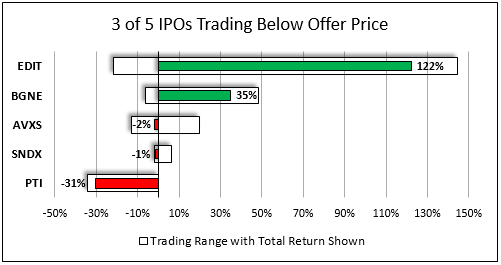
Each of this year's IPOs have broken issue at some point and experienced heightened volatility, especially Editas Medicine (NASDAQ:EDIT) and AveXis(NASDAQ:AVXS). Editas surged again this week and is now 182% above its lows three weeks ago; the gene-editing biotech's 122% total return from IPO tops every offering from 2015. AveXis traded up 18% during the week, but that gain was wiped out in the last two hours of trading on Friday. The chart below shows trading ranges and total returns for this year's five IPOs.
Enter your alt tag here
IPO Pipeline update
Hutchison China MediTech (Pending:HCM), which markets drugs and develops immuno-oncology therapies, filed terms for a US listing (it trades on the AIM in London) that could raise $100 million at a market cap of $2 billion. Indian solar power utility Azure Power Global (NYSE:AZRE) updated financials ahead of its $100 million US IPO.
Image result for IPO2016 by the numbers
The IPO market did not see a notable increase in filing activity after the seasonal mid-February pause. At this point last year, there had been 32 new filings and 26 IPOs that raised $4 billion to date. In 2016, there have been just 22 new filings and five IPOs that have raised $450 million (ex-SPACs). This year has also seen every operating company postpone its attempted IPO.
IPO Market Snapshot
The Renaissance IPO Indices are market cap weighted baskets of newly public companies. The Renaissance IPO Index is down 10% year-to-date, compared to -2% for the S&P 500. Renaissance Capital's IPO ETF (NYSE: IPO) tracks the index, and top ETF holdings include Synchrony Financial (NYSE:SYF), Alibaba (NYSE:BABA) and Citizens Financial Group (NYSE:CFG). The Renaissance International IPO Index is down 7% year-to-date, compared to -3% for ACWX. Renaissance Capital's International IPO ETF (NYSE: IPOS) tracks the index, and top ETF Holdings include NN Group and Recruit Holdings.
Investment Disclosure: The information and opinions expressed herein were prepared by Renaissance Capital's research analysts and do not constitute an offer to buy or sell any security. Renaissance Capital, the Renaissance IPO ETF (IPO), the Renaissance International IPO ETF (IPOS), or the Global IPO Fund (MUTF:IPOSX), may have investments in securities of companies mentioned.
By Renaissance Capital IPO Research

Wednesday, May 6, 2015

5 Reasons to Buy Alibaba Stock Now (NYSE: BABA)


buy Alibaba stockNow is one of the best times to buy Alibaba stock.
Alibaba Group Holding Ltd. (NYSE: BABA) stock has fallen 25% in 2015. Today, BABA hit its lowest value to date at $77.77. The company will announce quarterly and fiscal-year earnings on Thursday, May 7.
But this year's Alibaba stock price slump is not a bad sign for the long-term value of BABA.
"For investors, an error of omission with Alibaba stock would be worrying about the short-term and missing the stock's long-term potential," Money Morning's Executive Editor Bill Patalon said.
Money Morning experts are extremely bullish on BABA stock now. In fact, Money Morning's Defense and Tech Specialist Michael Robinson recently said Alibaba "could be the single-greatest wealth opportunity of our lifetime."
Here are the five biggest reasons to buy Alibaba stock today…
Image result for alibaba

Reasons to Buy Alibaba Stock No. 1: Chinese E-Commerce Growth

Alibaba is China's largest e-commerce company. In 2014, Alibaba's network of sites handled roughly 80% of all online transactions in the country.
In 2013, online shopping in China was a $298 billion industry. That surpassed the United States as the largest e-commerce market in the world.
And the market is growing at an incredible rate.
New research from AT Kearny estimates Chinese e-commerce will total $718 billion by 2017.
"Alibaba is gaining traction in its home market in China just as that country's people are truly joining the Internet revolution," Robinson said. "And the development of easy-to-use mobile commerce is giving Alibaba a strong tailwind."
A recent study by the China Internet Network Information Center (CNNIC) determined the number of Internet users in the country will hit 800 million by 2016 or sooner.

Reasons to Buy Alibaba Stock No. 2: Mobile Growth

Alibaba has invested heavily in its mobile development.
In February, it spent $590 million on a minority stake in the Chinese smartphone maker Meizu. Before that, Alibaba spent $1.9 billion on the mobile web developer UCWeb. It also dropped $215 million for a minority stake in the messaging app Tango.
Those purchases have been paying off.