Showing posts with label Bitcoin. Show all posts

Monday, February 12, 2018

How the New Tax Law Impacts Cryptocurrencies


Image result for new tax law

The tax bill that Donald Trump signed into law in late December represents the most substantive changes to the federal tax code in 30 years, but Congress passed up its chance to clarify matters for cryptocurrency investors, traders, issuers and miners. The community is left with a host of questions and ambiguities; but while the tax bill does not directly address cryptocurrencies such as bitcoin, ether and the tokens issued through ICOs, it does impact them indirectly. 
Especially important are changes to six provisions in the tax code: like-kind exchanges, loss carrybacks, the corporate tax rate, the business interest deduction, miscellaneous personal deductions, and the treatment of pass-through businesses. (See also, Trump's Tax Reform.)

Like-Kind Exchanges

Google "bitcoin tax bill" or some variation, and most of the results will focus on section 1031 of the tax code, which allows capital gains taxes to be deferred for certain "like-kind" exchanges of property for other, similar property. The provision was originally envisioned as a break for farmers swapping livestock, but came to be used for trades in commercial real estate, art and airplanes – and

According to three attorneys contacted by Investopedia, at least some cryptocurrency investors regard a sale of bitcoin for ether, for example, to be a like-kind exchange that is exempt from capital gains taxes. None of the attorneys we spoke to, however, is convinced: taxpayers who treat crypto-for-crypto exchanges as like-kind are "taking the risk that if they got audited, the IRS would disagree," says Jeremy Naylor, a partner at Cooley LLP. Under the new law, he continues, "it's clear now that you can't do that." The exemption that section 1031 previously applied to "property of like kind" only applies to "real property of like kind" under the new law, meaning that cryptocurrencies definitely don't qualify.
Investors considering taking advantage of this break for the 2017 tax year should weigh the risks. Matthew Gertler, senior analyst and counsel at Digital Asset Research, says, "Like-kind exchanges were never a thing for crypto," adding, "most of the articles I have read supporting that like-kind exchanges apply were not written by attorneys or accountants." Trading one stock for another doesn't qualify for the break, he points out, nor does trading gold for silver, "so I want to hear why the trading of one cryptocurrency for the other constitutes the same kind of property."

Loss Carrybacks

A second change to the tax code affects businesses in the cryptocurrency space, such as those raising money by issuing tokens through initial coin offerings (ICOs) or a similar fundraising method known as a SAFT. Under the old tax law, business losses could be carried back two years, a boon to companies that raise money in a token sale one year, then experience operating losses in subsequent years. The new law eliminates loss carrybacks.
"Some folks doing ICOs and raising money selling tokens were assuming they'd be able to use losses [in 2018 and 2019] to offset income in 2017," Naylor says. "That benefit is no longer there."

Corporate Tax Rates

The central provision of the new tax law is a steep cut in the top corporate tax rate from 35% to 21%. Short-term capital gains are taxed as ordinary income, at marginal rates ranging from 10% to 37% under the new law in 2018. Long-term capital gains – profits from selling assets held for at least a year – are taxed at a top rate of 20%. For traders who hold cryptocurrencies for shorter durations, therefore, the new corporate rate could represent an opportunity.
"We would never suggest that someone take their personal activities and blindly incorporate," says Evan Fox, a manager in the tax department at Berdon LLP, but "there are a few scenarios – and this would need to be analyzed by tax advisors and accountants – where it could make sense for an individual to form a corporation to do their crypto trading." (See also, How the GOP Tax Bill Affects You.)

Pass-through Deduction

The introduction of a new deduction for pass-through entities, which allow business income to be paid through personal tax returns, could also represent an opportunity. Gertler, Naylor and Fox all stressed that cryptocurrency traders are not eligible for this deduction, but Fox thinks that the pass-through deduction could be interesting to miners. (See also, What Is Bitcoin Mining?)
The new law allows a deduction of up to 20% of pass-through income, limited to 50% of wages paid by the entity or 25% of wages plus 2.5% of the unadjusted basis of the entity's property. Mining is an extremely capital-intensive business, requiring the purchase of large arrays of ASICs – the specialized hardware used to carry out the hash functions involved in proof of work – and for particularly large organizations, employees to maintain them.
Another bonus for miners, Fox adds, is immediate expensing for new equipment for five years.

Business Interest Deduction

The new law doesn't just give, however, it taketh away. Business interest deductibility – previously unlimited – will be capped at 30% of adjusted earnings (Ebitda for four years, then Ebit). "It seems like a lot of clients are tripping" that limit, says Fox, "and having a non-deductibility of interest." Miners in particular appear to be taking on the kind of leverage that runs into the limit. The new cap does not apply to personal interest, he notes, so it won't apply to "people out there mortgaging their houses to buy bitcoin." That's "probably a bad idea," he adds. (Yes, it probably is.)

Miscellaneous Personal Deductions

Finally, individuals should be aware that a number of 2% deductions – which taxpayers who itemize can claim on the amounts by which certain expenditures exceed 2% of adjusted gross income – were eliminated by the new law. "Especially in the crypto world, people are traveling a lot to see different companies, they're going to conferences, they're buying segregated computers, they're purchasing cold wallets," says Fox. "Expenses can get into the thousands and thousands of dollars, and now those are essentially irrelevant for tax purposes."

Waiting for the Rules

Naylor cautions that "a lot of this is going to be unclear until we get regulations that implement the law," a caveat that Fox echoed. Investors, traders, miners and the rest of the crypto community should be cautious until the IRS has fleshed out the legislation (due to funding and staffing shortages at the agency, however, this could take several months). And of course taxpayers should seek professional advice before making decisions based on changes to tax law. (See also, The Investopedia Tax Center.)

Click link below to get $10 worth of bitcoin when you open an account with coinbase https://www.coinbase.com/join/5a6e2f127942b905f74c6837

Source: 
https://goo.gl/VA4tMY

Friday, December 1, 2017

Wall Street Breakfast: Tax Concerns Weigh On Stock Futures

Image result for wall street breakfast

Includes: AAPLABCAMZNAPRNASMLCAHDISGMINTCLYFT

U.S. stock index futures are pulling back from the Wall Street highs seen in the previous session as the Senate tax bill ran into significant hurdles. With concerns over the deficit, it's now possible that deep tax cuts might have to be moderated, future tax increases might be built in and that some conservatives might seek to attach spending cuts. A Senate vote has now been delayed, and it's not clear if it will even take place today.
Economy
The breakthrough in Brexit talks that Theresa May has been working to clinch next week is at risk after Northern Ireland's Democratic Unionists made it clear they were in no mood to compromise over the Irish border. Other big news from Britain... RBS is closing more than a quarter of its branches across the U.K., or 259 locations, as the bank encourages customers to use its online services.
November was the best month for eurozone factories in over 17 years. IHS Markit's final manufacturing PMI for the bloc climbed to 60.1 last month from October's 58.5. Suggesting the expansion will continue through December, new orders soared, backlogs surged and headcount increased at the fastest rate since the survey began in 1997.
Seeking to forge a new government, German Chancellor Angela Merkel has held her first meeting with the Social Democrats, while the business world criticized the prolonged political deadlock. "Germany can afford many things, but not an unstable government," said VW Truck & Bus (OTCPK:VLKAY) CEO Andreas Renschler. The government should be ready to tackle future challenges "in a creative, bold and forceful way."
Greece plans to return to the international capital markets with a new seven-year bond issue early next year, after completing a €30B voluntary bond swap this week, FT reports. If market conditions are favorable, two more issues of three- and 10-year bonds would follow by July, ahead of Greece's expected exit from its bailout program next August.
On the third day of his trial, Halkbank executive Mehmet Hakan Atilla told a U.S. federal court that Turkish President Recep Tayyip Erdogan had authorized transactions to help Iran evade U.S. sanctions. Several methods to launder the money were carried out, like gold trades and fake food purchases, while his testimony could further strain relations between the two NATO allies.
The Hwasong-15 missile that North Korea launched on Wednesday is a new type of ICBM that can fly over 8,080 miles, a South Korean defense ministry spokesman told Reuters. South Korea's economy appears to be shaking off the tensions. Gross domestic product expanded at a 3.8% annualized rate in Q3, marking the fastest pace of growth in seven years.
Christmas Pillow Dark Red T-Shirt FrontA private survey that focuses on small and medium-sized firms in China showed that manufacturing activity picked up at a slower pace in November. The Caixin/Markit manufacturing PMI came in at 50.8, the lowest level in five months. The economy in Q4 is still likely to "maintain the stability observed since the start of the second half of the year," said Zhengsheng Zhong of CEBM Group, a subsidiary of Caixin.
Stocks
Lithium-ion revolution? Tesla's (NASDAQ:TSLA) Elon Musk has beat today's 100-day deadline to install the world's biggest battery in South Australia, which will supply power to 30,000 homes. But he'll probably have to relinquish that crown by February. Hyundai Electric & Energy Systems is building a 150-megawatt unit, 50% larger than Musk's, that will go live in about three months in Ulsan, South Korea.
With some bad blood spilled during the last few months, Toshiba (OTCPK:TOSYY) is close to settling a legal dispute with Western Digital (NYSE:WDC) that has threatened to become a major stumbling block in selling its $18B semiconductor unit. According to Bloomberg, the U.S. firm will drop its efforts to block the deal in exchange for an extension of their joint venture agreements.
ASML -2% premarket after Intel (NASDAQ:INTC) cut its stake in the Dutch semiconductor equipment supplier to below 5%. The U.S. company took a 15% stake in 2012 as part of a program to help build the next generation of smaller, faster chips. With ASML's new machines now entering commercial production, the investment program is winding down.
Bitcoin is hovering around the $9,900 level after tumbling about 15% from an all-time high hit this week in volatile cryptocurrency trade. In further signs of mainstream acceptance, however, bitcoin has gone to the Big Four. Accounting firm PricewaterhouseCoopers has accepted the first bitcoin payment for its advisory services.
According to Reuters, Nissan (OTCPK:NSANY) has begun international arbitration against India to seek more than $770M in a dispute over unpaid state incentives. There are currently over 20 similar cases pending against the nation, among the highest of any single country, brought by investors concerned about issues ranging from retrospective taxation to payment disputes.
Lyft saw an explosion of sales growth in the first half of the year, according to The Information. Revenue is estimated to have tripled from the year-ago period to $483M, while LYFT's net loss fell 27% to $206M. The company's strong revenue gains come at a time when larger rival UBER struggles with a series of scandals and setbacks.
General Motors thinks it can make billions of dollars building and operating a fleet of self-driving cars, taking on UBERLYFT and others. "This business is potentially bigger than our current core business," CFO Chuck Stevens told analysts yesterday. GM hopes to launch its autonomous robo-taxi fleets in big cities by 2019.
With six years of shrinking sales and a wave of maturities coming due in 2018, Sears (NASDAQ:SHLD) is seeing less big-box in its future. "Innovative smaller-format stores continue to showcase our company's unique integrated retail capabilities by combining new technology, our strongest categories and in-store experts," CFO Rob Riecker said on a pre-recorded conference call.
Amazon is in talks with generic drugmakers, including Mylan (NASDAQ:MYL) and Sandoz (NYSE:NVS), about a potential entry into the pharmacy space. The conversations are about making a role in drug purchasing, competing against distributors such as McKesson (NYSE:MCK), AmerisourceBergen (NYSE:ABC) and Cardinal Health (NYSE:CAH), but the plans remain vague, and some are skeptical Amazon (NASDAQ:AMZN) will pull the trigger.
Blue Apron +3% premarket after replacing CEO Matthew Salzberg with CFO Brad Dickerson, who joined the company from Under Armour (NYSE:UAA) in 2016. Salzberg is the second co-founder to leave following Blue Apron's (NYSE:APRN) stock market debut in June. The meal-kit maker is struggling to hold on to customers and reverse a precipitous drop in investor confidence.
Copyright infringement? Disney (NYSE:DIS) has filed a lawsuit against Redbox in an attempt to stop the DVD rental company from selling digital copies of its movies. Redbox is offering $7.99 to $14.99 per title because it doesn't have a distribution arrangement with the studio and buys retail copies of its discs to rent to customers that come with download codes.
Another battle... Qualcomm (NASDAQ:QCOM) has filed three new patent infringement complaints against Apple (NASDAQ:AAPL), saying there were 16 more of its patents that the company was using on its iPhone. It follows Apple's countersuit on Wednesday against Qualcomm, which alleged that Snapdragon mobile phone chips infringed on its patents.
Microsoft has elected four new members to its board of directors, bringing the total to 14, of which nine have been appointed since Satya Nadella became CEO in February 2014. He has already made a significant mark on the company, emphasizing its cloud products over the Windows franchise, and getting Microsoft (NASDAQ:MSFT) out of the smartphone business. Since Nadella took over, shares have soared more than 70%.
Today's Markets 
In Asia, Japan +0.4%. Hong Kong -0.4%. China flat. India -1%
In Europe, at midday, London -0.4%. Paris -0.9%. Frankfurt -1%
Futures at 6:20, Dow -0.3%. S&P -0.4%. Nasdaq -0.7%. Crude +0.6% to $57.76. Gold +0.2% to $1278.60. Bitcoin +0.3% to $9947. 
Ten-year Treasury Yield
Today's Economic Calendar
Companies reporting earnings today »

Tuesday, August 29, 2017

Litecoin hits a record high and is up nearly 1,400 percent this year

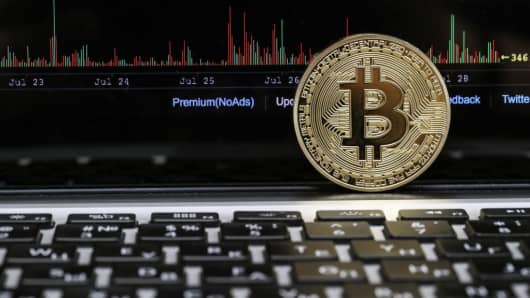
A Bitcoin cryptocurrency souvenir coin.

  • Litecoin hit a record high of $64.2 on Monday and has rallied 1,400 percent since the start of the year
  • Differences between bitcoin include speed of transactions, size of supply, and use case
  • Litecoin creator Charlie Lee says that he sees the cryptocurrency being used for purchases whereas bitcoin is more a store of value
Litecoin, the fifth-largest cryptocurrency by value and rival to bitcoin, has rallied nearly 1,400 percent since the start of the year after hitting a record high price.
On Monday, litecoin hit an all-time high of $64.2, marking a 1383 percent rise since January first where it traded at $4.33, data from industry website Coinmarketcap.com showed. The price pulled back slightly on Tuesday and was just above $62 in early trade.
CNBC runs through the differences between bitcoin and litecoin, and what's driving the price.

What is litecoin?

Litecoin is a cryptocurrency founded by Charlie Lee. It has a market capitalization of around $3.28 billion according to Coinmarketcap.com. This makes it the fifth-biggest digital currency behind ripple, bitcoin cash, ethereum, and bitcoin, which is the largest with a market cap of $72.4 billion.
Like bitcoin, it runs on a blockchain, which is a public ledger of transactions that can't be tampered with.
Bitcoin could be set for more confusion ahead from CNBC.

How does litecoin differ to bitcoin?

  • There is a limited supply of 84 million litecoins, compared to 21 million bitcoin. Currently 52,679,982 litecoin and 16,530,563 bitcoin are in circulation.
  • Litecoin transactions currently take just over 2 minutes to go through compared to about 100 minutes for bitcoin.
Litecoin creator Charlie Lee recently explained that he sees the cryptocurrency as being a key player in payments, whereas bitcoin is more a store of value.
"Bitcoin will always be the gold standard because bitcoin will have the strongest network, the most secure, the most money mining it," Lee said in an interview with blogger Crypto Hedge, which was posted on YouTube on Monday.
"Litecoin will be second to that and bitcoin being the most secure will obviously cost more … Litecoin transaction will cost less. So Litecoin will provide a niche where it will be more used for payment whereas bitcoin will be more used for storing."

What is Blockchain? CNBC explains the break-though technology from CNBC.

So for example, if you wanted to instantly swap some litecoin for bitcoin, Lightning Network will make that possible.
There are a plethora of so-called "alt-coins" on the market, but Lee said he doesn't expect all of those to survive. Instead, bitcoin and litecoin will be the main ones but the Lightning Network will allow easy access to other coins should they be needed by users.
"My vision is that with Lightning network … you wouldn't need to hold all these coins, you could just hold all your money in bitcoin or litecoin, and if there is an application that requires ether or some other token, you can easily … convert it on the fly to the token that you need," Lee said.
By Arjul Kharpan
Source: https://goo.gl/bRR1M8


Friday, July 21, 2017

It's not bitcoin or ethereum: This digital currency rose 3,977% in the first half of 2017

Image result for ripple coin

  • Ripple's XRP token finished the second quarter priced at $0.263, up 3,977 percent higher year-to-date
  • The digital currency is currently listed on 30 exchanges
  • The San Francisco-based start-up said there were $30 million worth of XRP transactions in the second quarter of 2017
    

Ripple, a San Francisco-based digital currency start-up, recorded $30 million worth of transactions in the second quarter of 2017 as 25 new exchanges listed its token, XRP.
XRP finished the quarter priced at $0.263, up by 1,159 percent from the previous quarter and 3,977 percent higher year-to-date. It is currently listed on 30 exchanges.
The currency from the five-year-old company boasts the third-largest market capitalization in the space — behind bitcoin and ether.

XRP, unlike Ethereum and Bitcoin, is owned largely by Ripple. The company has released plans in May to structure the sale of its currency, and that announcement was instrumental to driving up interest in the second quarter, according to Miguel Vias, Ripple's head of XRP markets.
"With respect to XRP, we are incredibly focused on international payments, I think we are probably the only digital asset that has a clear use case with respect to what we are trying to do with the asset," he said.

As for the future, Vias hinted that new announcements may be forthcoming.
"With respect to growth and outreach, we will continue to partner with digital asset exchanges for listings and mostly importantly ... it is really all about payments and in this quarter, you will see some very interesting developments with respect to our partnership in payments, with respect to XRP in particular," Vias told CNBC.
Despite volatility in the cryptocurrency market and some analysts expressing concern about a potential split in bitcoin, Vias said he is optimistic about the future for both Ripple and its competitors.
"What we have seen is an embracing of digital assets broadly by really established institutions. When you have folks like the [Bank of England], which did a [proof of concept] with us, as well as the Bank of Japan coming out and saying, we are considering this as legal tender at some point — when you see those developments, you can't help but feel that we are on the right path, that interest is going to continue to grow," Vias said.
By Rohini Nambiar

Source: https://goo.gl/x8q2xt

Friday, June 23, 2017

Ethereum briefly crashed from $319 to 10 cents


  • Ethereum briefly suffered a flash crash on the GDAX exchange on Wednesday.
  • The price fell from around $319 to 10 cents in a matter of seconds.
  • Many ethereum traders lost large sums of money.
  • The cryptocurrency later rebounded.


The price of ethereum crashed as low as 10 cents from around $319 in about a second on the GDAX cryptocurrency exchange on Wednesday, a move that is being blamed on a "multimillion dollar market sell" order.
Ethereum is an alternative digital currency to bitcoin and had been trading as high as $352 on Wednesday. It has since rebounded from its flash-crash lows to trade to about $325 on the GDAX exchange. According to industry and price tracking website Coinmarketcap, which takes into account the price on several exchanges, ethereum was trading around $338.

Image result for Ethereum

Adam White, the vice president of GDAX which is run by U.S. firm Coinbase, posted on the exchange's blog, outlining what took place at around 12:30 p.m. PT on Wednesday. According to White, the multimillion dollar market sell order resulted in a number of orders being filled from $317.81 to $224.48.
As the price continued to fall, another 800 stop loss orders and margin funding liquidations caused ethereum to trade as low as 10 cents.
A stop loss order is a trade that is executed automatically once a security — in this case ethereum — hits a particular price. Margin funding is essentially trading with borrowed funds. Liquidation is when these positions are closed automatically in order to prevent further losses. The knock-on selling effect caused the flash crash on GDAX.
The chart below is a screenshot of the GDAX price showing the high and low price.

GDAX
Many on social media criticized GDAX and alleged there was some sort of illegal activity taking place. GDAX denied this.
"Our initial investigations show no indication of wrongdoing or account takeovers. We understand this event can be frustrating for our customers. Our matching engine operated as intended throughout this event and trading with advanced features like margin always carries inherent risk," White said in a blog post.
"We are continuing to conduct a thorough investigation and will keep customers updated with any resulting actions."
White also noted that these trades are final and will not be reversed. The exchange temporarily halted trading of ethereum on Wednesday before restoring the system shortly after.
As well as the issues on GDAX, investor demand at the funding launch for an ethereum-based messaging app called Status clogged the ethereum network, an industry insider told CNBC.

User makes $1 million off $380?

Ethereum traders were outraged by the crash blaming GDAX for not having proper controls, and even accusing whoever put the sell order in of market manipulation.

Monday, March 13, 2017

Bitcoin Crash Creates Golden Opportunity

Image result for bitcoin crash

GPL FSM ASM AGI
I’ve been wrong about my timing of the silver and gold trade twice now. Once to my followers in Momentum Trader and another time in a much more public way, on Bloomberg the end of last year. My fundamental investment thesis surrounding gold hasn’t been wrong just my timing. And now, with gold prices bouncing off $1,200 and last week’s Bitcoin debacle I’m taking another stab at it.
You could argue that Bitcoin and gold are both alternatives to global fiat currencies. Neither has a central bank which governs them nor do they pay interest. They are both a store of value and can be held anonymously. Gold and silver have a tendency to track with each other so I’m including it when I look for stock ideas.The Bitcoin debacle I’m referring to is last week’s decision by the SEC to reject the Winklevoss Twins’ proposal for a Bitcoin ETF. An ETF would have helped to legitimize the cryptocurrency and expose it to an entire new market of potential investors. The SEC’s decision was based on the unregulated nature of the Bitcoin market itself. With no way of overseeing the underlying investment, there was no way the SEC could give it a stamp of approval.
Of course there’s one giant difference between the two. Gold has been a historic store of value for ages and something you can physically possess. Bitcoin is a digital currency that was created from nothing a few years ago. There is still a huge amount of skepticism surrounding Bitcoin and other cryptocurrencies. A rash of high profile hacks, essentially digital bank robberies, have loomed like a cloud over Bitcoin for years. This ETF would have been something like a Bitcoin coming out party.
However, that was not the case and Bitcoin’s value plunged in Friday trading. Nearly simultaneous there was a huge rally in gold prices with the metal bouncing from just under $1,200 an ounce, an obvious psychological support level. Gold still does have an inverse relationship with yields. As interest rates rise you tend to see pressure on gold prices. We all know the Fed is going to hike rates next week. That is a huge negative on gold pricing. But if the metal can rally even in the face of that hike, then there could be overpowering fundamentals at play.
One way to play a potential continuation of silver and gold’s move higher is to look at the silver and gold miners. A lot of these companies got lean and mean in order to survive the plummet in prices and have emerged with much stronger balance sheets. They have found ways to minimize their acquisition costs and streamline their mining process. I’ve put together a list here of gold stocks that are Zacks Rank #1 (Strong Buy) and Zacks Rank #2 (Buy) stocks for you to investigate a little further.
Alamos Gold (AGI - Free Report)
Alamos Gold Inc., together with its subsidiaries, engages in the acquisition, exploration, development, and extraction of gold deposits in North America. It also explores for silver and precious metals. The company holds interests in the Young-Davidson mine, which includes contiguous mineral leases and claims totaling 11,000 acres located in Northern Ontario, Canada; the Mulatos mine located within the Salamandra Concessions in the Sierra Madre Occidental mountain range in the east-central portion of the State of Sonora, Mexico; and the El Chanate mine that comprises 22 mineral concessions covering 4,618 hectares situated in the State of Sonora, Mexico. It also holds interests in a portfolio of development stage projects in Mexico, Turkey, Canada, and the United States.
Avino Silver (ASM - Free Report)
Avino Silver & Gold Mines Ltd. engages in the production and sale of silver, gold, and copper bulk concentrates; and the exploration, evaluation, and acquisition of mineral properties. The company owns 42 mineral claims and leases 4 mineral claims in the state of Durango, Mexico. It also holds 100% interests in the Bralorne mine located in the Lillooet mining division, British Columbia, Canada; and the Eagle property located in the Mayo mining division of Yukon, Canada.
Fortuna Silver (FSM - Free Report)
Fortuna Silver Mines Inc. engages in the exploration, extraction, and processing of mineral properties in Latin America. The company explores for silver, gold, lead, and zinc deposits. It holds interests in the Caylloma mine located in the Arequipa Department in southern Peru; and the San Jose mine located in the State of Oaxaca in southern Mexico. 
Great Panther Silver (GPL - Free Report)
Great Panther Silver Limited, a silver mining and exploration company, engages in the mining of mineral properties in Mexico. It explores for silver, gold, lead, and zinc. The company holds interests in the Topia Mine and Guanajuato Mine Complex properties. It also holds mineral property interests in the exploration stage, such as the El Horcon and Santa Rosa projects located in Mexico, and Coricancha Mine Complex located in the Central Andes of Peru.
Bottom Line
I think Bitcoin blowing up here could benefit gold and silver over the short run. That being said, a great way to play the rise in these metals could be to look at the silver and gold miners. This is a short list to start researching the best one to buy.

Sunday, October 23, 2016

Opinion: This tiny country is the most technologically advanced in the world

Estonia, in the Baltics, has completely transformed its economy by supporting startups


Have you ever been to Estonia? Could you find it on a map?
The Baltic nation of only 1.3 million citizens stands out from its Eastern European neighbors in that it has an advanced economy and a high standard of living. And it’s a technology paradise. You may know it as the home of Skype. But there’s a lot more to the tiny country than that.
In Estonia, voting, signing documents and filling out tax returns is done online, thanks to X-Road, an online tool that coordinates multiple online data repositories and document registries. X-Road provides all Estonians — ordinary citizens, enterprises and government officials — with unparalleled access to the data they need to do business, get licenses, permits and other documents that would take days, weeks or even months in other countries.
–– ADVERTISEMENT ––

e-estonia.com
X-Road is built with scalability in mind, so that the growing number of services and repositories can easily be attached to the system. Although this digital backbone alone is rather impressive, it’s just one of many products in tech-forward Estonia.
Instead of being held back by its past and falling victim to ailments that plague many post-communist countries, such as corruption, a bloated government and an obsolete education system, Estonia has decided to start with a clean slate and invest in its future. To transform its society into a community of tech-savvy individuals, children as young as 7 are taught the principles and basics of coding. (In comparison, only one in four schools in the U.S. teaches computer programming.)
Such strong foundations have yielded impressive results: Estonians are driven, forward-thinking and entrepreneurial, and the same goes for the government. It takes only five minutes to register a company there and, according to The Economist, the country in 2013 held the world record for the number of startups per person. And it’s not quantity over quality: Many Estonian startups are now successful companies that you may recognize, such as Skype, Transferwise, Pipedrive, Cloutex, Click & Grow, GrabCAD, Erply, Fortumo, Lingvist and others. By the way, Estonia uses the euro.
If all this sounds enticing and you wish to become an entrepreneur there, you’re in luck; starting a business in Estonia is easy, and you can do it without packing your bags, thanks to its e-residency service, a transnational digital identity available to anyone. An e-resident can not only establish a company in Estonia through the Internet, but they can also have access to other online services that have been available to Estonians for over a decade. This includes e-banking and remote money transfers, declaring Estonian taxes online, digitally signing and verifying contracts and documents, and much more.
e-estonia.com
E-residents are issued a smart ID card, a legal equivalent to handwritten signatures and face-to-face identification in Estonia and worldwide. The cards themselves are protected by 2048-bit encryption, and the signature/ID functionality is provided by two security certificates stored on the card’s microchip.
But great innovations don’t stop there. Blockchain, the principle behind bitcoin that also secures the integrity of e-residency data, will be used to provide unparalleled safety to 1 million Estonian health records. The blockchain will be used to register any and all changes, illicit or otherwise, done to the health records, protecting their authenticity and effectively eliminating any abuse of the data therein.
While there are many lessons that the U.S. and the rest of the world can learn from Estonia, these are especially important: A country must be willing to adapt and change the infrastructure of both the government and the economy if needed, and to continually optimize them. A nation needs to understand that a change of mindset should be thorough and start with the young. An education system should be designed in a way that doesn’t cripple young minds, or overburden them with too much irrelevant information. And, finally, if you want entrepreneurship to thrive, it is necessary to remove bureaucratic and technical obstacles at all levels.
How close is your country to Estonia in technology? Let me know in the comment section below.
By Jurica Dujmović