Showing posts with label very strong buy stock. Show all posts

Saturday, October 1, 2016

Bull of the Day: Finisar Corp (FNSR)

Upgrade cycles have large impacts on suppliers, and today’s Zacks Bull of the Day, Finisar Corp. (FNSR - Free Report) is in the midst of two big ones.  Currently, China is in the middle stages of their fiber optical 100G upgrade cycle, and North America is in the beginning stages up the same metro cycle upgrade.  During the early stages of this upgrade cycle, Finisar has posted record revenues and margins have improved by more than 200 basis points. 

Image result for Finisar Corp

FINISAR CORP Price and Consensus

This Zacks Rank #1 (Strong Buy) company is a provider of fiber optic subsystems and network test and monitoring systems which enable high-speed data communications over local area networks, or LANs, storage area networks, or SANs, and metropolitan access networks, or MANs. They are focused on the application of digital fiber optics to provide aline of high-performance, reliable, value-added optical subsystems for data networking and storage equipment manufacturers.

Recent Earnings

Finisar reported Q1 17 earnings in the early part of September where they beat both the Zacks Consensus Earnings and Revenue estimates for the second consecutive quarter (they have beaten the earnings estimates for four consecutive quarters).  The company saw year over year gains in the following; Revenues +7.1%, Operating income +100%, Net income +83.2%, and operating margins increased from +4.4% to +8.3%.  On a quarterly basis, the company saw gains in the following; Sales of telecom products +29%, Sales of Datacom products +0.2%, and GAAP gross margins rose to +31.7% from +28.4% last quarter.

Management’s Take

According to Jerry Rawls, CEO, “I am pleased to announce that Finisar achieved record revenues for our first quarter of $341.3 million, an increase of $22.5 million, or 7.1% compared to the prior quarter. This growth was primarily driven by strong demand for 100Gb/s transceivers in CFP, CFP2, CFP4, and QSFP28 form factors. In addition, demand for wavelength selective switches was strong. Our gross margins improved significantly due to favorable product mix and leverage of our vertically integrated manufacturing infrastructure over the larger volume. The combination of revenues being at the higher end of our guidance range and better than expected gross margins resulted in earnings per fully diluted share exceeding the upper end of our guidance range.”

Price and Earnings Consensus Graph

As you can see from the graph below, both earnings estimates, and the stock price have risen significantly in the second half of 2016.


Increasing Estimates

Due to the strong quarterly results and future growth expectations estimates for Q2 17, Q3 17, FY 17 and FY 18 have all seen significant upgrades over the past 30 days; Q2 17 improved from $0.21 to $0.38, Q3 17 rose from $0.21 to $0.38, FY 17 jumped up from $0.85 to $1.39, and FY 18 improved from $0.99 to $1.62.

Bottom Line

Over the past two quarters, revenues have more than doubled due a few reasons; China is in the middle stages of their 100G optical metro upgrade cycle with continued growth expected through 2017.  North America is now in the beginning stages of their metro upgrade with companies like Verizon boosting their 100G capability. Lastly, Finisar has enhanced their product mix, and margins have steadily improved over the past two quarters.

Tuesday, April 28, 2015

Bull of the Day: HealthStream (HSTM)


Image result for HealthStreamHealthStream (HSTM - Snapshot Report) has seen its estimates increase due to a solid Q1 earnings report where subscriber growth for the Workforce Development Solutions segment was the main driver.  Further, revenues grew +23% year over year, while contracted subscribers increased +15% year over year.  These combined factors has made HealthStream the Zacks Bull of the Day.

For all intended purposes, HealthStream has a solid grip on the healthcare education market, and is considered the industry leader.  The company boasts of having their customer base represented by over half the nation’s hospitals, and about 4.1 million healthcare professionals, who have all chosen HealthStream’s platform of products and solutions. 
This Zacks Rank #1 (Strong Buy) stock is known for pioneering Web-based solutions to meet the training and education needs of the healthcare industry utilizing a proprietary system.  Through strategic relationships with medical institutions and commercial organizations the company has amassed hours of training and educations courses.  The company distributes hours of these courses online to allied healthcare professionals, nurses, doctors, and other healthcare workers.
Their Workforce Development Solutions segment is the main driver for the company where each sub-segment saw growth above or in line with management’s expectations.  Also, the Patient Experience Solutions segment, second largest segment, saw +8% year over year growth, and has recently contracted two large health systems for just over $1 million in services. 
Price and EPS Surprise
The graph below shows the Price and +EPS Surprise for HealthStream.
Increasing Estimates
Over the past 7 days, estimates have increased for Q2 15, Q3 15, FY 15, and FY 16; Q2 15 rose from $0.04 to $0.06, Q3 15 increased from $0.06 to $0.08, FY 15 jumped from $0.22 to $0.32, and FY 16 rose from $0.39 to $0.43. 
Company Data
Image result for HealthStream
Bottom Line
HealthStream’s dominate position in healthcare education and training has produced 10 consecutive quarters with revenue growth, while containing COGS and SG&A to reasonable levels.  During the same 10 quarters, the company has also increased Total Assets each quarter.  These are all indications of a solid growth company.
After their fifth consecutive earnings beat and solid client pipeline HealthStream has earned its spot as the Zacks Bull of the Day.  Further, with high expectations, and increasing estimates, it is expected that this company will continue to grow over the next few quarters.

Thursday, April 23, 2015

3 Mid-Cap Tech Stocks to Add to Your Portfolio Right Now

NEW YORK (TheStreet) -- Mid-cap tech companies can be risky investments. Compared to their larger cousins they have less capital, which means less financial resources to deal with economic shocks. Less capital also means they have lower access to equity and debt markets. Also, they are less diversified companies and are limited in the number of products or services they sell. Finally, they have fewer shares outstanding and it takes a small volume of buy or sell orders to have big changes in the stock price, which leads to higher volatility.
Yet, their shares have potentially higher returns, unlike large-cap companies. If a $1.5 billion mid-cap company gains $500 million in market cap, investors have made a 33% return; if a $15 billion large-cap company does the same, investors only get a 3.3% return.
Image result for stock portfolioMid-caps also have lower operational risk compared to small-cap companies (which also have high potential returns). Also, they are easier to manage, quick to adapt to market changes, they know the markets they sell to, and help investors diversify their portfolios. If mid-cap companies have good management, they can be good bets to make.
So what are the best mid-cap tech companies investors should buy? Here are the top three in the application software sub-sector, according to TheStreet RatingsTheStreet's proprietary ratings tool. Companies in application software sub-sector develops or licenses electronic technologies.
TheStreet Ratings projects a stock's total return potential over a 12-month period including both price appreciation and dividends. Based on 32 major data points,TheStreet Ratings uses a quantitative approach to rating over 4,300 stocks to predict return potential for the next year. The model is both objective, using elements such as volatility of past operating revenues, financial strength, and company cash flows, and subjective, including expected equities market returns, future interest rates, implied industry outlook and forecasted company earnings.
Buying an S&P 500 stock that TheStreet Ratings rated a "buy" yielded a 16.56% return in 2014 beating the S&P 500 Total Return Index by 304 basis points. Buying a Russell 2000 stock that TheStreet Ratings rated a "buy" yielded a 9.5% return in 2014, beating the Russell 2000 index, including dividends reinvested, by 460 basis points last year.
Check out which three mid-cap tech companies made the list. And when you're done be sure to read about which telecom stocks to buy now. Year-to-date returns are based on April 22, 2015 closing prices. The highest-rated stock appears last -- read more to see which one is No. 1. TYPE ChartTYPE data byYCharts
3. Monotype Imaging Holdings Inc. 
 (TYPE - Get Report) 
Rating: Buy, A+
Market Cap: $1.3 billion
Year-to-date return: 15%

Monotype Imaging Holdings Inc. develops, markets, and licenses technologies and fonts in the United States, the United Kingdom, Germany, Japan, and rest of Asia.
"We rate MONOTYPE IMAGING HOLDINGS (TYPE) a BUY. This is based on the convergence of positive investment measures, which should help this stock outperform the majority of stocks that we rate. The company's strengths can be seen in multiple areas, such as its solid stock price performance, growth in earnings per share, increase in net income, revenue growth and largely solid financial position with reasonable debt levels by most measures. We feel these strengths outweigh the fact that the company shows weak operating cash flow."
Highlights from the analysis by TheStreet Ratings Team goes as follows:
  • The stock has risen over the past year as investors have generally rewarded the company for its earnings growth and other positive factors like the ones we have cited in this report. Turning our attention to the future direction of the stock, it goes without saying that even the best stocks can fall in an overall down market. However, in any other environment, this stock still has good upside potential despite the fact that it has already risen in the past year.
  • MONOTYPE IMAGING HOLDINGS has improved earnings per share by 15.0% in the most recent quarter compared to the same quarter a year ago. The company has demonstrated a pattern of positive earnings per share growth over the past two years. We feel that this trend should continue. During the past fiscal year, MONOTYPE IMAGING HOLDINGS increased its bottom line by earning $0.80 versus $0.78 in the prior year. This year, the market expects an improvement in earnings ($1.16 versus $0.80).
  • The net income growth from the same quarter one year ago has significantly exceeded that of the S&P 500 and the Software industry. The net income increased by 15.8% when compared to the same quarter one year prior, going from $8.09 million to $9.37 million.
  • Despite its growing revenue, the company underperformed as compared with the industry average of 9.9%. Since the same quarter one year prior, revenues slightly increased by 7.8%. This growth in revenue appears to have trickled down to the company's bottom line, improving the earnings per share.
  • TYPE has no debt to speak of therefore resulting in a debt-to-equity ratio of zero, which we consider to be a relatively favorable sign. Along with this, the company maintains a quick ratio of 3.05, which clearly demonstrates the ability to cover short-term cash needs.
Must Read: 3 Large-Cap Pharmaceutical Companies to Invest in Right Now 

MENT ChartMENT data by YCharts
2. Mentor Graphics Corp.  (MENT - Get Report)

Rating: Buy, A+
Market Cap: $2.9 billion
Year-to-date return: 13.1%
Mentor Graphics Corporation provides electronic design automation software and hardware solutions to automate the design, analysis, and testing of electro-mechanical systems, electronic hardware, and embedded systems software.
"We rate MENTOR GRAPHICS CORP (MENT) a BUY. This is based on the convergence of positive investment measures, which should help this stock outperform the majority of stocks that we rate. The company's strengths can be seen in multiple areas, such as its increase in net income, revenue growth, largely solid financial position with reasonable debt levels by most measures, attractive valuation levels and expanding profit margins. We feel these strengths outweigh the fact that the company has had somewhat disappointing return on equity."
Highlights from the analysis by TheStreet Ratings Team goes as follows:
  • The company, on the basis of net income growth from the same quarter one year ago, has significantly outperformed against the S&P 500 and exceeded that of the Software industry average. The net income increased by 8.5% when compared to the same quarter one year prior, going from $105.54 million to $114.49 million.
  • Despite its growing revenue, the company underperformed as compared with the industry average of 9.9%. Since the same quarter one year prior, revenues slightly increased by 9.5%. This growth in revenue appears to have trickled down to the company's bottom line, improving the earnings per share.
  • MENT's debt-to-equity ratio is very low at 0.19 and is currently below that of the industry average, implying that there has been very successful management of debt levels. To add to this, MENT has a quick ratio of 1.81, which demonstrates the ability of the company to cover short-term liquidity needs.
  • The stock has not only risen over the past year, it has done so at a faster pace than the S&P 500, reflecting the earnings growth and other positive factors similar to those we have cited here. Turning our attention to the future direction of the stock, it goes without saying that even the best stocks can fall in an overall down market. However, in any other environment, this stock still has good upside potential despite the fact that it has already risen in the past year.
 Must Read: 3 Airline Stocks You Should Add to Your Portfolio Right Now

Thursday, November 6, 2014

Despite Washington This Medical Device Company Keeps Growing


Free market capitalism is, in theory, about a kind of economic Darwinism. The fittest will survive and thrive while the weakest face a certain, if unpleasant fate. Of course, it doesn't always work that way. As the adoption of TARP and the bailout of the U.S. auto companies during the financial crisis showed, the concept of “too big to fail” crosses ideological and party lines and is a fact of life in the modern world
This leaves the dire consequences of failure as anything but certain. The survival and success of the fittest, however, particularly during difficult times, can still give investors valuable indications as to what may constitute a good long term investment. When medical device company Hologic (HOLX )

 released earnings after yesterday’s market close it was an example of just such a positive indicator.

Conventional wisdom maintains that these are indeed difficult times for the medical device industry, and that they will soon become a little less difficult. It is frequently said that the medical device tax that was a part of Obamacare has put a squeeze on the industry and that the Republican gains in the mid-term elections will result in its repeal. A case can easily be made that neither of these statements is actually relevant to the performance of individual companies, nor even true.
The tax applies across the industry so no individual company is at a particular disadvantage, and medical devices, like many healthcare products, have fairly inelastic demand. If your doctor believes you need one, then a 2.3 percent tax on the device is unlikely to sway that opinion. A Congressional Research Service report published at Modernhealthcare.com came to just that conclusion, that the tax would have a negligible effect on both the producers of medical devices and on overall healthcare costs.
The reality for medical device producers, then, is not as bad as some would suggest. What the advent of the tax has done, though, is to prompt companies to look for improvement efficiencies, which is never a bad exercise for a company in a business with inelastic demand.
That doesn’t mean that the new Republican majority in Congress won’t attempt to repeal the tax, however. It is one part of a law that they oppose that has some bi-partisan opposition. The tax is cast as a tax on jobs and as such an attempt to repeal has too much political appeal to be ignored.
Whether it will pass the President’s veto pen or not depends on whether there is some other way of funding the resultant shortfall in Obamacare funding. If not, the President would see it as a backdoor way to put pressure on his signature achievement and reject any repeal bill.
To Hologic, however, it seems that none of these political shenanigans really matter. They are doing what good companies do when faced with a less than ideal market; going about their business of growing and making money. Yesterday’s results showed a beat on both the top and bottom lines. The 5year chart for HOLX confirms the impression of a company that has continued to grow, even as its industry becoming a political football has caused some volatility in the stock.
There has been a positive reaction to yesterday’s earnings, with the stock indicating gains of around 2-2.5 percent at the opening this morning. That, and the past volatility of the stock, may make a delayed purchase strategy more profitable than an outright buy at these levels. If, as discussed above, any attempt to repeal the medical device tax is vetoed by a President with nothing to lose it is likely that HOLX, along with all medical device companies, would fall quite precipitously.
That said, it would be a shame to miss out on a company that has demonstrated the ability to grow through consistently as you wait for a correction that may not come. It could even be that Obama, concerned about a perception of intransigence would care more about his legacy than any budget implications and not veto a repeal of the tax. In that case all medical device stocks would get a boost. It makes far more sense to adopt a strategy of controlled averaging in a situation like this.
Buy half of your intended total position at market and then set two more orders, even if just in your head. One would be to buy at last month’s low around $23 and the other to buy at around $29 should the stock continue on upward. (Incidentally if you physically place these orders, don’t forget to include the instruction that one cancels the other).
This would leave you with a full position at either $25 or $27.50. Either way you would own stock in a company that has shown the ability to work through whatever Washington throws at it and still make money and continue to grow. That has to be a good thing.

By ,

Source: http://www.nasdaq.com/article/despite-washington-this-medical-device-company-keeps-growing-cm410931#ixzz3IKaa311w

Sunday, July 20, 2014

Gilead: 50% Upside From Here

Disclosure: The author is long GILD. (More...)


Summary

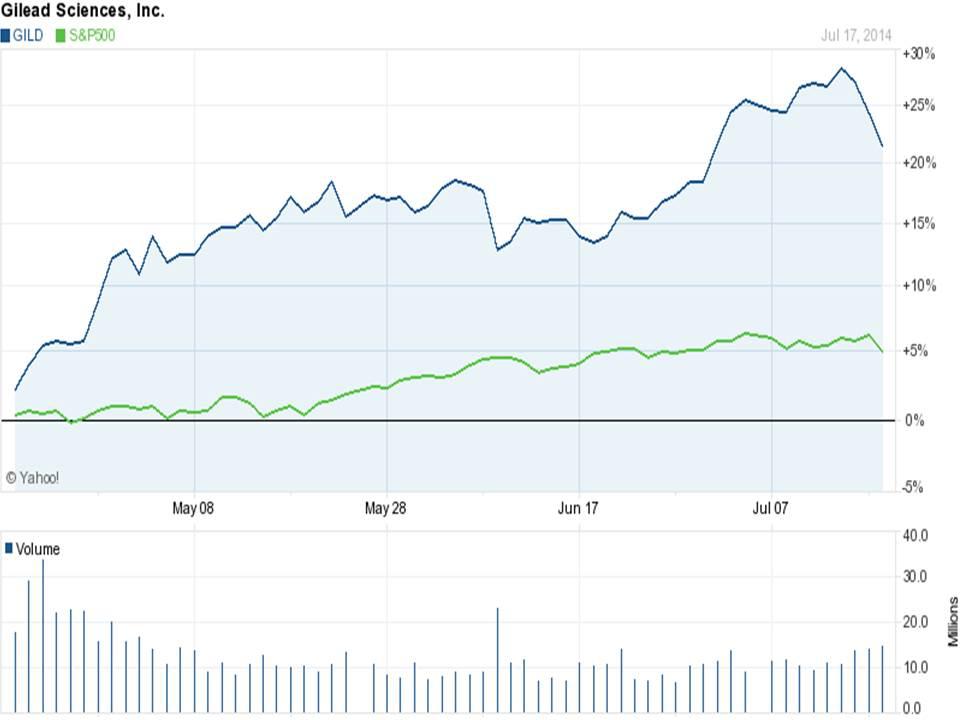
  • Gilead Sciences has appreciated more than 20% over the past three months easily besting the performance of the S&P 500.
  • Despite the recent rally, this fast growing biotech concern is still significantly cheaper than the overall market.
  • The stock appears poised to post significant further gains and investors might want to add to positions in front of next week's earnings report.
My regular readers know that I am a huge bull on biotech Gilead Sciences (NASDAQ:GILD). Not only is the company the biggest position I own in this volatile sector, it is also the largest holding within my portfolio, which I recentlydetailed.
The shares have run up more than 20% over the past three months but still are substantially cheaper than the overall market despite the company delivering huge increases in earnings as well as its substantial growth potential to come.
(click to enlarge)
I am circling back to the shares for two reasons. First, earnings are due to be reported. Given the company's recent history, results are likely to easily beat expectations so this might be the last time investors can get into or add shares to their existing holdings before the next stage of the stock's rally.
Second, Nomura took up its price target on Gilead yesterday from an already attractive $130 a share to $141 a share, which would be more than 50% upside from the current price of the stock. As importantly, some of the color provided by Nomura's four star ranked analyst provides why Gilead still has substantial gains ahead of it.
Nomura now believes that peak sales for the company's new Hepatitis C drug Sovaldi will reach $22B annually up from its previous estimate of $16B. To put this in perspective, Gilead paid just $11B for the company that developed Sovaldi back in late 2011. It also is the total amount of revenue the company should post this year (Sovaldi is ~50% of overall sales, the majority of the rest comes from the company's market share leading HIV franchise).
The investment bank also believes new two-drug and three-drug HCV combos will be launched in 2017 and 2018 further powering growth. Finally, Nomura believes Gilead's free cash flow will hit $13B next year (10% of its current market capitalization) and calls the company "most attractively priced large-cap growth stock in the healthcare industry."
What is amazing about Gilead is its valuation even after its recent rally. The stock sells for just over 13 times forward earnings even as the company more than tripled last year's earnings on the back of a doubling of revenue this year.
The market overall is going for ~16 times forward earnings and is nowhere in the vicinity of the growth that Gilead is experiencing. Gilead beat the consensus earnings expectations by over 60% last quarter incorporating the first months of Sovaldi's sales.
It seems likely the company will beat estimates once again even as analysts have significantly hiked their earnings forecasts since then. I think Nomura is right in hiking their Sovaldi sales bogey yesterday.
The company is marching to earnings of ~$6.60 a share this year. Putting a still conservative 20 times forward earnings on that number provides a price target of $132 a share on Gilead, a little more than 50% above the current stock price.
Investors should open their ears on this undervalued long term growth play. The noise they would hear is the sound of a horn up ahead coming from a train that is leaving the station. STRONG BUY
Source:http://seekingalpha.com/article/2323855-gilead-50-percent-upside-from-here

Tuesday, June 17, 2014

Det Norske: 200% Upside Potential After Game-Changing Acquisition

Disclosure: The author has no positions in any stocks mentioned, and no plans to initiate any positions within the next 72 hours. (More...)

Summary
  • Det Norske is well positioned to generate robust cash flows from a game-changing acquisition of Marathon Oil Norge AS.
  • The complementary production profile of the company’s biggest assets ensures that funding is secured until first Johan Sverdrup oil in 2019.
  • The valuation gap suggests a potential 200% upside with a 12-18 month time horizon.
(Editors' Note: Det Norske trades on the Oslo stock exchange under the ticker symbol DETNOR.OL, with ~18.5M NOK average daily volume).

Investment Summary

I had initiated coverage on Det Norske (OTC:DETNF) and Oslo- DETNOR on February 20, 2014. The stock moved sideways to lower since my initiation. However, in the last few weeks, the stock has surged by over 10%. The reason: A game-changing acquisition for the company.
In my initiation, I had discussed the funding concerns for the massive Johan Sverdrup development and potential asset sale to fund the development. The scenario completely changes with this acquisition. This re-initiation discusses the acquisition and why it is a game changer for the company. Given the current valuation, Det Norske is well set for a 100% upside.

The Acquisition

On June 2, 2014, Det Norske announced the acquisition of Marathon Oil Norge AS for a cash consideration of $2.1 billion. The cash consideration is based on a gross asset value of USD 2.7 billion and is adjusted for debt, net working capital and interest on the net purchase price.
While the acquisition is expected to close in the fourth quarter 2014, the effective date of the transaction is January 1, 2014. The positive impact of the acquisition was evident on the stock price with Det Norske surging by 9% on the day of acquisition announcement.

The Financing

For financing the acquisition, Det Norske has a fully committed and underwritten acquisition loan facility provided by BNP Paribas, DNB, Nordea and SEB. The company has also mandated and is in advanced discussions with the same four banks to finalise a seven-year Reserve Based Lending facility of $2.75 billion. This long-term facility will replace the acquisition loan and refinance Det Norske's current facilities.
Det Norske also intends to strengthen its equity base by issuing $500 million in new equity issue through a rights issue. The company's largest shareholder Aker Capital AS (OTC:AKAAF) has pre-committed to subscribe for its 49.99% pro rata share of the rights issue. Further, the remaining 50.01% is fully underwritten by a consortium of banks. In other words, the complete financing plan is largely secured.

Assets After Acquisition

Marathon Oil Norge AS, at the time of acquisition, had 136mmboe of proven and probable reserves. In addition, the company had 24mmboe of contingent resources and 80mmboe of potential upside in discoveries. Marathon Oil Norge had a 2013 net average production of 80,000boepd with revenue of $3.2 billion. In terms of acquisition price, Det Norske has paid $19.85 per barrel of oil equivalent considering a gross asset value of USD 2.7 billion.
For the combined entity, the proved and probable reserves as of December 2013 were 202mmboe with 60% of the combined reserves in production. Further, for the combined entity, the contingent resources are 101mmboe and the 2P and 2C reserves exclude the Johan Sverdrup development.
Among the acquired and producing assets, Alvheim field has 2P reserves of 93mmboe with more than 80% liquids. The production in the field is expected to last until 2031. The 2014 working interest production from the Alvheim field is expected to be 60,000boepd. The Volund field has 2P reserves of 14mmboe and production in the field is forecasted to last until 2025. The Vilje field has 2P reserves of 14mmboe with production until 2030. The Boyla field, which has reserves of 15mmboe, is expected to commence production in the first quarter of 2015. The gross plateau production from the field is expected to be 20,000boepd and the production is forecasted to last until 2030.
Among the existing assets (excluding Johan Sverdrup), Ivar Aasen has 2P reserves of 55mmboe, Gina Korg has 2P reserves of 7mmboe with other assets having 2P reserves of 3mmboe. The company's Ivar Aasen project is on schedule and the first oil from the project is expected in the fourth quarter of 2016. The company's share of production from Ivar Aasen is expected to be 16,000boepd with a plateau of 23,000boepd by 2019.

The Game Changer

I mentioned at the onset that the acquisition is a game changer for Det Norske. In summary, the acquisition and the financing discussed above ensure that Det Norske is fully funded for its Sverdrup development. In other words, the company will not need any additional external funding through 2019, when the first oil is expected from Johan Sverdrup.
The complementary production and cash flow profile for Det Norske and Marathon Oil Norge AS assets makes this acquisition an excellent and well timed deal. My point will be clear with the charts below.
The first chart gives Det Norske's standalone production profile.
It is clear that the next few years would have been associated with relatively low production. The first production bump-up comes when Ivar Aasen starts first oil by the first quarter of 2016. The second production bump-up comes when Johan Sverdrup starts production in 2019.
The issue with the standalone entity was the lack of internal funding available for investment in the massive Johan Sverdrup project. For the same reason, I had discussed in my initiation that the company is exploring some asset sale option.
The second chart below gives the production profile for Marathon Norge.
It is clear that Marathon Norge is at the peak production profile at this point of time. The company's production in 2013 averaged 80,000boepd. For 2014, the production is expected marginally lower at 60,000boepd.
The most critical point here is that the complementary production profile ensures that Det Norske, as a combined entity, produces robust cash flow from 2014. The chart below gives the production profile of the combined entity.
The company's management expects that the cash flow from Marathon Oil Norge production, cash flow from Ivar Aasen and the recent financing will be sufficient to fund all the investment needed for Johan Sverdrup until 2019.
Another positive related to the acquisition is the prior to Marathon Norge; Det Norske was not in a tax paying position. Consequently, all the investments had to be funded on a pre-tax basis and the company was building up significant tax losses.
These tax losses could not be offset against revenue before Johan Sverdrup came on stream in 2019. After the transaction, the company can offset the tax against fields in production from day one. In other words, the use of tax benefits shifts to 2014 from an earlier expected date of 2019. While this is one of the side advantages, it was important to mention as it underscores the excellent timing of the acquisition.

Revenue Projections For 2014 and 2015

For the first quarter of 2014, Det Norske reported revenue of $27 million and a negative EBITDA of $2 million. This section discusses the revenue outlook for the remainder of 2014 and the revenue for 2015. The objective is to determine the kind of EBITDA and potential operating cash flow for Det Norske after the acquisition.
For the first quarter of 2014, Marathon Oil Norge AS reported an average production of 69,000boepd. The production in 1Q14 was negatively impacted by severe winter weather which resulted in eight days of curtailed production.
Therefore, for the remainder of 2014, my assumption is a marginally higher production of 72,000boepd. Det Norske (standalone) reported an average production of 2,895boepd in 1Q14. I have assumed production to remain at the same level for the remainder of 2014. In other words, the expected production for the remainder of 2014 is likely to be 74,895boepd. The projections for 2014 are considering this production level and a sales price of $106 per barrel (current crude oil price).
Marathon Oil Norge AS reported an EBITDA margin of 87% for the year ended December 2013. I have assumed the same EBITDA margin for 2014E. Also, Marathon Oil (MROreported an EBITDA cash conversion ratio of 74% for 1Q14 and I have assumed the same conversion ratio for operating cash flow calculation.
Therefore, with the acquisition, Det Norske is likely to generate an operating cash flow of nearly $1.4 billion for 2014. Strong operating cash flows will help fund the massive investment plan for Johan Sverdrup.
For 2015, the production upside will come from the Boyla field, which is expected to commence production in the first quarter. Considering a gross production of 20,000boepd from the field, the company's share of production comes to 13,000boepd for a 65% stake.
For my assumptions, I have considered production from other fields to remain stable at 72,000boepd and a production of 13,000boepd from the second quarter of 2015 from the Boyla field. Also, the EBITDA margin and EBITDA cash conversion ratio have been assumed to be the same as 2014. The sales have also been considered to be executed at a current oil price of $106 per barrel. With these assumptions, the revenue, EBITDA and cash flow outlook is as below.
The revenue, EBITDA and operating cash flow is likely to be $3.2 billion, $2.7 billion and $2.0 billion respectively for 2015E. Even for 2016 and 2017, the production bump-up will come from the rich Ivar Aasen field. The point I want to stress is that Det Norske will transform from a no cash generating position to a point where the company increases its revenue annually and also generates robust operating cash flows.

Johan Sverdrup Revisited

In my initiation on Det Norske, the capital expenditure funding for Johan Sverdrup was not certain and the asset value was therefore not completely discounted in the stock. I would again like to discuss Johan Sverdrup at a time when the funding is certain until first oil in 2019. I believe that the stock will discount the asset value, especially when the plan for development and operations, scheduled to be delivered in early 2015. This will be another significant stock upside trigger for Det Norske.
Johan Sverdrup was the biggest oil discovery in the world in 2011 and the biggest in Norway in decades. Det Norske holds stake in 2 licenses in Johan Sverdrup with the company holding a 20% stake in PL265, which is estimated to have gross contingent resources in the range of 900mmboe to 1,500mmboe.
Considering an average resource of 1,200mmboe, Det Norske's share in the license would come to 240mmboe. Det Norske also has a 20% stake in the PL502 license. The reserves in this stake are not significant as PL265 and PL501 are the main licenses. In order to have a conservative estimate, I would peg the total reserves from both the licenses at 250mmboe. The positive factor to mention here is that Statoil has recently announced that oil recovery of 70% is achievable in Johan Sverdrup. Higher oil recovery is likely to boost the asset valuation.
As mentioned in my initiation coverage, Lundin Petroleum (OTCPK:LNDNF), which also has stake in Johan Sverdrup, believes that the current transaction value for Johan Sverdrup should be in the range of $10/boe. This would peg the value of Det Norske's share of reserves at $2.5 billion in contrast to the company's current market capitalization of $1.7 billion and implies a stock upside of 56% from current levels.

Valuations

I consider Lundin Petroleum to be the best peer for Det Norske. The reason being that Lundin Petroleum also holds stake is the giant Johan Sverdrup field. The key difference between the two companies was the fact that Lundin expects significant cash flows from current developments to finance its investment in Johan Sverdrup. On the other hand, Det Norske was struggling to find a way to fund the Johan Sverdrup development.
With the acquisition, Lundin Petroleum and Det Norske are at par when it comes to financing Johan Sverdrup and Det Norske's forward valuation should catch up with Lundin Petroleum's valuation.
I had initiated Lundin Petroleum in one of my earlier articles and taking the 2015E EBITDA (revised for current oil prices), the stock is currently trading at an EV/EBITDA valuation of 4.8. On the other hand, Det Norske is trading at an EV/EBITDA (2015E) valuation of 1.6.
This implies a valuation gap of 200% and I strongly believe that Det Norske has this upside potential after the game-changing acquisition. I must mention here that I have incorporated the $2.7 billion acquisition debt and the planned $500 million equity offering by Det Norske in the calculation of EV. This largely incorporates the factors related to the acquisition.

Risk Factors

With high 2P reserves after the acquisition and a stable production profile, the risk related to immediate developments in the company is minimal. Of the current 2P reserves, 60% are in production and this ensures strong operating cash flow for the company over the next few years. The offsetting factor to strong cash flows can be a decline in oil prices.
For the forecast, I have assumed crude oil price of $106. Any decline in prices can negatively impact cash flows and also potentially delay the development of Johan Sverdrup. I however believe that a decline in oil prices is unlikely considering the supply constraints that might arise from prevailing tensions in the Middle-East. From that perspective, the company is operating in a safe-zone when it comes to geo-political risks.

Conclusion

The $2.7 billion acquisition of Marathon Oil Norge AS completely changes the scenario for Det Norske in terms of funding and growth. The acquisition complements the company's production profile and provides robust cash inflow until 2019. Just over the next two years, a potential cash inflow of $3.4 billion is likely.
Det Norske stock was depressed prior to this news as there were big funding concerns. On the day of acquisition announcement, the stock jumped by over 9%. This is just the beginning of a long-term rally for the company and I believe that the valuation gap will be filled over the next 12-18 months. During this time period, the company will be generating strong cash flows and the plan for development and operations for Johan Sverdrup will also be in place. Det Norske is a "Very Strong Buy" at current levels.
Editor's Note: This article discusses one or more securities that do not trade on a major exchange. Please be aware of the risks associated with these stocks