Showing posts with label Donald Trump. Show all posts

Monday, February 12, 2018

How the New Tax Law Impacts Cryptocurrencies


Image result for new tax law

The tax bill that Donald Trump signed into law in late December represents the most substantive changes to the federal tax code in 30 years, but Congress passed up its chance to clarify matters for cryptocurrency investors, traders, issuers and miners. The community is left with a host of questions and ambiguities; but while the tax bill does not directly address cryptocurrencies such as bitcoin, ether and the tokens issued through ICOs, it does impact them indirectly. 
Especially important are changes to six provisions in the tax code: like-kind exchanges, loss carrybacks, the corporate tax rate, the business interest deduction, miscellaneous personal deductions, and the treatment of pass-through businesses. (See also, Trump's Tax Reform.)

Like-Kind Exchanges

Google "bitcoin tax bill" or some variation, and most of the results will focus on section 1031 of the tax code, which allows capital gains taxes to be deferred for certain "like-kind" exchanges of property for other, similar property. The provision was originally envisioned as a break for farmers swapping livestock, but came to be used for trades in commercial real estate, art and airplanes – and

According to three attorneys contacted by Investopedia, at least some cryptocurrency investors regard a sale of bitcoin for ether, for example, to be a like-kind exchange that is exempt from capital gains taxes. None of the attorneys we spoke to, however, is convinced: taxpayers who treat crypto-for-crypto exchanges as like-kind are "taking the risk that if they got audited, the IRS would disagree," says Jeremy Naylor, a partner at Cooley LLP. Under the new law, he continues, "it's clear now that you can't do that." The exemption that section 1031 previously applied to "property of like kind" only applies to "real property of like kind" under the new law, meaning that cryptocurrencies definitely don't qualify.
Investors considering taking advantage of this break for the 2017 tax year should weigh the risks. Matthew Gertler, senior analyst and counsel at Digital Asset Research, says, "Like-kind exchanges were never a thing for crypto," adding, "most of the articles I have read supporting that like-kind exchanges apply were not written by attorneys or accountants." Trading one stock for another doesn't qualify for the break, he points out, nor does trading gold for silver, "so I want to hear why the trading of one cryptocurrency for the other constitutes the same kind of property."

Loss Carrybacks

A second change to the tax code affects businesses in the cryptocurrency space, such as those raising money by issuing tokens through initial coin offerings (ICOs) or a similar fundraising method known as a SAFT. Under the old tax law, business losses could be carried back two years, a boon to companies that raise money in a token sale one year, then experience operating losses in subsequent years. The new law eliminates loss carrybacks.
"Some folks doing ICOs and raising money selling tokens were assuming they'd be able to use losses [in 2018 and 2019] to offset income in 2017," Naylor says. "That benefit is no longer there."

Corporate Tax Rates

The central provision of the new tax law is a steep cut in the top corporate tax rate from 35% to 21%. Short-term capital gains are taxed as ordinary income, at marginal rates ranging from 10% to 37% under the new law in 2018. Long-term capital gains – profits from selling assets held for at least a year – are taxed at a top rate of 20%. For traders who hold cryptocurrencies for shorter durations, therefore, the new corporate rate could represent an opportunity.
"We would never suggest that someone take their personal activities and blindly incorporate," says Evan Fox, a manager in the tax department at Berdon LLP, but "there are a few scenarios – and this would need to be analyzed by tax advisors and accountants – where it could make sense for an individual to form a corporation to do their crypto trading." (See also, How the GOP Tax Bill Affects You.)

Pass-through Deduction

The introduction of a new deduction for pass-through entities, which allow business income to be paid through personal tax returns, could also represent an opportunity. Gertler, Naylor and Fox all stressed that cryptocurrency traders are not eligible for this deduction, but Fox thinks that the pass-through deduction could be interesting to miners. (See also, What Is Bitcoin Mining?)
The new law allows a deduction of up to 20% of pass-through income, limited to 50% of wages paid by the entity or 25% of wages plus 2.5% of the unadjusted basis of the entity's property. Mining is an extremely capital-intensive business, requiring the purchase of large arrays of ASICs – the specialized hardware used to carry out the hash functions involved in proof of work – and for particularly large organizations, employees to maintain them.
Another bonus for miners, Fox adds, is immediate expensing for new equipment for five years.

Business Interest Deduction

The new law doesn't just give, however, it taketh away. Business interest deductibility – previously unlimited – will be capped at 30% of adjusted earnings (Ebitda for four years, then Ebit). "It seems like a lot of clients are tripping" that limit, says Fox, "and having a non-deductibility of interest." Miners in particular appear to be taking on the kind of leverage that runs into the limit. The new cap does not apply to personal interest, he notes, so it won't apply to "people out there mortgaging their houses to buy bitcoin." That's "probably a bad idea," he adds. (Yes, it probably is.)

Miscellaneous Personal Deductions

Finally, individuals should be aware that a number of 2% deductions – which taxpayers who itemize can claim on the amounts by which certain expenditures exceed 2% of adjusted gross income – were eliminated by the new law. "Especially in the crypto world, people are traveling a lot to see different companies, they're going to conferences, they're buying segregated computers, they're purchasing cold wallets," says Fox. "Expenses can get into the thousands and thousands of dollars, and now those are essentially irrelevant for tax purposes."

Waiting for the Rules

Naylor cautions that "a lot of this is going to be unclear until we get regulations that implement the law," a caveat that Fox echoed. Investors, traders, miners and the rest of the crypto community should be cautious until the IRS has fleshed out the legislation (due to funding and staffing shortages at the agency, however, this could take several months). And of course taxpayers should seek professional advice before making decisions based on changes to tax law. (See also, The Investopedia Tax Center.)

Click link below to get $10 worth of bitcoin when you open an account with coinbase https://www.coinbase.com/join/5a6e2f127942b905f74c6837

Source: 
https://goo.gl/VA4tMY

Thursday, November 2, 2017

Paul Manafort is accused of money laundering — what is it and how do you do it?

Manafort’s alleged $18 million in laundered money makes him a relatively small player in the global money laundering game


In addition to conspiring against the United States and failing to report foreign bank accounts, Paul Manafort, President Donald Trump’s ex-campaign manager, is charged with laundering more than $18 million and sending more than $75 million through offshore accounts. (Manafort’s lawyer has called the charges “ridiculous.”)
Of course, that’s a lot of money, but money laundering is so prevalent worldwide that Manafort’s alleged scheme makes him look like small potatoes, said Jeffrey Robinson, author of “The Laundrymen.” The top money launderer for Mexican drug kingpin El Chapo laundered $300 million to $400 million a year for a total of $1 billion over the course of a decade, according to Mexican law enforcement.
The practice of making so-called “dirty money” clean has ballooned in the last couple of decades, and these days some $1.25 trillion to $1.5 trillion is probably circling the globe looking to get clean, Robinson estimates.
“It’s out of hand,” he said. “The people who own this money are actually the most powerful special interest group in the world.”
What is money laundering and how does it work? Here’s what experts told MarketWatch:
What is money laundering?
The first step in money laundering is to commit a crime that makes you some money — a lot of money. Only people who have a bunch of cash they’ve made through illicit means need to launder money. The process takes “dirty money” — ill-gotten gains -- and turns it into “clean” money that appears to be legitimately earned.
“You have a bulk problem. If you’re a drug trafficker, your friends will steal it from you. So you have to get into the banking system.”
- Jeffrey Robinson, author of “The Laundrymen”
Authorities say Manafort acted as an unregistered agent for a foreign government (Ukraine) and failed to pay taxes on the income he earned doing that. Manafort and his associate Rick Gates allegedly earned “tens of millions,” and, over the course of a decade, allegedly used several corporations, bank accounts and partnerships to hide the Ukrainian payments from U.S. authorities. (Read the full indictment here.)
Why do people have to launder their money?
Though spending large sums of cash would seem to be as American as singing the National Anthem, it is almost impossible to do so without attracting the attention of the government and law enforcement — even if you’re a law abiding citizen.
Every time someone spends $10,000 or more in cash in the U.S. — in some cities, like New York, the amount is lower — the transaction is reported to authorities. Banks, casinos, sellers of gold and jewelry, even mortgage lenders and insurance companies must file what are called “suspicious activity reports” with financial crime investigators.
They review the reports and look for red flags. BeyoncĂ© and Jay-Z walking into an auto dealership to drop a pile of cash on a new car doesn’t raise eyebrows, but Joe Shmoe who’s unemployed and hasn’t paid taxes in several years would probably get a second look, said Kevin Sullivan, a former New York state police investigator who used to read the suspicious activity reports.
Large amounts of cash wasn’t an issue for Manafort — he allegedly used wire transfers from offshore accounts to access his money. But cash can be a burden for drug traffickers and others who deal in dollar bill-intensive enterprises: $1 million in $100 bills weighs about 22 pounds and stacks about 8 to 10 feet high, Robinson noted. “You can’t get them into an attache case the way James Bond did,” Robinson said. “You have a bulk problem. If you’re a drug trafficker, your friends will steal it from you. So you have to get into the banking system.”
How do people launder money?
“You work very hard for your illegal money and you want to enjoy the fruits of it. You have to seem like a legit guy. The government is watching you,” said Chris Mathers, author of “Crime School: Money Laundering.”
“This is an industry that’s in flux with all the new technology that’s out there. It’s a good time to be in money laundering.”
- Kevin Sullivan, Anti-Money Laundering Training Academy
In Manafort’s case, authorities allege he used shell companies (which he controlled, but weren’t linked to his name) to funnel millions into accounts in the Seychelles, Cyprus and St. Vincent and the Grenadines. Using the shell companies, he wired the money into the U.S. to buy real estate in New York and Virginia, then took out mortgages on the properties to get cash, authorities say. He also allegedly paid for a “lavish lifestyle,” spending millions on high-end rugs, antiques, clothes and upgrades on a house in the Hamptons. Bills for the those items were paid by the shell companies.
Other classic money laundering techniques:
• Trade price manipulation
Let’s say a drug dealer makes $1 million selling heroin. Instead of putting the money in the bank, the dealer creates a fictitious company and uses it to buy 200 Rolex watches at $5,000 each. He ships the watches overseas, but on the ship’s bill of lading, he lists them as fake watches worth little money. Once the watches reach their destination, a partner in that country sells them at their full price, and the dealer recoups his $1 million.
• Commingling dirty money with clean money
This method is well-known to fans of the AMC TV show “Breaking Bad,” in which lead character Walter White and his wife laundered drug money by mixing it with money they made at a car wash they owned. To do so, they would ring up charges for say, 1,000 car washes in a single day, when in reality they had sold only 500 car washes that day. They would use their dirty money to pay for the fictitious car washes, which they could then claim as business income. The recent Netflix show “Ozark,” starring Jason Bateman as a financial adviser who launders money for a Mexican drug cartel, featured a similar plot line, captured in this handy how-to guide:


• “Smurfing”
With this older method, criminals with large sums of cash, say $1 million, would send 50 guys into 50 different banks to deposit $2,000 each.
‘It’s a good time to be in money laundering’
The same new technologies disrupting how we handle money in person and online are also affecting the money laundering business. “This is an industry that’s in flux with all the new technology that’s out there,” Sullivan said. “It’s a good time to be in money laundering.”
Mobile payment systems, virtual currencies, and currencies used in online gaming all provide new territory for money launderers to mine, he said. But one positive for law enforcement is that high tech methods generally leave a trail of digital bread crumbs for investigators to follow.
Who does it?
Classic money launderers include terrorists, arms dealers and drug traffickers, but these days most of the dirty money around the world is linked to corporate and political corruption, Robinson said.
One reason for its growing prevalence: prosecutors are increasingly reluctant to pursue money laundering cases. That’s because cases are time-consuming and sometimes very complicated to explain to a jury. And at the end, the accused may not go to jail, because he’ll probably cop a plea and pay a fine, Robinson said.
“If you look at Mexico or Russia, you understand that dirty money is doing to these countries what it did to Colombia, which is pollute the political world,” Robinson said, noting that Medellin drug cartel leader Pablo Escobar influenced Colombia’s politics for years by “buying and selling” politicians. “It’s a very very destructive force,” he said.
Another side effect? Money launderers don’t pay taxes on their money, which means governments are missing out on that tax revenue, and leaving the rest of us to foot the bill.
What skills does money laundering involve?
Like many jobs, being a successful money launderer depends on who you know. Just like we use professional mechanics to fix our cars, sophisticated criminal groups use professional money brokers to fix their money-washing problems. It also helps to know good accountants, have contacts at financial institutions, and most of all, have highly skilled lawyers who can help create shell companies that are structured to leave no trace of their true owners.
Lawyers are important because in some jurisdictions they’re not required to report unusual financial transactions the way banks and other institutions are, Mathers said. And what happens between them and their clients is privileged information, he added.
“In order to launder money, you need human beings,” Mathers said. “You need cooperation from other people, particularly attorneys. You can’t launder effectively without attorneys, period.”
By Leslie Albretch

Thursday, July 6, 2017

The global economy is doing something it hasn't done in 7 years and that has Wall Street excited

View of Hangzhou skyline at Hangzhou Civic Culture Center displaying flags of G20 members in preparation for the 2016 G20 Hangzhou summit on June 11, 2016, in Hangzhou, Zhejiang Province of China.

  • A "global synchronous recovery" is the new talk of Wall Street bulls.
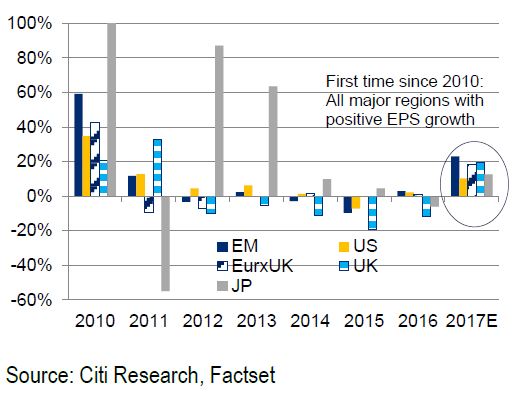
  • All major markets will report strong earnings growth in 2017, predicts Citi Research, the first simultaneous upturn since 2010.


ll the major economies of the globe and the companies that make them up are picking up steam at the same time right now, the first such simultaneous recovery in years. 

This is making the phrase "global synchronous recovery" among the favorites of bulls on Wall Street.
"We expect all the major markets to report healthy EPS growth in 2017. That's the first synchronized upturn since 2010," wrote Robert Buckland, chief global equity strategist at Citi Research, in a note Tuesday.
"That's a big change compared to recent years, when we had various regions and countries moving in and out of EPS recessions," he added.
Along with earnings growth, the major markets will see decent economic growth this year as well that will carry over into next year, Citi estimates. The research analysts forecast global GDP growth of 3.1 percent this year and 3.3 percent next year.
"This eight-year global bull market may be old, but we don't think it is finished," Buckland wrote. They forecast a 9 percent return for global stocks over the next 12 months and favor technology, energy and banking stocks.
Major equity markets have already posted strong performances for the year in response to this synchronous recovery. In the U.S., the S&P 500has gained 8.4 percent in 2017, while the pan-European Stoxx 600index and the Japanese Nikkei 225 index have advanced 5.9 percent and 5.1 percent, respectively.
Emerging markets, meanwhile, have outperformed developed markets, with the iShares MSCI Emerging Markets exchange-traded fund (EEM)surging more than 17 percent this year.
The global synchronous recovery was also mentioned Wednesday in a report on commodities from UBS.
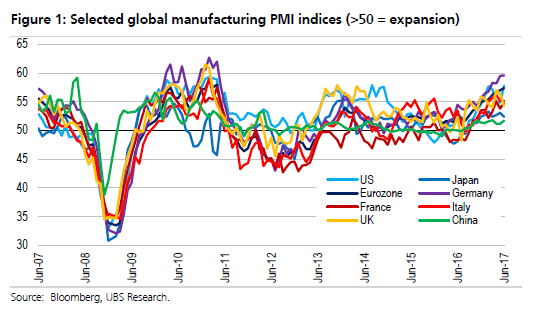
Lachlan Shaw, an analyst at UBS, pointed out in the note that purchasing managers' indexes "across key economies are synchronized and strong" and that backs up the firm's overweight position in the commodities sector.

WATCH: Forget 9-to-5. Four hour workdays are the future, says Jack Ma


The chart below illustrates the manufacturing PMIs for the U.S., euro zone, France, the U.K., Japan, Germany, Italy and China from June 2007 to June 2017.

RELATED SECURITIES


Symbol
Price
 
Change
%Change
.NKXQ20081.63
 
49.280%
EEM41.55
 
-0.08-0.19%
STOXX600379.88
 
-3.11-0.81%
S&P 5002432.54
 
3.53

By Fred Imbert

Source :https://goo.gl/xgL6kg

Monday, January 16, 2017

What Does a Donald Trump Presidency Mean for the Markets?


In a historic victory that shocked the political establishment and global financial markets alike, Donald J. Trump will become the 45th president of the United States. In an uncanny echo of the Brexit outcome, millions of Americans frustrated with the country’s direction voted against the perceived status quo in the world’s wealthiest and most powerful democracy. Yet lack of clarity on how the president-elect actually will govern poses both risks and opportunities for investors.

What Could a Trump Presidency Look Like?

Republican candidate Trump beat his Democratic opponent Hillary Clinton by a notable margin. The uncertainty around his policies has unnerved investors, at least initially. Global stock markets were volatile, the U.S. dollar slid against major currencies and U.S. Treasuries and gold rallied as investors moved away from higher risk assets.

Now investors and international leaders must take measure, and Americans will adjust to the style and tone of a self-proclaimed outsider in the White House. However, the Republican majority in both the House and the Senate means Trump stands a good chance of enacting much of his economic agenda. He could do that via the so-called budget reconciliation process, under which tax and spending changes can pass with a mere majority of the Senate, not 60 votes. Investors now spooked by Trump’s election may find themselves surprised next summer by the economic stimulus Trump’s Washington enacts.

While we expect market volatility to continue as investors adjust to the reality of a new balance in power in Washington, here are five key areas in which policy decisions could have an economic impact.
The president-elect has talked about an infrastructure plan of what could be at least $500 billion, based on his informal pledge to roughly “double” what his opponent campaigned on. 
While many in the nation’s capital are skeptical, this effort may well include some version of a border wall intended to staunch the flow of immigrants across the southern border of the U.S., a centerpiece of his campaign. In theory, the U.S. could even give Mexico loan guarantees to borrow at very low interest rates to assist in its construction, thus making good on Trump’s promise to have Mexico “pay” for the wall. Such a huge project might come to be seen as a Keynesian-style jobs program on both sides of the border. 
Meanwhile, the same drive that led Trump to put his name on skylines in New York and elsewhere seems likely to inspire the new president to embrace an infrastructure agenda that would leave his legacy imprinted on any number of new or repaired roads, bridges, tunnels, seaports, airports, sewer systems, electric grids and more. If a stimulus of the size he’s discussed were to be dispersed over a five-year time frame, it could add up to half a percentage point to gross domestic product annually over the period.
Those infrastructure projects could be partially paid for through a corporate tax overhaul. Any such deal would likely include a provision to repatriate the estimated $2 trillion of U.S. corporate earnings trapped overseas by taxing it on a one-time basis at roughly a 10% rate. This could entice companies to bring the cash back to the U.S. 
Most Republicans and Democrats agree that the U.S. corporate tax code needs reform. That makes it a prime candidate for bipartisan agreement and a potent early chance for Trump to showcase his negotiating skills. During his campaign, he pledged to cut the top marginal corporate tax rate to 15% from 35%, which should have the desirable side effect of curbing inversions — transactions that allow a U.S. company to merge with an overseas firm and pay a lower tax rate in the latter’s country. This practice has become popular over the past several years, much to the dismay of policymakers. 
Trump has also pledged to dramatically lower personal income tax rates. If Trump has his way in the reconciliation process, the resulting blueprint — which would also include substantial defense increases — would spell higher budget deficits in the near-term. More traditional Republican entitlement reformers, like Paul Ryan, will likely seek assurances from President Trump that he’ll return to these long-terms concerns within a few years.
A president has more unilateral power to make changes to current trade arrangements than is commonly understood. That means President-elect Trump could rewrite deals to be tougher on trade partners — or use the threat of U.S. withdrawal from existing deals as a negotiating ploy to force changes in areas he deems important. While the Washington establishment fears Trump will lead us into a destructive and recession-inducing trade war, that’s hardly guaranteed. It seems more likely that Trump would see his and the country’s interests better served by a posture that flexed some unused trade muscles to arrive at better terms at the margins. 
In particular, Trump has pledged to revise the North American Free Trade Agreement, which was signed by his opponent’s husband, President Bill Clinton, in 1993. He would also kill the Trans-Pacific Partnership, a result that would hurt America’s prestige in the region. Finally, Trump has called for tougher rules on trade with China, who he says has taken advantage of U.S. trade negotiators for years. He could also attempt in various ways to crack down on U.S. firms that move jobs, plants or operations overseas.
Although Trump has been vague about his precise plans for health care, he has campaigned on repealing the Affordable Care Act (ACA). Most observers believe, however, that it would be politically disastrous to simply cancel coverage for the 20 million Americans who’ve gotten health coverage under the ACA. So it’s likely that the GOP plan to “repeal and replace” the law will ultimately be implemented as a kind of “repeal and rebrand” — i.e., some scaling back of subsidies and regulations Republicans find excessive while nonetheless holding the vast majority of current ACA beneficiaries harmless. During the transition there may be market jitters for hospital and health plans that depend on the ACA’s subsidies and related supports. In the end, however, they should be able to flourish even after a GOP revamp. 
During his campaign, Trump also criticized high drug prices, saying the government needs to be a stronger negotiator with pharmaceutical firms. If he follows through, that could mean a push for the government to exert its pricing power through Medicare, Medicaid and its other programs. However, the GOP more broadly is not aligned with Trump on the idea of direct price negotiations, so the outcome for now remains unclear.
Trump has called for major defense spending increases, which would probably include beefing up defensive homeland security as well as offensive capabilities. That could signal something of a reversal from the Obama administration, which allowed defense spending to decline. Of course, if growth for such expenditures picks back up, it would be welcome news to big defense contractors in industries like aerospace.
Over the long run, the U.S. economy is likely to remain one of the strongest globally no matter who resides in the White House. Nevertheless, the president has the power to execute policy changes that can move markets. 
While these five areas are some of the most significant in which the president-elect hopes to make changes, he and the new Congress can affect the economy in other ways as well. For example, Trump has said he’ll roll back 2010’s Dodd-Frank financial regulation law. Trump has also said that he would pull out of the Paris climate deal and undo environmental regulations to promote fracking and the coal mining industry. That could have a negative impact on renewable energy companies and a positive one on fossil fuel firms. These steps would also be highly controversial.
In the end, a Trump administration means a significant shift in Washington policy for at least the next four years. That could worry markets initially as they wait to see how a Trump presidency actually takes shape.
By Matt Miller

Source: http://www.investopedia.com/sponsored/?prx_t=G4cCAEL4LACg4PA

Wednesday, November 16, 2016

Wall Street Breakfast: Snapchat Ready To Make A Lasting Mark?

 Includes: AMZNBABABABCSCBSCHATCRARYCRMDBFG

The clock has started ticking for one of the most eagerly awaited market debuts of 2017. Snapchat has reportedly filed for an initial public offering in what could be the biggest U.S. listing since Alibaba (NYSE:BABA) went public two years ago. The ephemeral messaging service's parent, Snap Inc. (Private:CHAT), is eyeing a $20B-$25B valuation range, with Morgan Stanley and Goldman Sachs as lead underwriters of the IPO.
Economy
Oil rose around 6% yesterday, its best one day performance since April, on renewed hopes of an OPEC deal to cut production. But prices are now dipping lower after the IEA left its supply and demand forecasts unchanged despite the 2015 Paris Climate Change Agreement entering into force. "The difficulty of finding alternatives to oil in road freight, aviation and petrochemicals means that, up to 2040, the growth in these three sectors alone is greater than the growth in global oil demand," the IEA said in its annual World Energy Outlook.
Longtime Donald Trump supporter and activist investor Carl Icahn has confirmed the president-elect is considering Wall Street veteran Steven Mnuchin and billionaire Wilbur Ross for Treasury and Commerce Secretary, respectively. Meanwhile, Paul Ryan was unanimously chosen for another term as House speaker by his Republican colleagues as he called for his party to unite behind Trump.
"A single policy-rate increase, possibly in December, may be sufficient to move monetary policy to a neutral setting," St. Louis Fed President James Bullard said at a UBS conference in London. "There were a lot of predictions that if the election went the way of Republicans and President-elect Donald Trump, then there would be great deal of volatility, but that has not materialized so far."
Bank of Canada Deputy Governor Timothy Lane will speak about globalization at noon ET and market watchers will look for any hints on the central bank's view of the U.S. election results after it held rates last month citing uncertainties. The U.S. is also Canada's biggest trading partner and the destination for roughly three-quarters of Canadian exports.
Citing persistent terror threats, Francois Hollande wants to extend the state of emergency in France until the presidential elections in April and May. The measures were introduced in November 2015, following a series of terror attacks in Paris that left 130 people dead. They give authorities far-reaching powers, including banning people from leaving their homes and conducting searches without a court order.
Germany's banks are robust but suffer from weak profitability and may be underestimating the risk of falling asset prices or rising interest rates, the Bundesbank said in its latest stability review. Although the eurozone's largest economy has driven the bloc's recovery in recent years, German economic growth has slowed in recent quarters, and concern is mounting about the weak profitability of its vast but inefficient banking sector.
Stocks
Amazon for the first time has filed lawsuits against counterfeit sellers, after a number of businesses voiced concern that knockoffs were killing their sales and endangering consumers. Amazon (NASDAQ:AMZN) has increasingly relied on third-party sellers to fuel its growth, but opening its website brought with it a greater chance for fake goods to enter its warehouses.
Seeking to allay concerns over its largest ever deal, Microsoft (NASDAQ:MSFT) has offered concessions to EU antitrust regulators over its $26B bid for LinkedIn (NYSE:LNKD). The European Commission, which will rule on the deal by Dec. 6, did not provide details. It's expected to seek feedback from rivals and customers before deciding whether to accept the concessions, demand more or open a full investigation.

Wednesday, November 9, 2016

President Trump: The First 100 Days' Investment Winners

 About: SPDR S&P 500 Trust ETF (SPY)DIASHSSOVOOSDSIVVSPX

Summary

All rhetoric aside, the post election economy will be driven by traditional policy factors; taxes, monetary, and regulatory.
Trump will need Congressional agreement to enact any significant policies. For economic stimulus, he already has bipartisan supporters and should enact massive economic change in his first 100 days.
Tax, Trade, The Fed; these 3 Ts are the policy areas which will drive the economy under Trump.
Subscribers to Income From Covered Option Writing receive an advance look at this material.
DOW futures are swooning at a Trump Presidency. Let's look at reality to see if we can expect a good or bad economic outlook.
Apple (NASDAQ:AAPL), Microsoft (NASDAQ:MSFT), and 10 other companies can expect to be among the largest beneficiaries of the First 100 Days. Why and how are discussed below.
Reality Review: The Job
Donald Trump has been elected President of the United States. He has not been crowned king and has very few dictatorial powers. His, is an executive job, leading and managing what the Congress enacts as law and funds spending for. The courts also add significant further legal restraint on the ability to rule by fiat.
Election rhetoric that can't be done without the (nonexistent) support of the Congress and the Courts includes:
  • Ban immigration or new visas based on religion or creed (unconstitutional and would require an amendment).
  • Round up and deport millions of illegal (undocumented and visa overstay) aliens. (An impossible task, far underfunded and courts would drag out beyond 4-year term and likely ban ultimately).
  • Renounce existing ratified trade treaties. (Most all would require congressional approval to renounce. Most will have bi-partisan support to significantly modify to attempt to achieve the original results of *balanced trade and net job creation for all sides).
  • Modify tax code. (This is complex but there probably is bi-partisan support in a give and take tradeoff for both tax policy issues and quid quo pro spending deals).
  • Trade War With China. (Trump never claimed he wanted a trade war, only that he wants China to stop cheating on existing agreements. Critics claim China will reject his attempts. This ignores that China is the largest trade partner of the US and needs US trade. China also owns a huge part of US debt and weakening the US dollar would harm China and devalue the debt it holds. It would also harm China's currency which is partially linked directly to the US Dollar).
  • Heat up the Global War on Terror. (We have had hot and cold wars on terror and communism since the end of World War II. These are not grand economic determiners. Each alternative policy has both plus and minus effects on both short and long range economic outcomes. Overall, it can be considered neutral or indeterminant).
The 3 Ts, Policies likely to achieve bi-partisan support and be enacted in the first 100 days:
Tax, Trade, and The Fed (via interest rates) are the 3 primary policies that have always traditionally driven the economy and will continue to do so.
Trump has proposed 2 significant tax policies. One, a reduction to 10% tax rate for repatriated foreign earnings. This proposal is highly likely to bring bi-partisan support because it benefits everyone and harms no special interest. The resulting immediate infusion of over $2.5 trillion into the US economy in 2017 (and perhaps 2018). This would mean a $250 billion windfall to the tax treasury along with additional taxes from the economic activity generated by the remaining $2.250 trillion as it is spent on special dividends, mergers and acquisitions, and corporate expansion.
Add in the re-cycling of the 2nd cycle as the new jobs and orders create more economic growth and jobs as newly enriched consumers spend their money on deferred necessities and increased discretionary spending. It is estimated that every trillion dollars of economic activity results in 10.5 million jobs. Thus, the repatriation and investment of $2.5 trillion can stimulate creation of over 26 million new jobs.
Which are the companies that will most benefit from this change in tax policy?
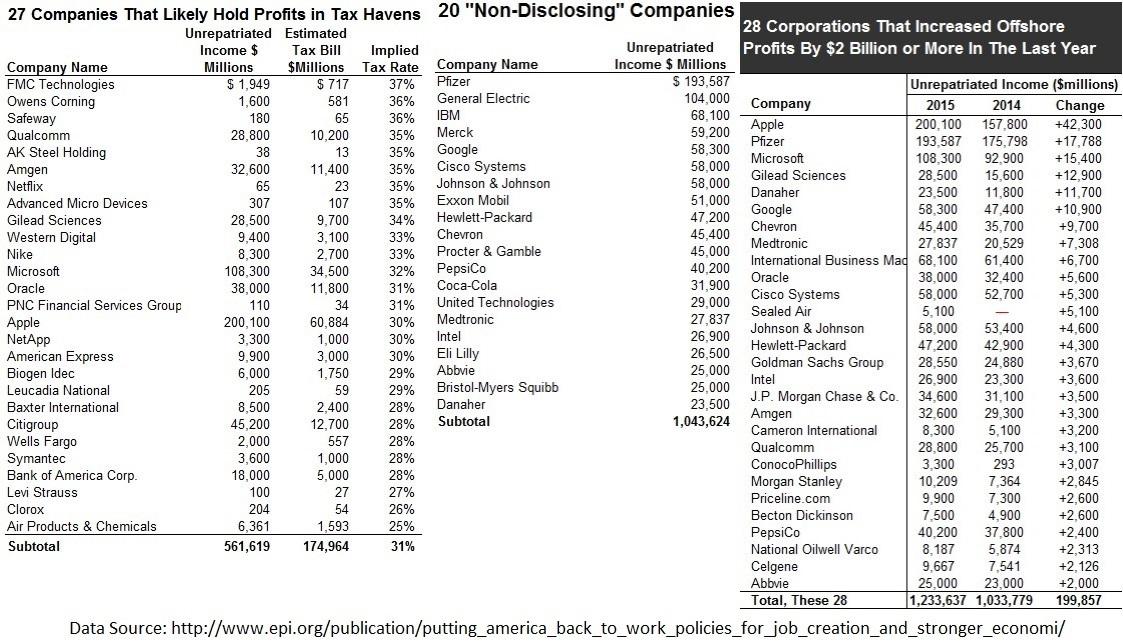
It is clear from the chart below that Apple, Pfizer (NYSE:PFE), Microsoft, and General Electric (NYSE:GE) will be at the top of the winners pile. Together, they represent $660 Billion (about 25% of the $2.5 trillion) in un-repatriated profits currently held in tax havens.
Changes in individual and corporate tax rates will take long and hard negotiations on policy components and specific tax targets. These are likely to result in a cut in tax rates, an increase in tax revenues, and overall economic growth. This has always been the case for such negotiated tax rate cuts in the past.
As the newly repatriated cash is put to work, the next immediate segments to benefit will likely be investment banking and employment services. This includes M&A giants like Goldman Sachs (NYSE:GS), JPMorgan Chase (NYSE:JPM), and Barclays (NYSE:BCS). Employment services will also benefit from a growing economy and job creation. Consider U.S. leaders such as the top four public companies: Adecco (OTCPK:AHEXY), Randstad Holding (OTCPK:RANJY), ManpowerGroup Inc. (NYSE:MAN), and Kelly Services (NASDAQ:KELYA).
It is of course difficult to pick individual winners at this early date. You may want to consider an ETF or mutual fund for each of these sectors so as to benefit from the basket as a whole. A rising tide will indeed float all boats. Some to consider are the iShares Edge MSCI USA Momentum Factor ETF (NYSEARCA:MTUM), the PowerShares DWA Momentum Portfolio (NYSEARCA:PDP), and the Index IQ Merger Arbitrage ETF (NYSEARCA:MNA).
Trade and The Fed Interest rate policies will lag implementation due to the complexity of negotiations both with the outside parties and the Congress, coupled with a time lag for results to flow into the broader economy. For these reasons, I will wrap up this "Winners of First 100 Days," part 1 for now. I will revisit the subject in latter series additions as appropriate.
Closing Thoughts:
I welcome comments and insights (but not political discussion please).
If you find this article thought-provoking, please consider becoming a follower by scrolling back to the top and clicking the "Follow" link next to my name. This ensures you are notified of all my work as it is published and gives me feedback to know what readers find of interest. You will find a full index to all published "Engineered Income" articles here in my instablog. Thanks for taking the time to read. Join the comments section below to continue this discussion and share your thoughts and experiences.
Income-oriented investors are invited to consider my exclusive premium research by subscription, offered in Income From Covered Option Writing through Seeking Alpha's MarketPlace.
Disclaimer: I am not a licensed securities dealer or advisor. The views here are solely my own and should not be considered or used for investment advice. As always, individuals should determine the suitability for their own situation and perform their own due diligence before making any investment.
Disclosure: I am/we are long AAPL, MSFT.
By Richard Berger