Showing posts with label Technology. Show all posts

Wednesday, June 28, 2017

Medical Imaging Corp Continues To Expand In Rapidly Changing Field

image description

The medical imaging industry has a long track record of stability and profit opportunity. The need for CT, X-ray scanners, ultrasound, MRI, and Teleradiology machines located at doctor's offices, hospitals, and specialty facilities, has fueled a multi-billion dollar industry.
Imaging Medical News reports that the global market for medical imaging was worth $30.05 billion in 2015 and it is expected to reach $40.56 billion in 2021. The market is expected to expand at a compound annual growth rate (CAGR) of 5.1 percent between 2016 and 2021.
The report defines medical imaging equipment as X-ray devices, computed tomography (CT) scanners, magnetic resonance imaging (MRI) scanners, ultrasound devices, and nuclear imaging scanners.
Helping lead the way in the medical imaging industry is Medical Imaging Corp (MEDD), a Nevada-based corporation that operates five subsidiaries focused on each type of medical imaging device named above.


image description

Medical Imaging Corp. specializes in the acquisition of existing medical imaging businesses. The company also operates CTA, a Teleradiology company that can assess and report on radiology images, such as X-rays, CTs, and MRIs, from remote locations.

Strong Organic Growth And A Flagship Location

Total revenue at Medical Imaging Corp. increased by 1% from 2015 through the end of the fiscal year 2016. MEDD CEO Mitch Geisler told investors during the company's fiscal year filing that the company is focused on building a strong and sustainable brand while "laying a strong foundation for a growing medical imaging company."
Geisler says organic growth at already established centers and through the company's radiology service businesses allows for increased revenue without the high costs associated with acquiring new facilities.
"Over the course of the last year, we have developed a flagship location and have devoted resources to ensure current and future locations meet the same standards of care and commitment to our patients and communities. We look forward to another year of growth and continued acquisitions that meet our criteria and expectations," Geisler added.
Along with same-location growth, the company plans to continue acquiring more locations to grow out its patient network. MEDD plans to look at opportunities to increase revenue and EBITDA while streamlining costs companywide.


image description

An Open Communication Plan For Investors And Other Interested Parties

Medical Imaging Corp. recently announced the launch of its new corporate website located at www.medimagingcorp.com. The new website features a dedicated channel for investor information.
MEDD also launched new YouTube, Twitter, Instagram, LinkedIn and Facebook accounts which are accessible from the company's website. The social media channels were established to allow for an open dialogue between the company and its investors. MEDD is currently seeking questions and comments from current and potential shareholders.

A Management Team With A Track Record Of Success In The Medical Industry

CEO Mitchell Geisler is a seasoned veteran in the health, mining, hospitality, and technology sectors. He currently serves as the company's CEO, President, and Chairman of the Board, roles he has held since 2010. He has also served as President of all of the company’s subsidiaries, Custom Teleradiology Services (CTS) and Schuylkill Medical Imaging (SMI), since January 2010 and December 2012, respectively and PIV, PIN, PIC since November 2014. Geisler also served as Chief Operating Officer and director of Pacific Gold Corp from 2004-2014. He has experience in operations, expansion, contract negotiations, capital raising, marketing, cost control, and acquisitions.
Richard Jagondnik serves as CFO and Director at MEDD. He has served in his current role since July 2005. He was previously the company's CEO, President, and Chairman of the Board. As CFO, he oversees the company's SEC reporting, strategic planning, budgeting, project development, contract management, and organizational planning. Prior to occupying his current role, Jagondnik was Vice President of Finance for Interesting Displays and Ideas, a Montreal-based manufacturing organization. He began his career at Friedman and Friedman, Chartered Accountants.
image description


A Real-Time Imaging Diagnostic Solution For Hospitals

The Canadian Teleradiology Services division of MEDD is capable of delivering real-time access to imaging centers throughout the country. CTS can work in conjunction with DI managers and chief radiologists to provide nights, weekend and even 24/7 service. The company employs professional Canadian licensed radiologists to serve the needs of facilities all over the country.
MEDD promises to save medical facilities time, money, and resources by providing a streamlined service with 24 hour turnaround times on all normal stories and one-hour delivery for emergency STAT cases.


image description

Comfort And High-Tech Solutions: The Heart Of The Company's Expansion

Being placed inside an MRI machine, Cat Scan, or other medical devices can be a nerve-racking experience for patients. At Medical Imaging Corp, the company strives to provide the best possible experience for all patients.
Take for example the company's Schuylkill Medical Imaging facility. Claustrophobic patients can choose between a traditional closed system MRI and an Open MRI machine.
The company even provides same day, evening and Saturday appointments to accommodate a patient's needs and schedule.
The company utilizes a leading closed 1.5 T Siemens Symphony as well as a Siemens Concerto Open MRI System with Syngo software, which gives patients the comfort of an Open MRI system combined with high-field MRI speed and quality.
Before a patient even steps through the doors at a MEDD facility, they have already consulted with their referring physician to determine which MRI machine is best for each individual level of comfort.

Learn More About Investment Opportunities At MEDD

As previously stated, the company has taken an open approach to attracting and maintaining investor interest. You can learn more about investment opportunities at http://www.medimagingcorp.com/toinvestors.html
The medical imaging industry continues to rapidly expand and will add billions of dollars in revenue over the next half decade. It may just be the right time to invest in a company that is looking to acquire more facilities while leading the pack in the quick and accurate reporting of patient records.
Visit http://www.medimagingcorp.com/ to learn more or check out the company's profile on OTC Markets.

Apple Glasses will be bigger than the iPhone, analyst Gene Munster says

Apple Inc CEO Tim Cook is shown with TV personality James Corden and musician Pharrell during a taped comedy bit in this image shot from a projection screen during an Apple media event in San Francisco, California, U.S. September 7, 2016.
Beck Diefenbach | Reuters : Apple Media event California, U.S. September 7, 2016
Apple Inc CEO Tim Cook is shown with TV personality James Corden and musician Pharrell  

  • Loup Ventures' Gene Munster says Apple Glasses will be bigger than the iPhone in a few years
  • Apple Glasses are expected to offer augmented reality
  • Munster thinks iPhone sales will peak in 2019.


Apple Glasses will launch by 2020 and will eat into sales of iPhones, Loup Ventures' Gene Munster said this week.
Munster, who's widely followed by Apple watchers, said Apple Glasses will be an augmented reality (AR) wearable that would let users view digital content on top of the real world — including information that users currently rely on iPhones to provide.
Munster believes that iPhone growth will peak in fiscal 2019 before beginning a slow decline with the introduction of Apple Glasses.
"We expect iPhone revenue to grow at 15 percent in FY18 (essential the next iPhone cycle) and account for 64% of revenue," Munster said. "We believe tough comps after the next iPhone cycle will have a negative impact on iPhone growth in FY19, and in FY20 we believe Apple Glasses will start to impact iPhone sales."

WATCH: Apple's Siri vs. Google Assistant: We picked a clear winner


Munster doesn't explain why sales might drop off, but the reason might be simple. Augmented reality glasses could offer features that are redundant on an iPhone, allowing users to interact with apps right on their faces without having to pull out an iPhone.
Munster said he expects iPhone revenues to begin to sink by about 3-4 percent year-on-year between 2020 and 2022, with unit sales falling up to 2 percent.
Apple Glasses are expected to be the next big product from Apple, at least according to Munster. "In 10 years we expect the iPhone will be around, but be a much smaller part of Apple's business as Apple Glasses slowly gains market adoption.
Apple has in no way confirmed it's working on smart glasses, but has discussed how it believes AR will play an important role in the future of technology.
By Todd Haselton

Source: https://goo.gl/xV4Vhk

Monday, May 22, 2017

If you bought $100 of bitcoin 7 years ago, you'd be sitting on $75 million now

Store with Bitcoin sign
Philippe Lopez | AFP | Getty Images

  • The price of bitcoin hit a fresh record high on Monday nearing $2,200.
  • Monday also marks the seventh anniversary of Bitcoin Pizza Day, which is widely considered to be the first transaction using the cryptocurrency.
  • If you bought $100 worth of bitcoin on May 22, 2010, you'd be sitting on around $72.9 million today.


On May 22, 2010, Hanyecz asked a fellow enthusiast on a bitcoin forum to accept 10,000 bitcoin for two Papa John's Pizzas. At the time, Hanyecz believed that the coins he had "mined" on his computer were worth around 0.003 cents each.
Bitcoin mining involves solving a complex mathematical solution with the miner being rewarded in bitcoin. This is how Hanyecz got his initial coins.
The cryptocurrency has many doubters as it continues to be associated with criminal activity, but it has still seen a stunning rally. Here are two facts, on Bitcoin Pizza Day, however, that highlight this:
  • While being worth $30 at the time, Hanyecz pizzas would now cost $22.5 million at current bitcoin prices.
  • If you bought $100 of bitcoin at the 0.003 cent price on May 22, 2010, you'd now be sitting on around $75 million.
A number of factors have been driving the rally:
  • Recently passed legislation in Japan that allows retailers to start accepting bitcoin as a legal currency has boosted trading in yen, which now accounts for over 40 percent of all bitcoin trade
  • Political uncertainty globally has driven demand for bitcoin as a safe haven asset
  • debate within the bitcoin community about the future of the underlying technology behind bitcoin known as the blockchain has been taking place. There was fear at one point this could lead to the creation of two separate cryptocurrencies but those worries have largely subsided with an alternative, more palatable option now being put forward.
For an in-depth look at the factors driving bitcoin, click here.
Bitcoin has rallied over 120 percent year to-date.
By Arjun Kharpal

Source: https://goo.gl/3Bcbxu

Thursday, May 18, 2017

Bull of the Day: KLA-Tencor (KLAC)

Image result for KLA-Tencor

Headquartered in Milpitas, CA, KLA-Tencor (KLAC - Free Report) is one of the largest semiconductor equipment companies in the world. They provide process control and yield management solutions for the semiconductor, LED and related nanoelectronics industries.
The company was founded in 1997 with the merger of two companies--KLA Instruments and Tencor Instruments. They have customer operations and service centers around the world.
Impressive Results
The company reported third-quarter fiscal 2017 earnings of $1.62 per share, ahead of the Zacks Consensus Estimate of $1.54. Revenues surged more than 28% year-over-year to $913.8 million, also better than the Zacks Consensus Estimate.  
"KLA-Tencor delivered excellent results in Q3 of fiscal 2017, thanks to another outstanding performance by our employees in executing the Company's growth strategies in an exciting and dynamic period for the Company, and for the semiconductor industry," said the CEO.
Returning Capital to Shareholders
The company continues to boost shareholders’ value through dividends. They have a track record of consistently increasing their dividend payout with the growth in free cash flow. They have maintained a payout ratio of ~40 to 50%. The stock has a dividend yield of 2.11% currently.
Rising Estimates
The Zacks Consensus Estimate for FY 2017 and FY 2018 have surged to $5.88 per share and $6.62 per share respectively, up from $5.71 and $6.29, before the results.The company has an impressive record of beating estimates; they have missed only twice in the past 20 quarters.

KLA-Tencor Corporation Price and Consensus

The Bottom Line
Semiconductors have outperformed the broader market as well as most all other segments of the technology sector. “Semiconductor Equipment - Wafer Fabrication” industry is currently ranked 4 out of 265 Zacks Industries (top 2%). With rising demand from many high growth areas, this outperformance is likely to continue.
Lam Research had agreed to acquire KLAC for $10.6 billion last October but the two companies had to abandon their merger plans after the Justice Department expressed serious concerns on antitrust grounds. However, most analysts are optimistic on the company’s prospects as a stand-alone entity.
Will You Make a Fortune on the Shift to Electric Cars?   
Here's another stock idea to consider. Much like petroleum 150 years ago, lithium power may soon shake the world, creating millionaires and reshaping geo-politics. Soon electric vehicles (EVs) may be cheaper than gas guzzlers. Some are already reaching 265 miles on a single charge.
 With battery prices plummeting and charging stations set to multiply, one company stands out as the #1 stock to buy according to Zacks research.
It's not the one you think.
Disclosure: I own KLAC in the Income Investor portfolio.
By Neena Mishra

Wednesday, April 26, 2017

9 Iconic Internet Brands That Have Disappeared

Image result for Abandoned

When it was revealed earlier this month that AOL and Yahoo! (YHOO) would soon be known as Oath, the internet was equal parts confused and angered by the announcement. 
Many wondered what the meaning was behind Verizon's (VZcorporate rebranding following its $4.48 billion acquisition of Yahoo's core digital business. Others, meanwhile, began questioning if two of the most iconic and long-lived web brands would continue to survive. 
Luckily for those clinging to their cherished internet brands, AOL has confirmed that it and Yahoo will live on even after Verizon decides to #TaketheOath, presumably in the next few months. In an interview with CNBC, AOL CEO Tim Armstrong emphasized that the two brands (and their popular properties) will continue to exist on their own, but that the name Oath would be a way to house the more than 25 brands that will be combined once the deal closes.

"It actually clears the lane for us to really promote Yahoo and AOL and TechCrunch and Huffington Post and Moviefone," Armstrong explained. "Some of the reaction you see to the brand, I think, is short-term thinking."
While it seems clear the Yahoo! brand will continue to exist, the company's near-death experience was enough to conjure memories of some of the ghosts of the internet's past. Here's a collection of some of the internet's most memorable brands that are now defunct or have since been rebranded: 
1. Netscape 

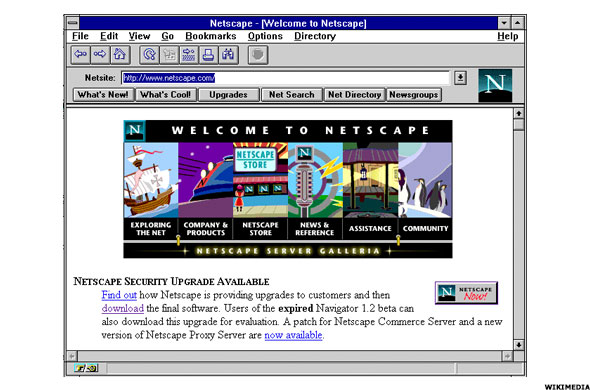
Netscape was the company behind the first widely-used internet browser of the nascent world wide web way back in 1994. The browser, called Netscape Navigator, was the catalyst for the browser wars that proceeded throughout the late 1990s and early 2000s between Netscape,  Microsoft's (MSFT) Internet Explorer and, later, Mozilla Firefox, Apple's (AAPL) Safari and  Alphabet's (GOOGL) Google Chrome. Netscape was a publicly traded stock under the ticker NSCP, until 1998, when it was purchased by AOL for $4.2 billion. The NetScape home page from the 90s, complete with descriptions of what a hyperlink is, can still be visited here, however.

2. Ask Jeeves

Ask.com, formerly known as Ask Jeeves, was launched in 1996 as a search engine that produced answers in "natural language." The search engine, which became a public company trading under the symbol ASKJ, was widely recognized for its mascot, a butler named Jeeves. But the character was eventually retired whenIAC/InterActiveCorp ( IAC) acquired Ask Jeeves for $1.85 billion in 2005. Ask Jeeves still exists, but it's primarily a question-and-answer service, having largely lost the search engine market to Google.

3. Hotmail


One of the world's first web-based email services, Hotmail was started in 1996 and acquired by Microsoft in 1997 for $400 million. After several iterations, it was rebranded as Outlook.com in 2013. But many users are still able to send and receive emails today using their @hotmail.com addresses, although they're likely to be derided for it

4. Justin.tv


Launched in 2007, Justin.tv was one of the early pioneers of live streaming, allowing everyday users to create channels where they could broadcast live content, similar to Google's YouTube. The website's popular video game streaming section, Twitch.tv, was spun off in 2011 and Justin TV was shut down in 2014 to focus on the video game content. Twitch was bought that same year by Amazon  (AMZN) for $970 million.

5. Orkut

Before Google launched its flagship social media platform, Google Plus, it had Orkut. The networking site, launched in 2004, was named after Google employee Orkut Buyukkokten and quickly became one of the most-visited websites in India and Brazil. In 2014, Google stopped allowing users to create Orkut accounts and Buyukkokten went on to create Hello, another social media network.

Image result for amazon.com, inc.Image result for mother's day gifts

Shop AMAZON for Mother's Day Gifts - https://goo.gl/bv4TND

6. GeoCities


Created in 1994, GeoCities was a popular web hosting service that was known for its unique, albeit tacky, personalization tools. GeoCities was once the third-most visited website on the internet and traded on the Nasdaq under the ticker GCTY. It was later purchased by Yahoo for $5 billion in 1999, renamed Yahoo! GeoCities and now only operates in Japan.

7. CMGI

CMGI became famous in the 1990s as an incubator for internet companies and one of the best-performing Internet stocks of the time. It gained popularity for web brands including the browser AltaVista, and even won the naming rights to the home stadium of the New England Patriots. However, it later became a symbol of the dot-com bubble after many of its early-stage companies flamed out and its stock lost most of its value. In 2008, the company changed its name to ModusLink Global Solutions (MLNKand refocused its efforts on providing supply chain management services. It's still traded today, although its market cap is only about $100 million.

8. Excite

Excite launched in 1995 as a search engine, email client and web portal, similar to MSN. It eventually became one of the most-recognized brands on the internet due to its collection of webpages, leading the internet provider @Home to acquire it for $7.5 billion in 1999 -- one of the largest internet deals at the time. The combined company, renamed Excite@Home (then trading as ATHM), later filed for bankruptcy in 2001. Excite@Home also sued Comcast ( CMCSA) in 2002 over allegations of insider dealing.

9. Friendster

Created in 2002, Friendster was one of the first social media networks to launch on the internet, many years before the rise of popular platforms like  Facebook ( FB) and MySpace. Google tried to buy the company for $30 million in 2003, but the company rebuffed their offer. Friendster eventually attempted to relaunch as a social gaming company in 2011, but has since shut down entirely.
By Annie Palmer

Source: https://goo.gl/3vwW0C

Wednesday, March 1, 2017

The latest hot start-ups to emerge from Israel’s cybersecurity war machine

Israeli soldiers march in front a Merkava tank
David Furst | AFP | Getty Images
Israeli soldiers march in front a Merkava tank
More than $680 million was invested in cybersecurity companies in 2016. But it wasn't in Silicon Valley. It was Israel.
Some of the biggest investment rounds were made in two standout start-ups to emerge from Israel's cybersecurity sector in recent years: GuardiCore and Fireglass. Last year these companies — both of which made CNBC's inaugural Upstart 25 list — raised funding rounds of $20 million. GuardiCore, founded in 2013, helps customers detect active breaches inside their data centers in real time, reducing the time it takes for a company to realize it's even been hacked from months to minutes. FireGlass, founded in 2014, uses isolation technology to protect networks. Users browse the internet or read email within the Fireglass service, which effectively places a secure buffer zone between the user and any malicious online content, preventing hackers from reaching the network. Large enterprises and Fortune 100 companies use the services of both companies to secure their data centers and protect their employees.
Image result for GuardiCore
Although they are separate companies, they share one characteristic that's at the heart of each start-up's meteoric rise: Both the founding teams of GuardiCore and Fireglass contain former members of the Israel Defense Forces.
For nearly four decades the Israeli military has been grooming a new kind of soldier: cybersecurity intelligence experts.
Some are trained in the elite Talpiot program, where they earn degrees in physics, math or computer science. Other soldiers, including some trained in Talpiot, work in the famed intelligence unit of the IDF, credited with creating the Stuxnet virus that infected the computers inside Iran's nuclear enrichment program.
"In Israel, companies and customers are more open to experimentation. So you have this small playground where you can try stuff."-Ron Berman, assistant professor of marketing, Wharton School of the University of Pennsylvania
In the Israeli military, the focus is often on securing large enterprise systems and data centers, practical training that has proved useful to IDF veterans who went on to found their own companies.
"When people leave the military, many go out and start their own companies. When you're finishing your army service at age 21 with three super-intense years of cyberdefense training at the highest level, that's really the biggest edge," said Tal Slobodkin, a veteran of the IDF and now partner at StageOne Ventures in Israel.

Leading the charge

The payoff has been huge. Israeli cybersecurity firms own roughly 10 percent of the worldwide $11.9 billion market today, and the country is home to some 300 cybersecurity companies. In 2016 alone, 83 new cybersecurity start-ups were founded, according to YL Ventures, an investment firm with offices in Silicon Valley and Tel Aviv.
"Israel has always been defense-minded and proactive in their defense," said Judith Germano, senior fellow at New York University's Center for Cybersecurity. "Combine that defense mind-set with an entrepreneurial spirit, and within Israel that has helped to create this boon."
According to YL Ventures data, $560 million was invested in Israeli cybersecurity companies in 2015. In 2016 that number rose to $689 million.
Of course, Israel has a history of cybersecurity success to draw upon. Check Point Software, among the earliest companies to develop firewalls to keep hackers out of computer networks, was founded by three IDF veterans and went public in 1996. CyberArk, whose co-founder and CEO Udi Mokady served in the intelligence unit of the IDF, makes software to identify and then block unauthorized access to privileged parts of an organization's computer network once hackers have made it inside.
Because the Israeli military tries to predict and plan for how cyberattacks of the future will be carried out, it's typically the case that those soldiers who receive cybersecurity training are "ahead of the curve with where things are going," Slobodkin said.
That carries over when IDF veterans found private companies. When CyberArk went public in September 2014, it was already pulling in revenue of more than $100 million. Following the hack of Sony Pictures Entertainment two months later, its share price rose quickly as large organizations recognized the need more than ever to protect their digital assets. By the end of 2015, CyberArk had $161 million in revenue, a 42 percent year-over-year increase, and was worth $1.42 billion.

Staying on the offensive

"Israel has been on the cutting edge on the military side of developing offensive and defensive cybersecurity. It's natural that this stuff has migrated from military applications to consumer applications," said Scott Tobin, a partner with Battery Ventures, based in Israel, who led the firm's investment in GuardiCore's latest funding round.
That cutting-edge cybersecurity found its way into GuardiCore and Fireglass.
Fireglass co-founder Guy Guzner worked 13 years at Check Point as director and then head of security products before leaving to start his own company. His co-founder, Dan Amiga, is a veteran of the IDF's intelligence unit, which is how isolation technology became the core of Fireglass' business today.

Thursday, November 3, 2016

Huawei launches ‘most powerful smartphone in the world’ to take on Apple and Samsung


Courtesy of Huawei
Huawei has launched the Mate 9, a high-spec, high-price smartphone which could see the China-based company square up to market leaders Apple and Samsung.
The latest device in Huawei's Mate series boasts a 5.9 inch full HD screen, inviting comparison with Apple's iPhone 7 Plus and the now discontinued Samsung Galaxy Note 7.
The manufacturer is making a big play on the handset's processing power, which Huawei said made it the "most powerful smartphone in the world." According to Huawei's testing, software in the Mate 9 performed 80 percent better than major competitors after one year of use.
However, Neil Mawston, executive director at Strategy Analytics, was not overly impressed by these claims, describing the product as merely "another big screen smartphone." But, Mawston, speaking to CNBC on the phone, did concede that the Mate 9 was a "nice incremental improvement" and that the release did a good job of "filling the Note 7 gap, at a lower price point than Apple."
Ben Wood, mobile industry analyst at CCS Insight, viewed the launch more positively, telling CNBC via telephone that it "shows just how ambitious Huawei are," and "reiterates (his organization's) belief that Huawei is emerging as a force to be recognized in the smartphone market."
The Mate 9's other key features include an 8 megapixel camera, 64GB memory and 4 microphones that in combination enable directional sound recording. Unlike the Apple's iPhone 7, the Mate 9 has a headphone jack.


Huawei did not disclose where the device's battery was manufactured; thereby not ruling out that this could be the same as that of the Samsung Galaxy Note 7, which is now notorious for overheating. But, Huawei did stress that the Mate 9's battery had been tested in house, by the manufacturer of the component and in independent research labs.

Whilst the Mate 9's release has been lucky in terms of its timing, the smartphone is likely to face stiff competition in a very competitive market space. Mawston told CNBC that "any differentiation from Huawei won't last long."
Wood said that Apple and Samsung were unlikely to be worried by the release, but that the "Mate 9 just boosts Huawei's profile" in a "sea of smartphone sameness." Ultimately, Wood said that the launch's success "comes down to price."
With regards to the Mate 9's reception in regional markets, Mawston said that "Huawei is coming under intense pressure at home in China as (lower end manufacturers) OPPO and Vivo offer similar phones at better price points. The Mate 9 will help alleviate some of that pressure." According to figures from the International Data Corporation released last week, both OPPO and Vivo saw their market share growth move into triple digits in the third quarter of this year, in comparison to the same period in 2015.
But, Mawston added that the Mate 9 was more likely to boost the company's position in Europe and India where Samsung has left a space in the market.
Huawei say that the Mate 9 is a "high end performance device aimed at professional users" and also serves as a "productivity tool."
But, smartphone development is arguably reaching a plateau. "We're in a mature phase of the smartphone market, now only incremental changes are being made," Mawston said.
Source : http://www.cnbc.com/2016/11/03/huawei-launches-most-powerful-smartphone-in-the-world-to-take-on-apple-and-samsung.html