Showing posts with label market returns. Show all posts

Monday, April 3, 2017

How To Beat The Market By 20 Percentage Points


Image result for stock market
Hedge funds are much better investors than you are made to believe by the financial press. Even hedge fund indices hide the truth about hedge funds’ amazing talent in picking winners and losers. Our research has shown that hedge funds’ top small-cap picks outperformed the market by nearly a percentage point per month between 1999 and 2012. We launched an investment newsletter that shares the stock picks of this strategy in real-time. This strategy returned 131.4% between the end of August 2012 and February, 2015. S&P 500 ETF (SPY) gained only 57.2% during the same period. Hedge funds’ top stock picks significantly outperformed the market.
However our advice to you is to dump your hedge funds.
The fact is that most hedge fund investors don’t make as much money as they did in the nineties and the first half of the past decade, where alpha in excess of 10% was the norm. Aggregately speaking, hedge funds’ alpha has been in decline over the past decade for several reasons. They are as follows:
1) A greater level of competition within the hedge fund industry has caused profit margins to shrink.
2) Hedge funds got bigger and started investing in less profitable areas.
3) There are a lot of unskilled hedge fund managers who are trying to get rich by being “lucky”.
4) Equity hedge funds charge an arm and a leg for beta exposure.
Our research has shown that hedge funds have a small edge when it comes to large-cap stock picks and a large edge when it comes to small-cap stock picks. We created a 50-stock portfolio of the most popular large-cap stocks among fund managers. Between 1999 and 2012, this 50-stock portfolio underperformed the market by less than 1 percentage point per year but its annual alpha was 0.7 percentage points (read the details here).
It should be clear to you, then, that hedge funds’ large-cap stock picks are marginally better than the S&P 500 index because of their lower risk profile. However, if you are a hedge fund client you won’t see much outperformance in this space because you have to surrender 2% of your assets and 20% of each year’s return to your hedge fund manager. If your hedge fund invested entirely in large-cap stocks in 2014, its gross return would have been 13.5% but YOUR net return would have been only 8.8%, because you have to pay 2 percent flat fee and 2.7 percentage points of performance fee as if they accomplished something significant!!
Hedge funds can’t generate enough alpha in the large-cap space to justify their high fees. They invest in the large caps because they have too much money to manage, and they don’t want to give up juicy management fees that enable them buy condos on New York City’s Park Avenue. How do hedge fund managers get away with this?
The answer is simple.
They generate significantly higher alpha in their small-cap stock investments. Generally speaking, there are fewer analysts covering the little guys, and these stocks are less efficiently priced. Hedge funds spend enormous resources to analyze and uncover data about these stocks because this is one of the places where they can generate significant outperformance. Our analysis also shows that this is also a fertile ground for piggyback investors.
Between June 1999 and August 2012, the 15 most popular small-cap stocks among hedge funds managed to return 127 basis points per month.
It is not a typo. Reread it.
This outperformance wasn’t due to high risk either. Our small-cap strategy’s monthly alpha was 81 basis points during this 13-year period (read the details here). This isn’t even the end of the story.
We launched a newsletter at the end of August 2012 that lists the stock picks of this small-cap strategy. During the 2.5 years between September 2012 and February 2015 hedge funds’ most popular small-cap stock picks returned 131.4% vs. 57.2% return for the S&P 500 ETF. This corresponds to an average monthly return of 2.95% for these stocks versus 1.55% for SPY.
Our proposition is very simple: dump your hedge funds and imitate their small-cap stock picks. You don’t have to surrender 2% of your assets and 20% of your returns. You don’t have to invest in hedge funds’ large-cap picks which usually underperform the market. Finally, you don’t have to worry about fraud/mismanagement and you will have instant access to your funds. Click viewer appreciation button on page top to donate for blog upkeep

Thursday, January 19, 2017

Inside The Obama Stock Market's 235% Return

The big stock winners of the Obama years were a beauty store chain, a shopping mall owner, Netflix and consumer discretionary companies like Under Armour. The losers were companies linked to oil and gas as commodities prices plunged.


When Barack Obama was sworn in as the 44th president of the United States on January 20, 2009, the U.S. stock market was in free fall. The financial crisis was in full swing following the collapse of Lehman Brothers and the Standard & Poor’s 500 index, a popular measure of the U.S. stock market, closed at 805 points on Inauguration Day.
Eight years later, the S&P 500 index has risen to 2,274 points after one of the great bull runs in stock market history. With Obama as president, the U.S. stock market, as measured by the S&P 500, returned 235%, or 16.4% annualized.

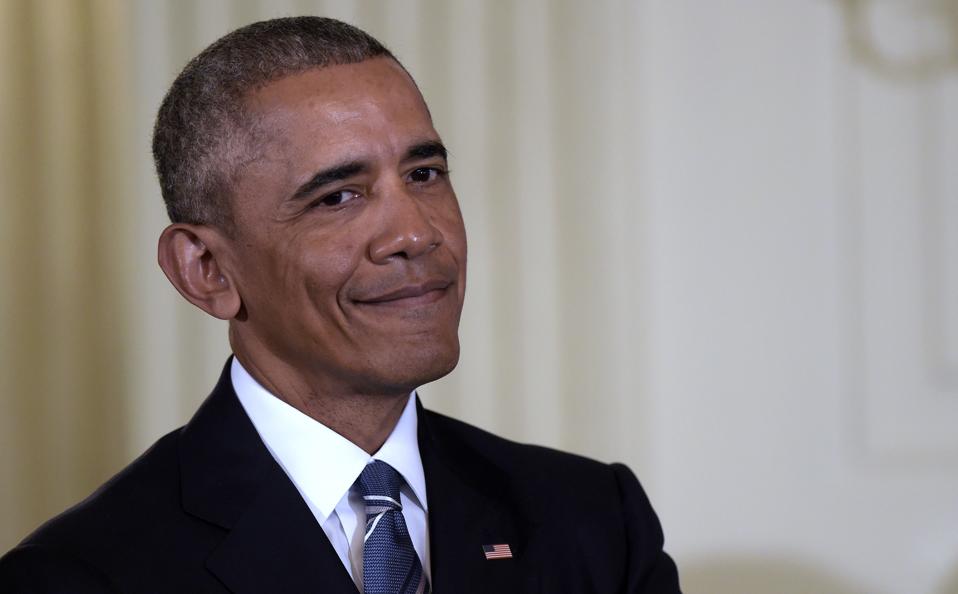
President Barack Obama  (AP Photo/Susan Walsh)
The Obama stock market trounced the stock market of his presidential predecessor, George W. Bush, which fell 30.6% from January 20, 2001 to January 20, 2009. Bill Clinton’s stock market, however, beat the Obama stock market, returning 264%, or 17.5% annualized.
The top-performing sector of the Obama stock market was the consumer discretionary sector, which returned 338%, or 20% annualized, according to FactSet Research Systems. The sector was driven by hot stocks like Under Armour and L Brands. Energy stocks were the worst performers during the Obama years as the price of oil and other commodities plunged. But even the energy sector managed to stay in positive territory and eke out a 53% return during Obama’s presidency.
Both Silicon Valley and Wall Street did well under Obama. Information technology was the second-best performing sector of the U.S. stock market during the Obama presidency, returning 285%. And while bankers complained about being political targets and dealt with new regulations limiting their risk-taking activities, Wall Street recovered in the years after banks received bailouts. Financial stocks were the third-best performing sector in the U.S. stock market during the Obama years, rising 261%.
In Obama’s America, the top-performing stock according to FactSet was a chain of beauty stores known for discount deals and based in Bollingbrook, Ill. Ulta Salon, Cosmetics & Fragrance has staged a stunning expansion during Obama’s presidency and now operates 949 stores across America, selling 20,000 beauty products ranging from cosmetics to skin care and salon services. Ulta Salon’s stock has returned 4,350% during the Obama years.
Shortly after Obama took office, a group of Wall Street investors led by billionaire hedge fund manager Bill Ackman reorganized a bankrupt shopping mall owner while U.S. real estate was reeling. General Growth Properties filed America’s largest ever real estate bankruptcy. The recapitalized company took the stock market by storm, returning 3,465%.
The Obama years coincided with lightning-fast technological change that was reflected in the stock market. The iPhone was introduced less than two years before he took office. During the Obama years, billionaire Reed Hastings transformed Netflix from a DVD rental-by-mail company into a video-streaming behemoth that changed the way people consume entertainment. Shares of Netflix have returned 3,037% in the last eight years.
Another revolution that has taken place while Obama has been president involves biotechnology. New medicines and treatments have produced disease-curing breakthroughs, creating massive stock market value in the process. Billionaire Leonard Schleifer’s Regeneron developed a drug to treat eye disease age-related macular degeneration, Eylea, which produced $4.09 billion in 2015 sales. The drug was approved by the Food & Drug Administration during Obama’s first term and Regeneron’s stock has surged by 2,294% while Obama has been in office.
Obama has long been an advocate of renewable energy and has particularly promoted solar energy. With the Obama Administration providing solar subsidies, investors rushed into solar stocks, but they have largely been disappointed by the results as those subsidies faded. First Solar, the largest U.S. solar equipment producer, has seen its stock fall by 74% as prices for solar panels fell, making it the worst performing S&P 500 stock of the Obama years.
With oil and natural gas prices weakening in recent years, the three other stocks among the top four worst performers in the S&P 500 during the Obama years were energy companies. Shares of Southwest Energy, Transocean and Chesapeake Energy tumbled by 63%, 58%, and 41%, respectively, while Obama was president.
Still, of the main stock index’s 469 stocks that were trading when Obama took office and remain listed today, only 12 of them ended the Obama terms in negative total return territory. Some of those stocks, like Goldman Sachs, got an extra boost after Donald Trump was elected and the stock market staged a Trump rally. But in the history books, those gains will be attributed to the Obama stock market.
By Nathan Vardi
Source: https://www.forbes.com/sites/nathanvardi/2017/01/17/inside-the-obama-stock-markets-235-rise/#701d93f616d1