Showing posts with label International trade. Show all posts

Sunday, April 2, 2017

Weighing The Week Ahead: What The Trump-Xi Meeting Means For The Economy

About: SPDR S&P 500 Trust ETF (SPY), QQQ, DIA, SH, IWM, TZA, SSO, TN

Image result for Presidents Trump and Xi.

Summary

Last week's slightly positive news was less important than optimism about the next element of the Trump agenda.
Next week features plenty of data, including the most important reports.
More important, and the focus for many newly-minted China experts, will be the meeting between Presidents Trump and Xi.
Plenty of good trades and investments might be available.
Lessons from the meeting should emphasize Trump diplomacy, not just specific deals with China.
We have a big economic calendar and potential Fed news. Those stories will take a back burner this week. My safest prediction is that we are about to see a new rash of China experts both in print media and on CNBC! These freshly-minted pundits will be asking:
What will the Trump-Xi meeting mean for the economy, and for stocks?
Last Week
Last week the news was mostly positive, but light. Markets continued the attention to the Trump Administration's next policy steps – especially the chances for tax reform.
Theme Recap
In my last WTWA I predicted a discussion about the aftermath of the ACA repeal decision. That was a good call, as assorted pundits explained what the next policy moves might be. The more adventurous speculated about whether the Freedom caucus would block changes in the debt ceiling or tax reform. Some of that discussion will continue in the early part of next week.
The Story in One Chart
I always start my personal review of the week by looking at this great chart from Doug Short via Jill Mislinski. She notes the overall weekly gain of 0.80% and the quarter one increase of 5.5%. The biggest takeaway might be the general rebound from last week's market reaction to the failure of the ACA repeal.
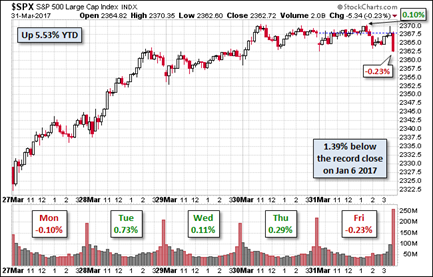
Doug has a special knack for pulling together all the relevant information. His charts save more than a thousand words! Read his entire post for several more charts providing long-term perspective, including the size and frequency of drawdowns.
The News
Each week I break down events into good and bad. Often there is an "ugly" and on rare occasion something very positive. My working definition of "good" has two components. The news must be market friendly and better than expectations. I avoid using my personal preferences in evaluating news – and you should, too!
This week's news was slightly positive.
The Good
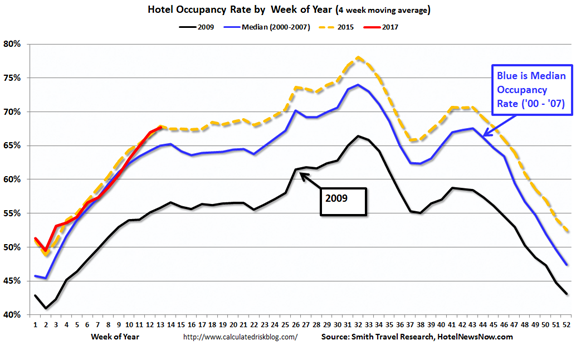
  • Hotel occupancy is strong. Calculated Risk reports interesting hard data from private sources. These are items you might not see elsewhere.
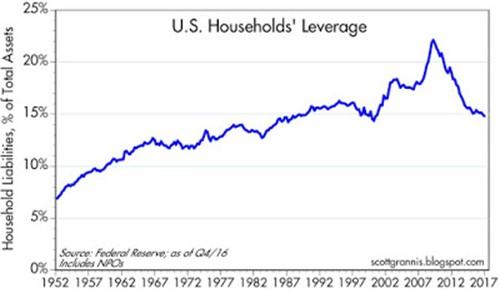
  • Household finances are on "solid ground" as explained by Scott Grannis. Debt levels as a percentage of disposable income are at 30-year lows. He provides an interesting chart of household leverage.
  • Serious delinquencies have declined to 1.19% (Fannie Mae via Calculated Risk). This is the lowest level in nine years.
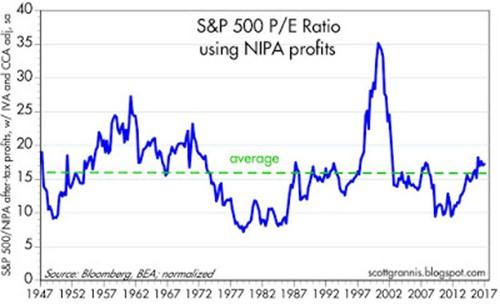
  • Corporate profits remain strong, increasing 9.3% year-over-year in Q416. New Deal Democrat has a good account of the trends, why National Income and Profit Accounts (NIPA) come so late, and how he estimates this series in advance. Scott Grannis has a similar report which also shows the relationship between NIPA profits and stocks. It is dramatically different from the popular valuation charts.
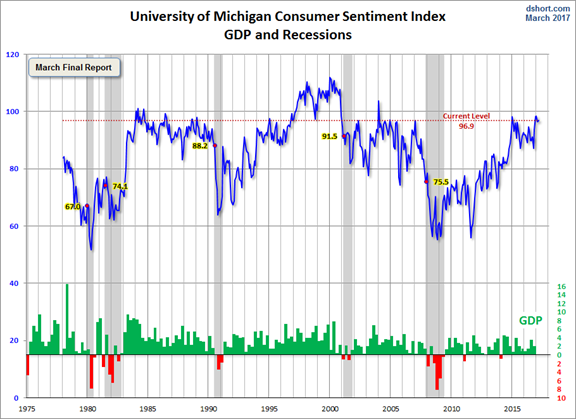
  • Michigan consumer sentiment remained strong, increasing to 96.9. Jill Mislinski has the update. It includes an interesting excerpt from the Survey of Consumers chief economist, Richard Curtin. He notes that expectations and partisanship are influencing the outlook. This bears watching. Jill also has this fine chart.
  • Q4 GDP revisions edged a little higher than expected to 2.1%
  • Pending home sales increased 5.5%. CNBC's Diana Olick has an interesting report, noting that sales would be much higher if there were more inventory. She has an interesting interview from Denver, where construction is 50% behind the pace needed. Builders blame the lack of labor, especially illegal immigrants frightened by recent policy changes. The builder interviewed stated that the jobs were not desirable for most U.S. workers.
    This report, if accurate and typical, has implications for homebuilders, Fed policy (labor market tightness), and immigration policy. You need to watch the video to see the key points.
The Bad
  • Personal consumption spending missed expectations. The increase was only 0.1% despite an income increase meeting expectations of 0.4% growth. Steven Hansen (GEI) has a thorough analysis with excellent tables and charts.
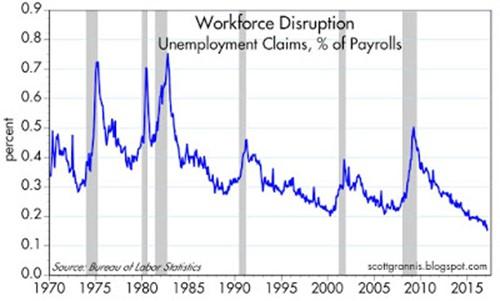
  • Jobless claims moved slightly lower, to 258K, but the four-week moving average moved higher. I am scoring this as "bad" because the series has moved a bit higher from the best levels. Scott Grannis helps us to keep this in perspective with this interesting chart of claims compared to the labor force.
The Ugly
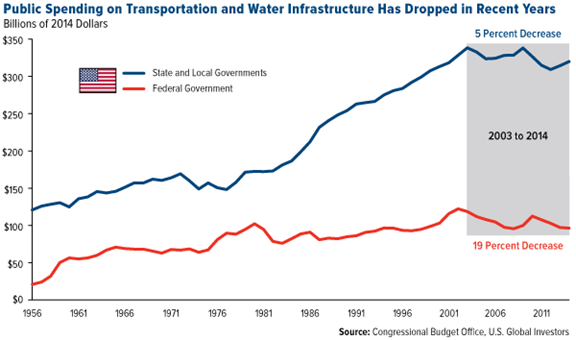
U.S. Bridges. (No, not the recent North American Bridge Championship, where Bill Gates had a nice win. While that particular event was limited to players with fewer than 10,000 masterpoints, it still included many experts. It was a nice victory, and his best career result). Turning back to actual structures, the American Society of Civil Engineers (ASCE) notes that 40% of bridges are more than fifty years old. Over the next twenty-five years the U.S. is short of needed spending by about $3 trillion.
The Silver Bullet
I occasionally give the Silver Bullet award to someone who takes up an unpopular or thankless cause, doing the real work to demonstrate the facts. No award this week, but nominations are always welcome. There are many bogus claims and charts out there! I wrote about headline spinning last week, and the misleading recession forecasts that resulted. We should all encourage astute analysts to help on this front!
The Week Ahead
We would all like to know the direction of the market in advance. Good luck with that! Second best is planning what to look for and how to react. That is the purpose of considering possible themes for the week ahead. You can make your own predictions in the comments.
The Calendar
We have a very big week for economic data, featuring the most important reports.
The "A" List
  • Employment report (F). Expectations are in the 180K range, down from last month's 235K.
  • ISM index (M). Continuing strength expected.
  • Auto sales (M). The concept of "peak auto" has some recent buzz, drawing attention to this private data.
  • ISM services (W). Wider scope than manufacturing, but a shorter history. Strength expected.
  • FOMC minutes (W). Will be scrutinized for hints about the pace of future rate hikes.
  • Initial jobless claims (Th). Is the series edging up from record low levels?
The "B" List
  • ADP employment change (W). A good independent read on job growth.
  • Construction spending (M). February data, but an important sector.
  • Factory orders (T). More February data of significance. Continuing strength expected.
  • Trade balance (T). Usually not a market mover, but will get extra attention this week.
  • Crude inventories (Th). Recently showing even more impact on oil prices. Rightly or wrongly, that spills over to stocks.
While the schedule is not as heavy as last week, FedSpeak will be featured on several days.
The Thursday meeting between President Trump and China's President Xi Jinping could be extremely important for economic policy and the markets.
Next Week's Theme
This is a big week for economic data. We could usually expect daily analysis of the news, focusing on the Friday employment data. A secondary theme might be the emerging change in Fed policy, with speakers and the release of minutes on Wednesday.

Monday, March 6, 2017

How Globalization Affects Developed Countries

Image result for globalization

The phenomenon of globalization began in a primitive form when humans first settled into different areas of the world; however, it has shown a rather steady and rapid progress in recent times and has become an international dynamic which, due to technological advancements, has increased in speed and scale, so that countries in all five continents have been affected and engaged.

What Is Globalization?
Globalization is defined as a process that, based on international strategies, aims to expand business operations on a worldwide level, and was precipitated by the facilitation of global communications due to technological advancements, and socioeconomic, political and environmental developments.
The goal of globalization is to provide organizations a superior competitive position with lower operating costs, to gain greater numbers of products, services and consumers. This approach to competition is gained via diversification of resources, the creation and development of new investment opportunities by opening up additional markets, and accessing new raw materials and resources. Diversification of resources is a business strategy that increases the variety of business products and services within various organizations. Diversification strengthens institutions by lowering organizational risk factors, spreading interests in different areas, taking advantage of market opportunities, and acquiring companies both horizontal and vertical in nature.
Industrialized or developed nations are specific countries with a high level of economic development and meet certain socioeconomic criteria based on economic theory, such as gross domestic product (GDP), industrialization and human development index (HDI) as defined by the International Monetary Fund (IMF), the United Nations (UN) and the World Trade Organization (WTO). Using these definitions, some industrialized countries are: United Kingdom, Belgium, Denmark, Finland, France, Germany, Japan, Luxembourg, Norway, Sweden, Switzerland and the United States.

Components of Globalization
The components of globalization include GDP, industrialization and the Human Development Index (HDI). The GDP is the market value of all finished goods and services produced within a country's borders in a year, and serves as a measure of a country's overall economic output. Industrialization is a process which, driven by technological innovation, effectuates social change and economic development by transforming a country into a modernized industrial, or developed nation. The Human Development Index comprises three components: a country's population's life expectancy, knowledge and education measured by the adult literacy, and income.
The degree to which an organization is globalized and diversified has bearing on the strategies that it uses to pursue greater development and investment opportunities.
The Economic Impact on Developed Nations
Globalization compels businesses to adapt to different strategies based on new ideological trends that try to balance rights and interests of both the individual and the community as a whole. This change enables businesses to compete worldwide and also signifies a dramatic change for business leaders, labor and management by legitimately accepting the participation of workers and government in developing and implementing company policies and strategies. Risk reduction via diversification can be accomplished through company involvement with international financial institutions and partnering with both local and multinational businesses.


Globalization brings reorganization at the international, national and sub-national levels. Specifically, it brings the reorganization of production, international trade and the integration of financial markets. This affects capitalist economic and social relations, via multilateralism and microeconomic phenomena, such as business competitiveness, at the global level. The transformation of production systems affects the class structure, the labor process, the application of technology and the structure and organization of capital. Globalization is now seen as marginalizing the less educated and low-skilled workers. Business expansion will no longer automatically imply increased employment. Additionally, it can cause high remuneration of capital, due to its higher mobility compared to labor.
The phenomenon seems to be driven by three major forces: globalization of all product and financial markets, technology and deregulation. Globalization of product and financial markets refers to an increased economic integration in specialization and economies of scale, which will result in greater trade in financial services through both capital flows and cross-border entry activity. The technology factor, specifically telecommunication and information availability, has facilitated remote delivery and provided new access and distribution channels, while revamping industrial structures for financial services by allowing entry of non-bank entities, such as telecoms and utilities.
Deregulation pertains to the liberalization of capital account and financial services in products, markets and geographic locations. It integrates banks by offering a broad array of services, allows entry of new providers, and increases multinational presence in many markets and more cross-border activities.
In a global economy, power is the ability of a company to command both tangible and intangible assets that create customer loyalty, regardless of location. Independent of size or geographic location, a company can meet global standards and tap into global networks, thrive and act as a world class thinker, maker and trader, by using its greatest assets: its concepts, competence and connections.

Beneficial Effects
Some economists have a positive outlook regarding the net effects of globalization on economic growth. These effects have been analyzed over the years by several studies attempting to measure the impact of globalization on various nations' economies using variables such as trade, capital flows and their openness, GDP per capita, foreign direct investment (FDI) and more. These studies examined the effects of several components of globalization on growth using time series cross sectional data on trade, FDI and portfolio investment. Although they provide an analysis of individual components of globalization on economic growth, some of the results are inconclusive or even contradictory. However, overall, the findings of those studies seem to be supportive of the economists' positive position, instead of the one held by the public and non-economist view.
Trade among nations via the use of comparative advantage promotes growth, which is attributed to a strong correlation between the openness to trade flows and the affect on economic growth and economic performance. Additionally there is a strong positive relation between capital flows and their impact on economic growth.
Foreign Direct Investment's impact on economic growth has had a positive growth effect in wealthy countries and an increase in trade and FDI, resulting in higher growth rates. Empirical research examining the effects of several components of globalization on growth, using time series and cross sectional data on trade, FDI and portfolio investment, found that a country tends to have a lower degree of globalization if it generates higher revenues from trade taxes. Further evidence indicates that there is a positive growth-effect in countries that are sufficiently rich, as are most of the developed nations.
The World Bank reports that integration with global capital markets can lead to disastrous effects, without sound domestic financial systems in place. Furthermore, globalized countries have lower increases in government outlays and taxes, and lower levels of corruption in their governments.
One of the potential benefits of globalization is to provide opportunities for reducing macroeconomic volatility on output and consumption via diversification of risk

Harmful Effects

Non-economists and the wide public expect the costs associated with globalization to outweigh the benefits, especially in the short-run. Less wealthy countries from those among the industrialized nations may not have the same highly-accentuated beneficial effect from globalization as more wealthy countries, measured by GDP per capita etc. Although free trade increases opportunities for international trade, it also increases the risk of failure for smaller companies that cannot compete globally. Additionally, free trade may drive up production and labor costs, including higher wages for more skilled workforce, which again can lead to outsourcing of jobs from countries with higher wages.
Domestic industries in some countries may be endangered due to comparative or absolute advantage of other countries in specific industries. Another possible danger and harmful effect is the overuse and abuse of natural resources to meet new higher demands in the production of goods.


The Bottom Line
One of the major potential benefits of globalization is to provide opportunities for reducing macroeconomic volatility on output and consumption via diversification of risk. The overall evidence of the globalization effect on macroeconomic volatility of output indicates that although direct effects are ambiguous in theoretical models, financial integration helps in a nation's production base diversification, and leads to an increase in specialization of production. However, the specialization of production, based on the concept of comparative advantage, can also lead to higher volatility in specific industries within an economy and society of a nation. As time passes, successful companies, independent of size, will be the ones that are part of the global economy.

By Nicolas Pologeorgis

Source:http://www.investopedia.com/articles/economics/10/globalization-developed-countries.asp