Showing posts with label starbucks. Show all posts

Tuesday, October 25, 2016

Opinion: 10 companies to benefit from millennials making money

Those born between 1982 and 1994 are enjoying strong job growth, which is putting a lot of money in their pockets

Millennials can’t get enough of Starbucks’ $4-and-up coffee
If you buy into media stereotypes about millennials, you probably believe the following about the infamous Generation Me. They’re under-employed. Bummed out about work prospects. And, as a result, holed up in their parents’ basements.
But thanks to an impressive surge in jobs in the past two years (which you may have missed because of the barrage of stereotypes), many millennials are actually hitting their stride in life.
Now, as they enter their prime spending years, the implications could be big for the economy. In short, millennials may help the economy grow faster than many analysts think, says James Paulsen, economist and market strategist at Wells Capital Management.

–– ADVERTISEMENT ––

Their newfound employment strength will also help companies that cater to their needs and lifestyles — such as TV-streaming company Netflix Inc. NFLX, -0.64%coffee chain Starbucks Inc. SBUX, -0.94% a small cosmetics company called e.l.f. Beauty Inc. ELF, +1.38% and seven others I mention below. Home builders may finally get a burst of growth from millennials, though that remains to be seen.
First, the facts, as stereotypes die hard.
  • Since January 2014, employment among millennials (25- to 34-year-olds) grew 7%, to 33.9 million. That was far more than the overall 4.6% growth in the number of workers in the economy, to 151.9 million. Here’s another way to put it: Millennials got 33% of the 6.74 million new jobs added, even though they account for only 22.4% of the number of people working. In contrast, employment among 35- to 54-year-olds was flat. Boomers, ages 55 and up, saw 9% job growth.
  • Probably as a result of the jobs gains, consumer confidence among millennials continued to surge in the past year, even as it flagged among boomers. This bodes well for our economy, which is two-thirds driven by consumer spending.
Both of those trends are “definitely a plus for the economy,” says Chris Christopher, director of consumer economics at IHS Global Insight, an economics research and forecasting firm. “Especially as the millennials start getting married, they are going to have children and that will add even more spanning,” he says.
One qualifier here is that millennials have a lot of student debt. But this headwind will probably diminish with time, as people tend to pay off most of their student debt in about 10 years, and as their employment situations continue improve, says Samuel Sturgeon, of Demographic Intelligence. “Student debt becomes less oppressive over time because people pay it down, and because they get more established in their careers.”
Here are 10 companies that should benefit from robust job growth among millennials, generally defined as people born between 1982 and 1994. (Fun fact: This means they were the first to graduate high school in the new millennium, hence their nickname.)
Retailers
Do millennials like to shop? Of course. “The idea that millennials are not materialistic, I don’t know where that comes from because all the data contradict it,” says psychologist Jean Twenge, author of “Generation Me: Why Today’s Young Americans Are More Confident, Assertive, Entitled — and More Miserable Than Ever Before.”
One problem here for investors is that millennials aren’t very loyal to brands. They make a lot of purchase decisions based on research conducted online. “Their favorite brand is what their smartphone tells them is the best product at the moment,” says Scott Galloway, a marketing professor at New York University’s Stern School of Business.
A way around this is to own Amazon.com Inc. AMZN, -0.23% and its de facto partner, FedEx Corp. FDX, -0.09% says Trip Miller, managing partner of Memphis-based Gullane Capital Partners. These companies also play into the millennial desire for instant gratification.
But millennials do favor certain brands, maintains veteran retail analyst Howard Davidowitz of Davidowitz & Associates, a retail consulting and investment banking firm in New York. He cites Nike Inc. NKE, -1.58% and Under Armour Inc. UA, +0.09%
‘Non linear’ companies
Millennials are a “non linear” generation, says Galloway. “They want what they want, when they want it. Especially media,” he says. “They want to consume media on their own terms.” They hate the idea of letting networks or cable companies decide when a movie or sitcom is available. The investment play here? “Netflix is the brand that embodies this trend,” says Galloway.
Starbucks
A recent look at millennial spending by Toronto-Dominion Bank found that they buy coffee way more than other age groups. “Our grandparents liked scotch. Our parents liked marijuana. And millennials are addicted to coffee,” quips Galloway.

Tuesday, March 8, 2016

3 Ways To Play The Rising Asian Middle Class

 Includes: ABEVBABABIDUECONEEMAFIZZFMXUFGISHKIIIIK

Summary

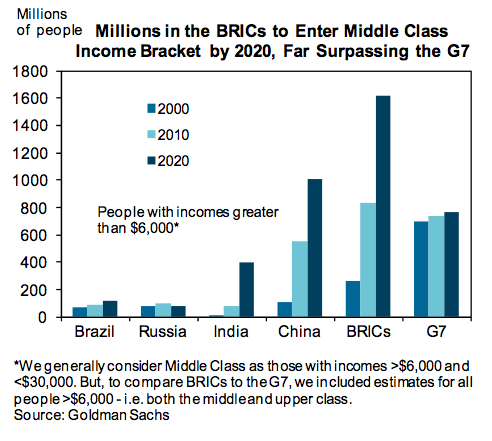
The Asian middle class is set to rise from around 600 million people now to 3 billion by 2030.
How will the Asian middle class spend its money?
My 3 ways to play the rising middle class.
Image result for asian middle classI wrote previously here on Seeking Alpha regarding Asia's rising middle class (you can read that article here). The key takeaway from that article was the massive demographic change occurring in emerging Asia now. Essentially, the Asian middle class is rising — from 600 million in 2015 on its way to 3 billionby 2030. To get a feel for this massive growth, it works out to around 438,000 new entrants a day to the middle class — every day.
Most of the rise will be in China and India, as the chart below clearly illustrates. However, other highly populous countries in ASEAN will also be part of this boom — think Indonesia, Philippines, Vietnam, Thailand, and Malaysia.
However, what's important as investors is how to capitalise on this incredible rise. To do this, I ask myself what the rising Asian middle class do with its greater disposable income. My thoughts are as follows:
  1. Buy food.
  2. Buy or rent housing (condo units, etc).
  3. Buy transport devices (mostly cheap motorbikes), clothes, cheap smartphones, internet service, online shopping, and entertainment.
Remember the Asian middle class will not be the same as the Western middle class that rose over the past 50 years. It will be a much larger group: billions. They will have lower incomes, so they will spend on essentials first; hence food is number 1 on my list.

My 3 ways to play the rising Asian middle class

1. Buy food-producing companies (consumer staples)

According to DBS: "Demand for food will hit nearly $3 trillion per year by 2020, double what it was a decade ago, opening up business and investment opportunities in food retailing, particularly in groceries".

Food ETFs to consider

PowerShares Dynamic Food & Beverage (NYSEARCA:PBJ) - Price: $31.89

The fund generally will invest at least 90% of its total assets in common stocks of food and beverage companies that comprise the underlying intellidex. The underlying intellidex was composed of common stocks of 30 U.S. food and beverage companies. These companies are engaged principally in the manufacture, sale or distribution of food and beverage products, agricultural products and products related to the development of new food technologies.
Holdings include McDonald's Corporation (NYSE:MCD), Starbucks (NASDAQ:SBUX), General Mills (NYSE: GIS), Kroger (NYSE: KR), Pepsico Inc (NYSE:PEP), National Beverage Corp (NASDAQ:FIZZ).
The downside is no local Asian food companies.
Current PE is 18.28, Price/Book 3.4, Yield 1.26%. The expense ratio is 0.58%.

Market Vectors Agribusiness ETF (NYSEARCA:MOO) - Price: $45.44

The Agribusiness Index is comprised of equity securities of companies that generate at least 50% of their revenues from: (1) agri-chemicals, animal health and fertilizers, seeds and traits, (2) farm/irrigation equipment and farm machinery and/or (3) agricultural products, aquaculture and fishing, livestock, plantations and trading of agricultural products. Top holdings are Syngenta AG (NYSE:SYT) (8.14%), Monsanto (NYSE:MON)(8.11%), and Deere & Company (NYSE:DE) (6.83%).
The ETF has been beaten down heavily in the recent rout and trading near 5 year lows, making a nice entry point.
Current PE is 15.06, Price/Book 2.01. Yield 3.05%. The expense ratio is 0.56%.
I chose MOO over iShares MSCI Global Agricultural Fund (NYSEARCA:VEGI) purely because the later has a higher PE of 21.8 (end of January 2016). However, for investors preferring a larger more liquid fund VEGI would be preferable. Their holdings are quite similar, as is their expense ratio with VEGI being the cheaper at 0.4%.

EGShares Emerging Markets Consumer (NYSEARCA:ECON) - Price: $20.72

As the name suggests this ETF tracks consumer stocks in the emerging markets, including 40% in Asia, and 33% in Latin America. Top holdings include Naspers (OTCPK:NAPRF), Fomento Economico Mexicano SAB de CV (OTC:FMXUF), Ambev SA ADR (NYSE:ABEV), and Tata Motors ADR (NYSE:TTM).
Current PE is 21.98, yield 1.18%. The expense ratio is 0.84%.
Of the three ETFs listed above ECON would be my choice, as it is more tiered towards emerging markets and Asia. I was not able to find a pure Asian food ETF, however it would be an excellent idea.
A larger list of consumer staples ETFs can be found here.

Food stocks to consider

Image result for asian middle classThere is a huge choice of Asian food companies, and the industry is fiercely competitive. One can buy the grain suppliers, the food producers, or the retail shops that sell the food. I think the later have the greatest barriers to entry and therefore the best pricing power and margins. Having said that these are my top ideas.
Robinsons Retail Holdings Inc (OTCPK:RRETY) - Price: $12.80
Robinsons operates as a retail company in the Philippines. The company operates in six segments: supermarkets, department stores, DIY stores, convenience stores, drug stores, and specialty stores. As of December 31, 2014, it had a portfolio of 1,327 stores, which included 111 supermarkets, 42 department stores, 161 DIY stores, 450 convenience stores, 320 drug stores, and 243 specialty stores.
The Philippines is just entering the demographic window with a booming economy (it grew 6.3% in 4Q 2015), driven by Overseas Foreign Workers (OFW) remittances, and the BPO sector (call centers etc). Robinsons and SM dominate the shopping market sector. On that note SM Investments (OTCPK:SMIVY) (which will soon own 77.3% of the expanded SM Retail group), is also a good investment. SM also own some shopping centers in China.
Robinsons current PE is 19.6, with a dividend yield of 0.11%.
Starbucks - Price: $60.04
I choose Starbucks because they are currently expanding rapidly (especially into Asia), and should benefit from the rising Asian middle class. Their brand name ensures their cafes are always busy.
In 2015, there were 21,366 Starbucks stores in 64 countries around the world. Starbucks plans to open 500 stores in China every year until 2021, an expect to increase China store count by at least 30%. In 2016, they plan to open1,800 new stores, of which 70% are expected outside the US.
Coffee is a legal addictive drink, and meeting friends in Starbucks is very trendy in Asia. Finally, there is talk Starbucks may introduce some alcoholic beverages (at night time) and drive through, starting in their US stores.
I choose Starbucks ahead of, say, McDonald's as it is earlier in its development, and coffee is quite addictive.
Starbucks current PE is 31.44, with a yield of 1.36%. Saxo consensus analyst is an 80% buy, 20% hold, 0% sell. Analyst consensus target is $68.13. A great stock to accumulate on dips.

San Miguel Corporation (OTCPK:SMGBY) - Price: $17.50

SMC is Southeast Asia's largest publicly listed food, beverage and packaging company as well as the Philippines' largest corporation in terms of revenue, with over 17,000 employees in over 100 major facilities throughout the Asia-Pacific region. San Miguel Beer is their flagship product, and it is exported globally. COO Ramon Ang is world class. My only concern would be the thin net profit margin of 1.88%. PE is a reasonable 20.61. Unfortunately the US listing looks a bit illiquid.
Some of the top ten global food and beverage companies below are definitely worth considering.
The Coca-Cola Co (NYSE:KO) - Price = $43.77, PE 26.21.
Coke is popular in Asia, however the carbonated beverages are sometimes viewed as unhealthy.
Nestlé (OTCPK:NSRGYOTCPK:NSRGF) - Price = $43.77, PE 26.21.
Milk powder, coffee etc. A global powerhouse.
Unilever (NYSE:UL) - Price = $43.37, PE 22.85.
Sells over 400 brands globally such as Axe/Lynx, Dove, Omo, Becel/Flora, Heartbrand ice creams, Hellmann's, Knorr, Lipton, Lux, Magnum, Rama, Rexona, Sunsilk and Surf.
You can read here about the top ten global food giants. For me I prefer to pick more Asian based food and beverage companies trading on lower PEs such as San Miguel Corporation discussed above.

Sunday, April 26, 2015

3 Big Stocks Everyone's Talking About -- and How to Trade Them


BALTIMORE (Stockpickr) -- Put down the 10-K filings and the stock screeners. It's time to take a break from the traditional methods of generating investment ideas. Instead, let the crowd do it for you.
From hedge funds to individual investors, scores of market participants are turning to social media to figure out which stocks are worth watching. It's a concept that's known as "crowdsourcing," and it uses the masses to identify emerging trends in the market.
Must Read: Warren Buffett's Top 10 Stock Buys
Image result for Amazon INcCrowdsourcing has long been a popular tool for the advertising industry, but it also makes a lot of sense as an investment tool. After all, the market is completely driven by the supply and demand, so it can be valuable to see what names are trending among the crowd.
While some fund managers are already trying to leverage social media resources like Twitter to find algorithmic trading opportunities, for most investors, crowdsourcing works best as a starting point for investors who want a starting point in their analysis.
Today, we'll leverage the power of the crowd to take a look at some of the most active stocks on the market today.
Must Read: 5 Toxic Stocks to Stay Away From


Amazon.com


Nearest Resistance: N/A¿
Nearest Support: $390¿
Catalyst: Q1 Earnings
E-commerce behemoth Amazon.com  (AMZN - Get Report) is up more than 14% on huge volume this afternoon, the end-result of strong first-quarter earnings numbers from the world's biggest online storefront. That's good enough to make Amazon the biggest single gainer on a percentage basis in the entire S&P 500. AMZN lost 12 cents per share last quarter, coming right in line with expectations, but the real pop is being driven by the double-digit top-line growth the firm achieved last quarter. That growth is continuing to accelerate, and management expects a small profit in the second quarter.
The news was good enough to send shares of AMZN to a new 52-week high. Making new highs is significant from an investor psychology standpoint because it means that everyone who has bought shares in the last year is sitting on gains. As a result, the "back to even" mentality is less of a concern than it would be for a name with a higher proportion of shareholders sitting on losses.
For traders who want to ride the bullish momentum, there's still time to build a position in AMZN now.
Must Read: 10 New Stocks Billionaire David Einhorn Loves


Pandora Media


Nearest Resistance: 19¿
Nearest Support: $17¿
Catalyst: Q1 Earnings
Internet radio stock Pandora Media  (P - Get Report) is seeing a big-volume move today, up about 2% this afternoon following the firm's first quarter numbers release. Pandora lost less money than expected during the quarter, shedding 12 cents per share versus average estimates of 17 cents.
While the reaction is pretty muted this afternoon, Pandora's chart looks solid. Shares have been in a downtrend for most of the last year, but this stock is finally showing signs of a turnaround, with a well-defined uptrend in play now. Shares touched trend line support at $17 at the open this morning, and they've been gaining steam over the course of the session. That makes now a good opportunity to be a buyer.
Must Read: 10 Stocks Carl Icahn Is Buying


Starbucks


Nearest Resistance: $52¿
Nearest Support: $48¿
Catalyst: Q2 Earnings
Last up on our list of high-volume movers is Starbucks  (SBUX - Get Report). This mega-cap coffee chain is up almost 5% in this afternoon's trading, boosted by second-quarter earnings results. Starbucks hit its earnings estimates dead-on, bringing in profits of 33 cent per share. The firm also reaffirmed its full-year earnings forecast of $1.55 to $1.57, a range that also fell in line with what Wall Street was looking for.
From a technical standpoint, SBUX has been in a textbook uptrend going back to October. Even with today's big bounce higher, shares remain squarely in that price channel right now. There isn't a lot of upside room between where SBUX sits now and $52 resistance. If you're looking for a buying opportunity, wait for a pullback to trend line support before jumping in