Showing posts with label Cramer. Show all posts
Showing posts with label Cramer. Show all posts
Monday, February 23, 2015

Monday, December 29, 2014
This Could Be One of the Best Stocks for 2015
I’ve always been a “car guy.”
Back in my high-school, college, and twentysomething years, the term was “motorhead.”
I liked to soup up cars, did a bit of drag racing, and restored several antiques and classics with my Dad.
So I know cars.
And as I told Private Briefing readers in a column a few weeks back, I also know Ford.
I’ve been following the brand, and Ford Motor Co. (NYSE: F) itself, since my teen years.
And a report that I came across yesterday bolstered my belief in my forecast.
Let’s take a look…
It’s Like the Financial Crisis Never Happened
U.S. sales of new cars and trucks will rise 2.6% to reach 17 million units in the New Year – the best showing since 2005, according to a new forecast by TrueCar, the Web-based auto-sales service.
And that follows a year (2014) in which combined U.S. sales of new and used vehicles will rise 8.3% to reach $1.1 trillion – creating a momentum so strong that it will carry into the New Year.
“The overall buying power in the auto market sometimes isn’t fully appreciated,” TrueCar President John Krafcik said. “To put this in perspective, new vehicle revenue alone will surpass the value of new single family homes in the U.S. nearly three times [in 2014]. It’s a remarkable year for the industry as both sides of the market are seeing notable growth and commanding strong pricing power.”
Pricing power – a term that investors love to hear.
What it means is that there’s so much demand for a product that the company making it can raise prices without scaring folks away. Pricing power provides an “operating leverage” that, in simple terms, means a company like Ford can make more money than it did previously on every vehicle it sells.
Ford has traditionally had some nice pricing power with its hot-selling F-150 pickup truck. But TrueCar forecasters are saying that car companies are going to enjoy even broader pricing power than in years past.
Combine that pricing power with forecasts for higher sales – some industry experts are predicting new car sales could match or exceed previous peaks in the 17 million range – and you’re talking about a bullish year for the auto sector.
The “catalysts” are there in the form of a cheap gasoline prices and a surging U.S. economy.
U.S. Growth Will Be Better Than Expected
We all know what’s been happening with energy prices. We’ve talked about the big slide in crude (and the money to be made there) in several recent Private Briefing reports.
And we’ve also talked to you about the strong economy.
But that’s worth drilling into a bit more…
A brand-new forecast by Kiplinger’s magazine calls for global growth to average 3.2% in the New Year – not bad, given the headwinds some regions are facing.
The U.S. economy is expected to grow at a 3% pace or better in 2015. Like the auto-sales numbers, that’s the best annual growth rate since 2005 – up from an expected 2.2% this year.
Wages are rising, giving U.S. families more buying power. And falling food and energy prices – coupled with the lowest household debt-to-income ratio since 2002 – gives households more to spend.
Businesses will do their part, increasing spending on plants and equipment by an average of about 7%, up from 5% in 2014.
“We’re in a boomlet here in the U.S.,” Bob Baur, chief global economist for Principal Global Investors, told Kiplinger’s.
And many consumers have been delaying a car purchase. According to Michael A. Robinson, our resident tech expert and editor of Radical Technology Profits, the average car on the road today is 11.4 years old.
“By tech standards that’s ancient history – and technology is a relevant point of discussion with autos these days,” Michael told me. “With cars more than a year or two old, we’re talking no backup cameras, no in-dash infotainment systems, no collision-avoidance sensors, self-parking features, Bluetooth, or integrated GPS. That becomes an additional incentive to buy a new car or truck.”
Analysts right now have a $22 high-water estimate on Ford. I’m using that “high” estimate because I believe some dour comments have been holding down that company’s share price of late. A $22 target price computes to a 43% gain from recent levels. And with the recent 3.3% dividend, you’ll be well-paid to wait
– William Patalon III
Wednesday, June 11, 2014
Sandstorm Gold: This Cash Flow Machine Is Well Positioned To Outperform
june. 10, 2014 4:29 PM ET | 7 comments | About: Sandstorm Gold Ltd. (SAND), Includes: FNV, GDX, PPP, RGLD,
Summary
- Sandstorm Gold has one of the most solid balance sheets in the gold sector, with over $110 million in cash, zero debt and $100 million line of credit available.
- The company is a gold streamer - not a miner. Streaming has several advantages over traditional mining, including fixed cash costs forever and no ongoing CAPEX requirements.
- Sandstorm provides exceptional leverage to the price of gold and lower risk; the company appears to have learned from its mistakes and is poised to outperform.
Sandstorm Gold (SAND) is a small-cap gold company with a pretty unique business model: the company gives capital to miners who are looking to build a mine and in return, Sandstorm receives a gold stream that gives the company the right to buy gold at a fixed price per ounce, for the life of the mine.
This business model has a number of key benefits:
- Gold mining tends to be a very capital intensive business because of the many ongoing capital requirements of operating a mine. For example, exploration to replace lost reserves is just one part of operating a mine, costing millions of dollars each year.
However, Sandstorm only has to make one original upfront payment to a miner to purchase a gold stream, and in most cases does not have to contribute funds for exploration or ongoing CAPEX - yet the company gets all of the exploration and production upside in the projects it invests in.
- Solid exploration results can lead to big production growth, which is where Sandstorm can really add value for shareholders.
- A gold streaming contract works like this: the company buys gold from the miner at a fixed price per ounce, often in the range of $250 - $500 per ounce, but sells the gold at spot price. For example, if a contract calls for ongoing payments of $500 per ounce, Sandstorm will sell gold at spot ($1,250) and pay the company $500, resulting in margins of $750 per ounce. This results in solid free cash flow generation.
- Today, Sandstorm Gold has an impressive portfolio of 37 gold streams and royalties, with 14 of them cash-flowing and the rest in the development or exploration stage. The company has a rock-solid balance sheet, with over $110 million cash in the bank and zero debt.
- Sandstorm Gold estimates gold production of 40,000 - 50,000 in 2014, growing to 60,000 in 2016, all from its current assets with no further capital required to fund this growth.
Here, I will try to make the case that Sandstorm Gold is currently one of the best ways to gain exposure to the gold market - I believe the company is in a great position to outperform going forward.
Gold Streamers Outperform Miners
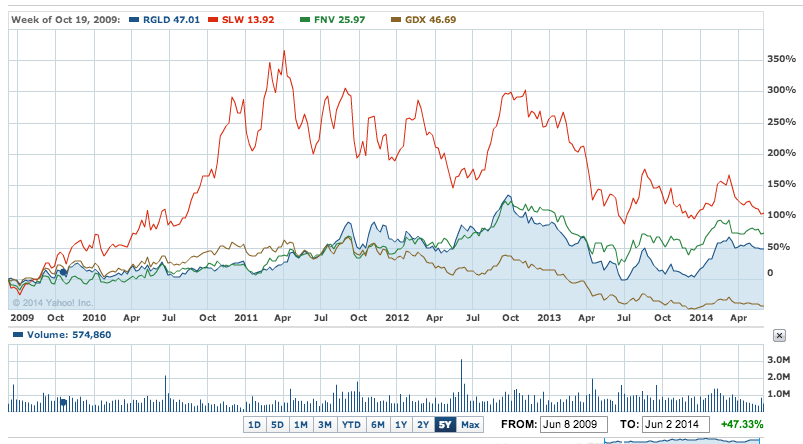
To prove my point about the gold streaming sector, here is a chart that shows the performance of the three major precious metals streaming companies over the past five years - Royal Gold (RGLD), Franco Nevada (FNV) and Silver Wheaton (SLW) - compared to gold miners (GDX).
You'll see a 100%+ performance from SLW, a 70% rise in FNV and a 50% rise in shares of RGLD, but a negative return in the miners:
(click to enlarge)
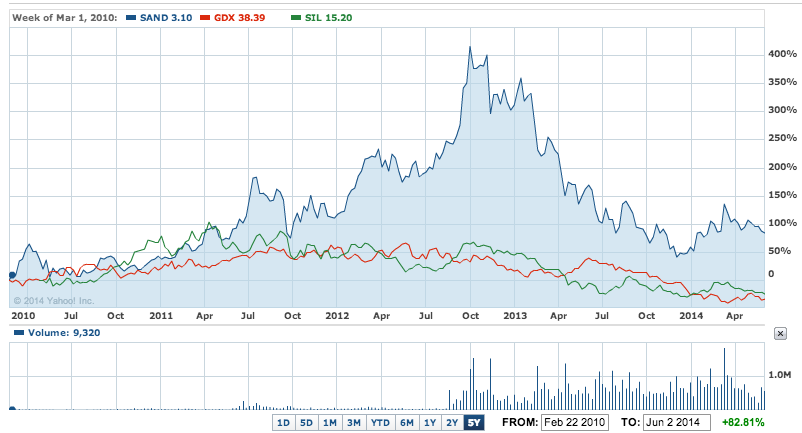
Meanwhile, Sandstorm Gold has also crushed gold and silver miners - the company is up 82.81% since February of 2010, compared to negative returns in the GDX and SIL:
(click to enlarge)
I fully believe that this outperformance has to do with the numerous advantages of the gold streaming business model. I only expect this outperformance to continue going forward - as miners have difficulty turning profits, developing properties and reducing ongoing capital costs, streamers will still be profitable and looking to invest.
Why Sandstorm Gold?
There are a few reasons why I consider Sandstorm to have the biggest upside out of the streamers:
Growth upside: With a market cap of just under $600 million, Sandstorm is tiny compared to its peers Silver Wheaton ($7.46 billion), Royal Gold ($4.23 billion), and Franco Nevada ($6.95 billion).
I believe the company has a ton of room for growth. The advantage of being smaller than its peers means that just a $20-$30 million gold stream can result in significant value creation. This is not the case for the larger streamers, where a $30 million deal would barely move the needle.
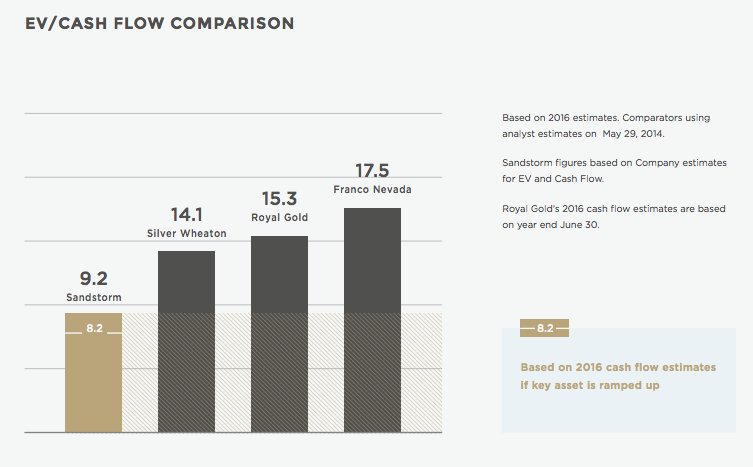
You will also see from this chart below that Sandstorm currently trades at a discount to its peers, trading at 8.2x its 2016 cash flow estimates.
(click to enlarge)
Balance Sheet Strength: With $110 million in cash plus a $100 million line of credit available, Sandstorm is well capitalized to grow its business by buying additional accretive gold streams.
Cash Flow Machine: Sandstorm Gold is profitable, even at $1,200 gold and below. This is due to the nature of gold streams, which allows the company to buy gold at a fixed price per ounce, in addition to the strength of its partners.
For example, for the first quarter of 2014, the company reported operating cash flow of $9.2 million and net income of $3.8 million, even with gold prices under $1,300 for most of the quarter. Most mining companies either did not turn a profit, or turned a small profit.
For the full year 2014, the company estimates cash flow of $47 million, increasing to $57 million by the end of 2016 (based on a $1,300 gold price). This is based on Sandstorm's current assets only, and does not include any potential future gold streams or royalties.
Tuesday, April 8, 2014
Wall Street Breakfast: Must-Know News
| 23 comments | Includes: AA, ALLY, BR, C, GIII, JRCC, LLY, LQ, MRETF, PATCA, PBYI, Q
 Economy
 Economy
The Bank of Japan has kept its key interest rate at 0.1% and left unchanged its program of expanding the monetary base by ¥60-70T ($580-680B) a year. The BOJ refrained from further easing and maintained its optimism about the economy despite concerns about the impact of a rise in sales tax that took effect last week.
Ukraine's security forces have been attempting to clear Kharkiv, the country's second-biggest city, of separatists as the government tries to counteract what it sees as Russian schemes to engineer more annexations. Violence has flared amid pro-Russian demonstrations in Ukraine, with the latter accusing its neighbor of using separatists to seize administration buildings in Luhansk and Donetsk. The increasing tension has weighed on European shares today.
The Senate has passed a bill that would extend benefits for 2.8M people who have been out of work for at least six months, with the measure receiving support from several prominent Republicans. The legislation would restore the payout for five months retroactive to December, when it expired. The bill now goes to the House, where approval may be harder to come by due to concerns about costs.
Puerto Rico has hired restructuring lawyers from Cleary Gottlieb Steen & Hamilton, prompting speculation that the commonwealth is about to revamp its $70B of debt. Puerto Rico wouldn't be drawn on what the law firm's specific role is. Cleary has represented a who's who of debt-laden countries, including Greece, Iceland and Argentina. News of the hiring comes after Puerto Rico raised $3.5B in bonds last month.
Stocks
A jury has ordered Japan's Takeda to pay $6B and Eli Lilly (LLY) $3B in punitive damages over allegations that they hid the cancer risks associated with the diabetes therapy Actos. However, Eli Lilly could be off the hook, as Takeda (OTCPK:TKPYY) agreed to indemnify Lilly for any legal liability connected to Actos. In addition, the award may well be cut on appeal.
A jury has ordered Japan's Takeda to pay $6B and Eli Lilly (LLY) $3B in punitive damages over allegations that they hid the cancer risks associated with the diabetes therapy Actos. However, Eli Lilly could be off the hook, as Takeda (OTCPK:TKPYY) agreed to indemnify Lilly for any legal liability connected to Actos. In addition, the award may well be cut on appeal.
Samsung's operating profit fell for the second quarter in a row in Q1, dropping a preliminary 4.3% to 8.4T won ($7.96B) vs consensus of 8.5T won. Sales rose slightly to 53T won from 52.87T won. Samsung (OTC:SSNLF) released its Q1 estimates ahead of the global launch of the Galaxy S5 on Friday amid criticism that the device doesn't have any overly interesting new features.
Subscribe to:
Posts (Atom)