Showing posts with label investment idea. Show all posts

Tuesday, September 19, 2017

Rebuilding Efforts From Hurricanes Harvey and Irma Make These 6 Stocks Must Buys

Image result for Owens Corning

Hurricanes Harvey and Irma destroys lots of homes and autos. Look for everyone from insulation-maker Owens Corning to car-radio service SiriusXM to benefit.

Florida and Texas residents will spend billions of dollars recovering from Hurricanes Harvey and Irma, and stocks expert Stephen "Sarge" Guilfoyle sees a half-dozen or so names as great plays on the restoration efforts.
"People need timber, they need roofing material, they need insulation," Guilfoyle said during TheStreet's latest monthly Trading Strategies roundtable discussion with some of our top columnists. "I think it's not too late [to invest] because many [hurricane victims] probably haven't even ordered these materials yet."
Guilfoyle's top picks for hurricane-recovery plays include:
  • Building-Supply Firms. Guilfoyle says home-insulation maker Owens Corning (OC - Get Report) and lumber giant Weyerhauser (WY - Get Report) should do well. He personally owns both stocks.
  • Conglomerates with Building-Supply Divisions. The expert likes Honeywell International (HON - Get Report) and United Technologies (UTX - Get Report) , two diversified companies with divisions that make building supplies. Guilfoyle noted that United Technologies has recently been trading at about $110 a share -- down some $10 from a recent peak -- "so you can actually buy UTX probably at a decent price."
  • Auto Stocks. The market watcher said car-related plays should do well as consumers replace vehicles damaged by floodwaters. "How many cars do they need to buy in Texas now?" Guilfoyle asked. "This is probably going to be good for the auto companies." His favorite automotive play is satellite-radio giant SiriusXM (SIRI - Get Report) , which most subscribers use with their car radios.
  • Valero Energy Corp. (VLO - Get Report) . Guilfoyle bought shares of this Texas-based oil refiner ahead of Hurricane Harvey and said he "got lucky" when the firm weathered the storm fairly well. "Valero actually happened to be the one that came through with I think the least amount of damage when Hurricane Harvey hit Texas, which is kind of like 'Bubba Gump shrimp boat' success."
You can watch a full replay of the round table here. 
By Jerry Kronenberg

Friday, September 1, 2017

A Bullish Look At PayPal

Image result for paypal

Summary

PYPL's focus on strategic partnerships has allowed the firm to reduce competitive risk and drive up revenue growth.
PYPL's emphasis on its mobile segment should allow the company to benefit greatly from the m-commerce trend.
The firm's plans to monetize Venmo are expected to be an important growth driver in the coming years.
Due to its ability to enhance network effect, capitalize on the accelerating m-commerce trend, and develop new revenue streams, I believe PayPal Holdings, Inc. (NASDAQ:PYPL) is a company with great upside potential. The company is well-positioned in the market, considering its business qualities, financial health, historical growth, and potential growth drivers.

Business quality

PYPL’s two most distinctive competitive advantages lie in its sound security system and first-mover advantage. With 15 million transactions per day and more than $200 billion total payment volume (TPV) annually, PYPL has maintained losses within 27-31 bps of TPV, the lowest among the industry. The company utilizes artificial intelligence technology to review patterns of likely frauds from its customer data base, thus spotting potential fraudulent purchases. Since PYPL is one of the largest digital payment companies in the world, the company has a larger customer data base than its competitors that allows it to detect more fraud patterns.
As a pioneer in the global digital payment industry, PYPL enjoys first-mover advantage. While this isn’t necessarily a sustainable competitive edge, it has allowed PYPL to develop competitive edges such as network effect. For instance, as of 2017 Q2, PYPL reached 210 million customer accounts and 17 million retailer accounts. This large size of customer base and merchant coverage has prompted more retailers and individuals to join PYPL, thus creating an economic moat hard for competitors to replicate. Furthermore, operating in more than 200 markets, PYPL has overcome regulation issues in 200+ countries and regions and countless financial institutions over the years. As handling regulatory requests is extremely time-consuming, this also serves as one of PYPL’s strongest competitive edges.

Industry analysis

Image result for paypal global reach
With more than 85% of global customer transactions involving cash and a $100+ trillion total addressable market according to PYPL, the digital payment industry has enormous growth potential. The fast-growing industry grew 19% in 2016 ($2,221 billion total transaction value in 2016) and is expected to grow 15% annually by total transaction value from 2017 to 2021. The huge market potential within the industry is expected to increase cutthroat competition and thus lower margins, with global firms such as Google (NASDAQ:GOOG) (NASDAQ:GOOGL), Apple (NASDAQ:AAPL), and Square (NYSE:SQ) expected to attract more digital transactions worldwide. Going forward, adoption of mobile commerce and mobile payments is expected to be the main growth driver of the industry as smartphone penetration rate in mature and emerging markets continues to increase. M-commerce accounted for 11.6% of U.S. e-commerce in 2016 and is forecast to reach $284 billion, or 45% of the total U.S. e-commerce market in three years.

Management quality

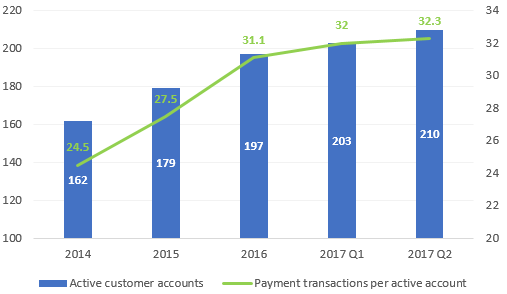
PYPL’s management team focuses on expanding PYPL's ubiquity and value of the PayPal brand through partnerships and new enhancements. The company has announced a number of partnership deals with competitors such as Visa (NYSE:V), Mastercard (NYSE:MA), and Apple in recent years to expand their market reach and provide existing users with more options. As a result, customer adoption, measured by active customer account growth, and user engagement, measured by payment transactions per active account, have both increased (Exhibit 1). PYPL managed to grow 6.6% in active customer accounts and 3.9% in payment transactions per active account in the first half of 2017, compared to 10% and 13% in 2016.
Exhibit 1. Active customer account growth ($mlns): 2014-2017 Q2
Source: PYPL analysts’ day
Furthermore, PYPL focuses on developing new enhancements to increase customer engagement. For instance, One Touch has been driving customer engagement and improving PYPL’s mobile performance by creating frictionless buying experience for buyers. As of 2017 Q2, over 60 million customer accounts and 5.5 million merchants opted in One Touch; payment volume from mobile devices increased 50% year over year, accounting for 34% of TPV ($36 billion). Other enhancements include PayPal Credit, which increases customer engagement and spend, and PayPal Working Capital, which drives merchant engagement and processing value. By extending the company’s market reach and deepening market penetration, PYPL has enhanced its powerful network effect.
PYPL also strives to develop new revenue streams and diversify its business. For instance, the company acquired Xoom in late-2015 to explore cross-sell opportunities and expand its global customer base.

Financial quality

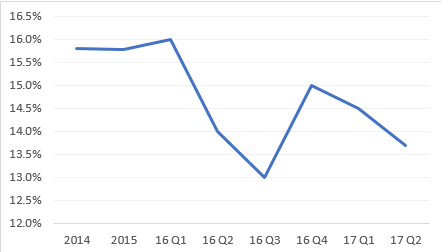
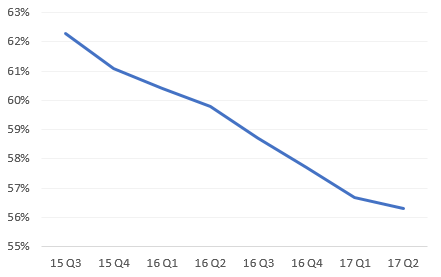
PYPL’s GAAP operating margin has declined in recent quarters (Exhibit 2). In 2017 Q1, the company’s margin was 14.5%, down 150 bps year over year; in 2017 Q2, operating margin was 13.7%, down 30 bps from last year. Margin decline was due to a couple of reasons. For one thing, Xoom, PYPL’s online international money transfer service the company acquired in November 2015, is not yet profitable. Substantial growth in Braintree, PYPL’s subsidiary that focuses on mobile and web payment services for merchants, also contributed to lower margins with its low take rate and high transaction costs. Lastly, PYPL’s focus on strategic partnership to reduce competitive risk contributed to margin compression due to an increase in transaction expenses (Exhibit 3).
Exhibit 2. GAAP Operation margin: 2014-2017 Q2
Exhibit 3. Transaction margin: 2015 Q3 to 2017 Q2
Source: PYPL annual report
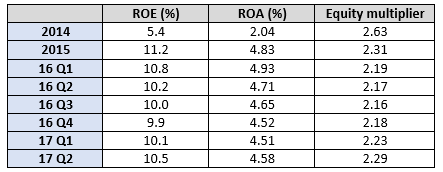
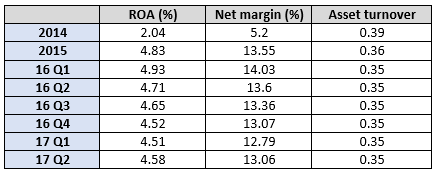
PYPL’s profitability can be further analyzed using DuPont analysis in the following.
Source: FactSet
As can be observed, though PYPL’s ROE has remained in the range of 10-11%, it has been on a downtrend since 2016 mainly due to a decreasing ROA. If we break down ROA into two parts as ROA = Net profit margin * Asset turnover, it appears that this decrease is a result of decreasing margins, as asset turnover has been stable over the quarters.
Source: FactSet
In terms of balance sheet, PYPL reduced all debt in 2015 Q3 and currently has zero debt. The main source of PYPL’s liability are funds payable and amounts due to customers.

Historical Growth

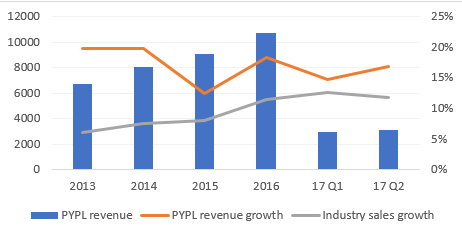
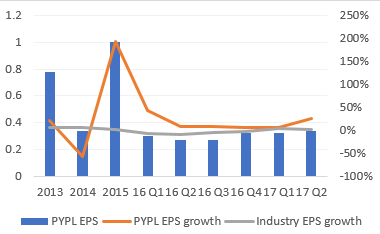
PYPL’s performance in revenue and EPS growth have both exceeded that of the industry in the past four years. The digital payment giant’s revenue maintained a growth rate of approximately 18% from 2013 to 2016 on a currency-neutral basis while growing 14.7% and 16.9% in the first and second quarter of 2017, respectively. The company also enjoyed high single-digit EPS growth in 2016 while generating EPS growth of 6.7% (Q1) and 25.9% (Q2) in 2017. This outperformance was primarily driven by growth in TPV, which grew by 26% in 2016 to $354 billion, 22.5% in 2017 Q1, and 23.5% in 2017 Q2. TPV increased mainly due to PYPL’s continuing expansion and deepening market penetration.
Exhibit 4. Revenue and revenue growth compared to the industry
Source: FactSet
Exhibit 5. EPS and EPS growth compared to the industry
Source: FactSet
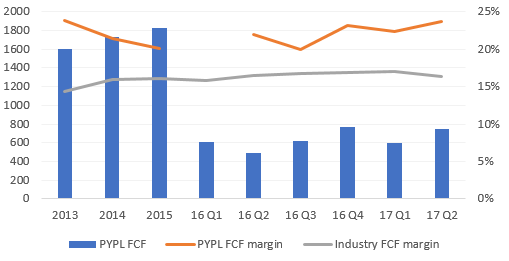
FCF margin has remained within 20-24% in recent quarters, generating approximately 20 cents of FCF for every dollar of revenue earned. The firm generated $2.5 billion in FCF in 2016, a 36%, or $665 million increase from the previous year. The increase in FCF during this period was mostly driven by higher cash generated from operating activities. The firm generated $603 million in FCF in 2017 Q1 and $747 million in Q2. PYPL’s ability to consistently generate strong cash flows has allowed the company to return large amounts of cash to shareholders. The company announced a $5 billion share repurchase plan in 2017 Q1 which will be effective after the completion of the previous $2 billion repurchase plan.
Exhibit 6. FCF and FCF margin compared to the industry
Source: FactSet

Growth drivers

As the world moves towards a cashless society, the digital payment industry enjoys an enormous growth potential that accounts for $100+ trillion total addressable market. PYPL, with its strong network effect and constantly increasing new enhancements, creates stickiness for its users and retailers. Thus, the company is expected to profit greatly from this global trend.
Additionally, PYPL has also been actively developing its mobile payment and mobile commerce segments in response to the upcoming m-commerce explosion. In terms of mobile payment, there is Venmo, the firm’s P2P payment platform, which has surged in popularity by incorporating social media features. The platform has enjoyed substantial growth in recent quarters, processing $6.8 billion in 2017 Q1, a 113% increase from the previous year, and $8 billion in 2017 Q2, a 103% increase year over year. Going forward, as the shift to mobile payments continues, Venmo is expected to maintain its high growth rate.
Though Venmo's take rate is currently low due to its lack of monetization, PYPL has announced its plans to capitalize on the platform. The firm plans to expand Pay with Venmo, the app that allows users to make purchases at retail stores using Venmo, by the end of 2017. PYPL anticipates Pay with Venmo to be available at millions of retailers, which will give a serious boost to the company’s revenue growth.
As for mobile commerce, PYPL focuses on Braintree. Braintree has helped a number of popular apps (e.g. Uber, Airbnb, StubHub) develop their payment gateways as growth in mobile payments spiked in recent years. The business segment currently processes over 1 billion transactions quarterly and has over 269 million Braintree cards on file as of 2016 Q1, a 108% increase from last year. In addition, TPV exceeded $50 billion in 2015, which is more than double than the $23 billion in 2014. The platform is expected to experience substantial growth as the mobile payment trend continues its acceleration, prompting more merchants to seek for payment solutions.

Risks

Though investors may be intrigued by PYPL’s growth prospects, there are also risks that should be taken into consideration, such as competitive risk, foreign exchange risk, and regulatory risk.
Although the global payment industry is still far from saturated, it is rapidly evolving and highly innovative, which may affect the competitive landscape negatively for PYPL. For instance, the shift from e-commerce to m-commerce has opened doors to established technology companies such as Apple, Google, Amazon (NASDAQ:AMZN), etc. In 2016, Apple Pay grew new accounts by 200% compared to PYPL’s 10%, while transactions increased 500% year over year in Q4. The technology giant’s renowned product, iPhone, has an estimated total installed base around 400 million, suggesting a huge potential customer base. As time moves forward, more financial and technology competitors may develop digital payment solutions that have similar functions to PYPL, intruding PYPL’s competency and lowering margins.
PYPL is also subject to foreign exchange risk as it operates in 200+ markets across the globe and has 47% of its revenue exposure in non-U.S. regions. The fluctuation of the U.S. dollar value versus currencies such as the British Pound and Euro impacts the translation of net revenues into the U.S. dollar. Additionally, cross-border trade, which generally provides higher margins than similar transactions that take place within a single market, is also subject to foreign exchange risk. While PYPL strives to hedge portions of its foreign currency translation and balance sheet exposure, it is impossible to eliminate these effects completely.
Lastly, PYPL’s business is subject to regulations and policies and legal interpretations in the markets in which the company operates. As the payment industry grows, this may result in increased regulatory oversight and tighter enforcement of regulations that apply to PYPL. Also, as PYPL expands and localizes their international activities, the firm will be obligated to comply with the laws of more nations and markets.

Momentum

PYPL has an impressive earnings beat track record, exceeding analysts’ estimation every quarter since its separation from eBay (NASDAQ:EBAY) in 2015. That said, the company had two dips during last year while beating estimates. The first dip took place in 2016 Q2, when PYPL announced partnership news with Visa, raising investors’ concerns of lower transaction margins. Stock price dipped again later in 2016 Q4, this time because though PYPL’s performance was in line with average estimations, it was on the lower side of analyst expectations.
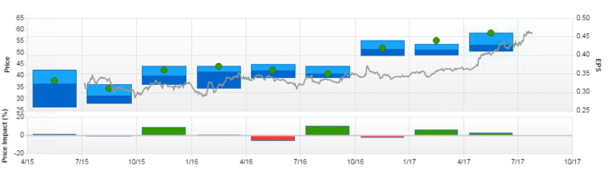
PYPL performed especially well in the first half of 2017, beating sales and earnings targets in both quarters while also announcing news of partnership deals with companies such as Apple, Samsung (OTC:SSNLF), Citi (NYSE:C), and Chase. This outperformance has prompted analysts to revise earnings estimation for future quarters upward and also drove up PYPL’s stock price. EPS target for 2017 Q3 increased from $0.41 to $0.43, while the target for 2017 Q4 was revised to $0.51 from $0.49. Stock price has appreciated 52% year to date.
Exhibit 7. Earnings surprise track record
Source: FactSet

Valuation

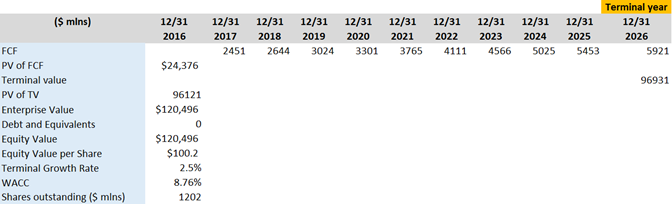
The 10-year DCF valuation indicates that PYPL’s intrinsic value is $100.2, suggesting a 61% upside potential. Revenue growth is projected to be in the range of 16-17.5% in the next three years and then start to decrease gradually. Such projection is based on the growth potential of Braintree and Venmo’s monetization, which is anticipated to have a larger impact in 2018 and 2019. In addition, as the mobile payment trend expands, PYPL’s popular enhancement One Touch is also expected boost the company’s TPV greatly as consumers and merchants seek for payment solutions that solve friction problems.
PYPL’s operation margin is forecast to decline over the years, from 14.6% in 2016 to 12.5%, on the basis of the company’s focus on strategic partnerships. Tax rate is projected by averaging the value of the past two years. For the WACC calculation, key inputs are as the following: a tax rate of 16%, PYPL’s beta 1.18, risk-free rate 2.13%, cost of equity 8.76%, and cost of debt 0% since PYPL has no debt.
Exhibit 8. DCF valuation
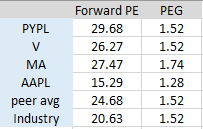
Exhibit 9 shows PYPL’s relative value compared to its major competitors and the industry. Relative to its peers and the industry, PYPL trades at a premium based on forward PE and is considered fairly valued based on forward PEG. The company's PE ratio translates into a projected earnings growth (22.7%) higher than its peers (Visa: 20.4%, Mastercard: 16.7%, and Apple: 8.4%). The company’s forward PEG translates into an expected growth rate of 19.5% for the next 12 months, which is slightly above PYPL’s own estimation (17-19% in 2017) but reasonable when considering the expected impact of Venmo’s monetization in the next two years.
Exhibit 9. Valuation multiples compared to peers and industry
Source: FactSet

Investment summary

Upon reviewing PYPL’s competitive edges, financial health, historical performance relative to the industry, growth drivers ahead, and impressive earnings surprise track record, the DCF model sets PYPL’s target price at $100, providing a 61% upside.
Disclosure: I am/we are long PYPL.
I wrote this article myself, and it expresses my own opinions. I am not receiving compensation for it (other than from Seeking Alpha). I have no business relationship with any company whose stock is mentioned in this article.
By I - Schiuan Lin

Thursday, April 20, 2017

As fear of a space war mounts, US Air Force taps start-up technology

 
Steven Puetzer | Getty Images


Tapping Elon Musk's SpaceX to launch some of its satellites is only the beginning in a larger top-to-bottom rethink of the way the U.S. Air Force approaches its operations in space. Air Force officials want to move faster when addressing emerging threats and future missions in orbit, and it's increasingly looking to start-ups to address a deepening sense that America's dominance in space is eroding.
The goal: to protect our satellites and spacecraft from cyberwarfare and missile attack. This is critical, since space weapons could be used to compromise navigation, surveillance, communications and other functions in wartime or during a national emergency.
The shift comes as the space domain is already receiving increased attention from lawmakers and the Department of Defense and, in the years ahead, likely more defense dollars as well. The Pentagon's Joint Interagency Combined Space Operations Center — known by the unwieldy acronym JICSPOC — was recently rebranded the National Space Defense Center, and under pressure from Congress, the Air Force this month created a new position for a three-star general that will serve as a kind of space czar, advising the Air Force Secretary and the Joint Chiefs of Staff.
That general will "come to work every day focused on this: making sure we can organize, train and equip our forces to meet the challenges in this domain," Gen. Jay Raymond, head of Air Force Space Command, said last week at the National Space Symposium in Colorado.
Part of that job of training, organizing and equipping the U.S. military's space forces could fall to smaller, more agile companies outside of the Air Force's conventional supply chain of major defense and aerospace contractors, Raymond suggested. Though procurement programs for new satellites and rockets have long been measured in years — sometimes decades — threats and challenges in the space domain are now moving much faster as potential adversaries like China hone their capabilities in space. "I really see a need to go fast," he told his audience. "We are developing ways to go fast."


Though international agreements such as the 1967 Outer Space Treaty prohibit the positioning of weapons in space, the Pentagon is increasingly aware of the vulnerabilities there. As more and more countries develop advanced rocketry programs and cyber capabilities, it grows more and more difficult to defend critical military satellites that provide U.S. air, ground and sea forces with intelligence, communications, navigation and targeting capabilities.
In a serious conflict with a sophisticated adversary — Russia or China, for example — those satellites would likely be among the first targeted. Both countries (as well as the United States) have successfully tested anti-satellite weapons capable of destroying satellites in orbit. Military officials have also expressed repeated concerns about cyber vulnerabilities that could allow an enemy to jam satellite transmissions or otherwise disable space assets remotely.

Monday, April 3, 2017

3 Revolutionary Drugs for Chronic Pain


Flexion Therapeutics, Cara Therapeutics, and Nektar Therapeutics have entirely new ideas for how to treat chronic pain, and those ideas may reshape the market.


Flexion Therapeutics (NASDAQ:FLXN), Cara Therapeutics (NASDAQ:CARA), and Nektar Therapeutics (NASDAQ:NKTR) may soon offer patients suffering from chronic pain a better option than opioids. Here's how these companies plan to reshape the way doctors treat the 39 million Americans with chronic pain.

Tackling knee pain

Flexion Therapeutics' Zilretta is under review by the Food and Drug Administration (FDA) as a new approach to treating knee pain caused by osteoarthtritis, and positive results from trials suggest it could eventually replace corticosteroid injections for millions of patients.
A man rubs his knee because of chronic knee pain.
IMAGE SOURCE: GETTY IMAGES.
The FDA will issue a go/no-go decision on Zilretta on Oct. 6, and data from studies may be compelling enough for a green light. In trials, Zilretta patients enjoyed a median 50% reduction in knee pain, and, more importantly, that pain relief was maintained throughout a three-month period. If Zilretta's effectiveness holds up in the real world, there's a good chance it will win support with doctors and patients because pain relief from corticosteroids typically wears off within weeks -- long before the next scheduled quarterly injection.
Roughly 5 million people currently receive corticosteroid shots because of their pain, and management thinks Zilretta could fetch $2,000 per patient per year. If this estimate is on target, it won't take a lot of market share for Zilretta to be a top seller. 
Recently, rumors have surfaced that acquisition-hungry Sanofi SA (NYSE:SNY) is kicking Flexion Therapeutics' tires. It wouldn't shock me if those rumors are true. Sanofi has attempted to buy Medivation and Actelion in the past year, so it's clearly on the hunt for acquisitions. Importantly, Sanofi already markets Synvisc-One -- a hyaluronan injection used to treat knee pain -- which generates $400 million per year, so it's already got the sales force in place to turn Zilretta into a winner. 

Outperforming opioids

Cara Therapeutics thinks CR845's ability to relieve pain with less risk of addiction could allow it to capture a big share of the 24 million pain prescriptions written for opioids every year.
Instead of targeting mu-opioid receptors in the nervous system like opioids, CR845 relieves pain at the source by targeting kappa-opioid receptors in the periphery of the body. Because CR845 is designed not to pass easily through the blood-brain barrier, it delivers less of a euphoric high than opioids.
CR845 is being studied in hip and knee pain in osteoarthritis patients, and management just reported data showing that it can help reduce chronic itch in dialysis patients.
The potential to elbow market share away from opioids and deliver greater relief to dialysis patients is exciting, but more trials are required before Cara Therapeutics can file for FDA approval of CR845. Because more work needs to be done, it may be a while before this drug makes it to market. Nevertheless, this company's opportunity is big, and that makes tracking its progress worthwhile.
https://www.amazon.com/?tag=shoprite0597-20&camp=1&creative=4269&linkCode=ez

Improving the standard

Like CR845, Nektar Therapeutics' NKTR-181 may eventually reduce pain patients' need for opioids. But, unlike CR845, NKTR-181 still targets mu-opioid receptors in the nervous system to deliver pain relief.
However, it does so selectively. And it's specifically designed to cross the blood-brain barrier slowly to reduce euphoria. By more precisely targeting the receptors and limiting euphoria, it may deliver similar relief to opioids with less of a risk of abuse.
Last week, the company announced results from a trial testing NKTR-181 for chronic back pain, and that trial's data didn't disappoint. NKTR-181 reduced pain relative to a placebo, and it did so without causing opioid-like levels of euphoria.
Those findings sent Nektar Therapeutics shares soaring, but the company hasn't announced its plans to file for FDA approval yet. Instead, management is searching for a bigger peer to partner with on the drug. Assuming it secures a deal, an FDA filing should come shortly thereafter, with an official regulatory decision coming 10 months later.
Todd Campbell

Sunday, March 19, 2017

How to Trade the Week's Most Active Stocks--Rite Aid, Amgen, MuleSoft and More

Here's how to trade six of the most active names on the market this past week.


Put down the 10-K filings and the stock screeners. It's time to take a break from the traditional methods of generating investment ideas. Instead, let the crowd do it for you.
From hedge funds to individual investors, scores of market participants are turning to social media and market data to figure out which stocks are worth watching. It's a concept that's known as "crowdsourcing," and it uses the masses to identify emerging trends in the market.
Crowdsourcing has long been a popular tool for the advertising industry, but it also makes a lot of sense as an investment tool. After all, the market is completely driven by the supply and demand, so it can be valuable to see what names are trending among the crowd.
While some fund managers are already trying to leverage social media resources like Twitter to find algorithmic trading opportunities, for most investors, crowdsourcing works best as a starting point for investors who want a starting point in their analysis.
So, today, we'll leverage the power of the crowd to take a look at some of the most active stocks on the market ...
Direxion Daily Junior Gold Miners Index Bull 3x ETF
  • Nearest Resistance: $10
  • Nearest Support: $5
  • Catalyst: Spot Gold Prices
The Direxion Daily Junior Gold Miners Index Bull 3x ETF (JNUG) once again ended Friday's session as one of the most actively traded issues on the NYSE, continuing this big ETF's streak as investors' favorite way to play gold in March. JNUG is a leveraged bet on junior miners, which makes it a magnified way to play the price moves in the precious metal. But despite lots of activity in this ETF, the overall trend has been hard to miss--JNUG is shedding points as shares close in on $5 support. It makes sense to steer clear of this stock for the near-term.
Rite Aid Corp.
  • Nearest Resistance: $5.25
  • Nearest Support: $4.50
  • Catalyst: Merger Progress
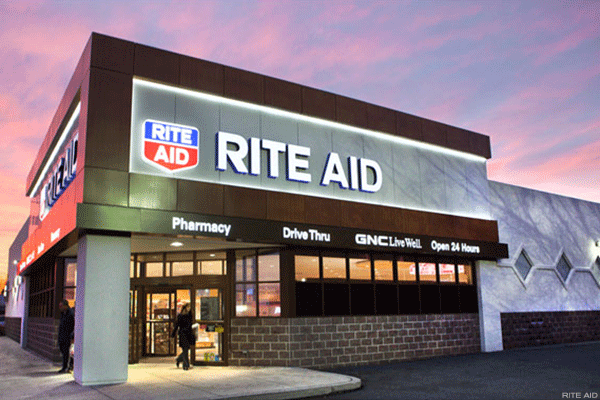
The saga continues in shares of $5.2 billion drugstore chain Rite Aid Corp. (RAD) , a stock that finished Friday correcting 3.8% on the latest update on the firm's pending merger with Walgreens Boots Alliance (WBA) . Rite Aid's plunge came after a former division head at the FTC's Bureau of Competition told news service that CTFN that the deal was "at a standstill."
From a technical standpoint, the price action in Rite Aid has been pretty ugly, and it's not showing any signs of changing its trajectory as I write. That said, headline risk remains very high surrounding the pending merger--any positive catalyst could slingshot shares higher. For that reason, all but the most nimble traders would do well to avoid this stock 
Amgen

  • Nearest Resistance: $185
  • Nearest Support: $165
  • Catalyst: Study Results
$122 billion pharma firm Amgen (AMGN)  ended the week on a sour note, shedding almost 6.4% after the firm's high-dollar cholesterol drug failed to reduce heart complications as much as Wall Street had been expecting. In the trial, Repatha decreased cardiac issues by just 15%. Analysts had been expecting nearly double that result in order to get higher levels of coverage from insurers. But while Amgen was down in Friday's session, don't count this stock out just yet.
That's because Amgen ended Friday at $168.61, a price level just above the trendline support line that's defined this stock's uptrend from its November lows. Put simply, the uptrend is still intact in Amgen--it makes sense to buy the next leg higher in this big drug stock ...
The Medicines Co.
  • Nearest Resistance: $50
  • Nearest Support: $44
  • Catalyst: Repatha Results
Amgen wasn't the only casualty of the Repatha results--another drug stock to backslide was $3 billion biopharma firm The Medicines Co. (MDCO) . MDCO dropped about 8% by the time the dust settled Friday, down because of the similarity between Repatha and its own experimental cholesterol drug, inclisiran. The selling was fueled by Wall Street's worry that the revenue outlooks they'd been projecting might not come to fruition.
Technically speaking, MDCO could look worse, although support at $50 got violated with Friday's selling. The glass-half-full outlook for MDCO is that shares "melted up" over the course of Friday's session, and ultimately didn't pierce the prior trend channel that shares had been stuck in last fall. Wait for MDCO to establish some more meaningful support before you pull the trigger on this trade.
Oracle Corp.
  • Nearest Resistance: $47
  • Nearest Support: $43.25
  • Catalyst: Technical Setup
Software giant Oracle Corp. (ORCL) spent Friday consolidating sideways on big volume, catching its breath following a 6.23% earnings-fueled pop Thursday. Oracle reported an adjusted profit of 69 cents per share for the quarter, besting the 61.8 cent profit that analysts were expecting, on average. Friday's tight range in ORCL wasn't unusual following Thursday's big gap higher. That said, the breakout in ORCL is a buy signal--consider building a position here, with a stop just below the 50-day moving average.
MuleSoft Inc.
  • Nearest Resistance: $25
  • Nearest Support: $23.50
  • Catalyst: IPO
Last, but certainly not least, on our list of the week's most actively traded issues, was MuleSoft Inc. (MULE) . This San Francisco-based cloud software company made its debut as a publicly traded company on Friday, rocketing 46% higher during its inaugural trading session on the NYSE. The IPO values MuleSoft at approximately $3.1 billion in market capitalization.
It's still too early to get a meaningful read on MULE's price action. Shares faded most of Friday, but that intraday weakness probably had a lot to do with just how far over its expected range shares began trading. It's a good idea to wait for this stock to establish some trading history before you think about diving in.
By Jonas Elmerraji