Showing posts with label semiconductor stocks. Show all posts

Thursday, May 18, 2017

Bull of the Day: KLA-Tencor (KLAC)

Image result for KLA-Tencor

Headquartered in Milpitas, CA, KLA-Tencor (KLAC - Free Report) is one of the largest semiconductor equipment companies in the world. They provide process control and yield management solutions for the semiconductor, LED and related nanoelectronics industries.
The company was founded in 1997 with the merger of two companies--KLA Instruments and Tencor Instruments. They have customer operations and service centers around the world.
Impressive Results
The company reported third-quarter fiscal 2017 earnings of $1.62 per share, ahead of the Zacks Consensus Estimate of $1.54. Revenues surged more than 28% year-over-year to $913.8 million, also better than the Zacks Consensus Estimate.  
"KLA-Tencor delivered excellent results in Q3 of fiscal 2017, thanks to another outstanding performance by our employees in executing the Company's growth strategies in an exciting and dynamic period for the Company, and for the semiconductor industry," said the CEO.
Returning Capital to Shareholders
The company continues to boost shareholders’ value through dividends. They have a track record of consistently increasing their dividend payout with the growth in free cash flow. They have maintained a payout ratio of ~40 to 50%. The stock has a dividend yield of 2.11% currently.
Rising Estimates
The Zacks Consensus Estimate for FY 2017 and FY 2018 have surged to $5.88 per share and $6.62 per share respectively, up from $5.71 and $6.29, before the results.The company has an impressive record of beating estimates; they have missed only twice in the past 20 quarters.

KLA-Tencor Corporation Price and Consensus

The Bottom Line
Semiconductors have outperformed the broader market as well as most all other segments of the technology sector. “Semiconductor Equipment - Wafer Fabrication” industry is currently ranked 4 out of 265 Zacks Industries (top 2%). With rising demand from many high growth areas, this outperformance is likely to continue.
Lam Research had agreed to acquire KLAC for $10.6 billion last October but the two companies had to abandon their merger plans after the Justice Department expressed serious concerns on antitrust grounds. However, most analysts are optimistic on the company’s prospects as a stand-alone entity.
Will You Make a Fortune on the Shift to Electric Cars?   
Here's another stock idea to consider. Much like petroleum 150 years ago, lithium power may soon shake the world, creating millionaires and reshaping geo-politics. Soon electric vehicles (EVs) may be cheaper than gas guzzlers. Some are already reaching 265 miles on a single charge.
 With battery prices plummeting and charging stations set to multiply, one company stands out as the #1 stock to buy according to Zacks research.
It's not the one you think.
Disclosure: I own KLAC in the Income Investor portfolio.
By Neena Mishra

Thursday, March 16, 2017

Tech is leading the market — and this stock could be the pick of the litter


Image result for Skyworks Solutions.

Technology stocks will continue to lead the market, according to one technical analyst, who specifically recommends buying shares of hot semiconductor stock Skyworks Solutions.


"First off, we're bullish on the stock market in general, so step one, the question we have to ask ourselves is, what sector do we want to own? Answer: We think technology," Ari Wald, Oppenheimer's head of technical analysis, said Wednesday on CNBC's "Trading Nation."

The S&P 500 technology sector in Wednesday trading hit its highest level back to early 2000; a popular technology-tracking exchange-traded fund, the XLK, was trading at levels not seen since late 2000. Apple boosted the sector, as it traded at all-time highs on Wednesday and closed about 1 percent higher. Wald, observing a chart of the XLK relative to the S&P 500, noted a recent breakout above a consolidation period that's formed since 2012.
Semiconductors, from a technical perspective, stick out to Wald as a top industry pick within the sector. He noted that yet another breakout is afoot when measuring the Philadelphia Stock Exchange Semiconductor Sector Index relative to the technology sector, and sees further strength for semiconductors as a group within tech.
Skyworks Solutions, up nearly 33 percent so far this year, is one of Wald's "favorite ideas" in the semiconductors space. The chipmaker and Apple supplier on Monday was trading at levels not seen since mid-2015.
"Bit of a rotation idea here. [There was a] prior period of underperformance, beginning to shift higher, reverse higher, and I think this is playing the rotation game here within this leading group," Wald said.
Indeed, semiconductors as a group within technology do appear to have a "much brighter outlook" than perhaps the rest of the tech sector at this juncture, said Chantico Global CEO Gina Sanchez. She said certain "super trends" across technology — like companies' shift toward incorporating artificial intelligence and cloud computing — are supportive of semiconductor companies.

"On the flip side, however, you have a hardware industry that has largely not really been going anywhere in terms of innovation and in terms of new products," Sanchez said.

Another potential risk for technology in general involves pending regulatory changes regarding net neutrality, which could hurt streaming services companies, she said.

Analysts on average give Skyworks Solutions a rating of "overweight," with a slightly bearish $94.76 price target. The stock closed slightly higher on Wednesday, at $99.11 per share.


Source:http://www.cnbc.com/2017/03/15/tech-is-leading-the-market--and-this-stock-could-be-the-pick-of-the-litter.html

Sunday, February 12, 2017

3 Reasons To Buy Broadcom: Growth, Value And Prospects

Image result for broadcom

Summary

It is the first time that I buy a stock at an all-time high.
Broadcom's debt is something to watch, but probably it is temporary.
Broadcom is great value stock and a great growth stock at the same time.
The stock seems fairly valued or even undervalued.
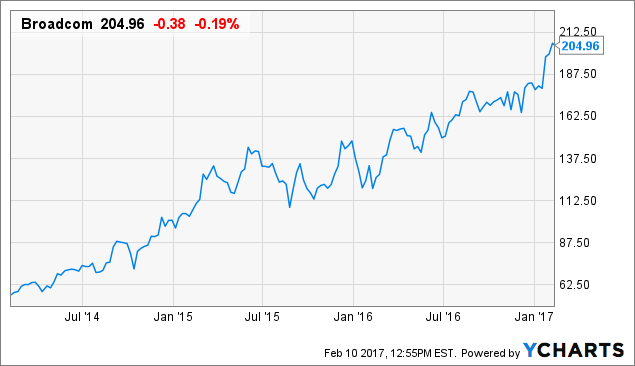
For the first time since I started investing, I have added a stock to my portfolio which is at its all-time high: Broadcom (NASDAQ:AVGO).
AVGO Chart
AVGO data by YCharts
Broadcom has got some safety issues, but I think they are controllable at the moment. The main reason I have added it to my portfolio is because it is a great combination of a value stock and a growth stock. It has a solid 2% dividend with a great dividend growth rate in the last few years and a huge potential to keep the dividend hikes in the double digits for years to come. Besides that, it has the potential to double in five years' time if you look at EPS and even in less than three years' time if you look at the free cash flow. In short: a great total return stock!
Safety
One of the first things I look at when I buy stocks is safety. Safety can be seen in the credit rating and in debt management. I buy for the long term and companies with junk status are too unstable for my taste to invest in for the long term.
Broadcom is in the very competitive semiconductor sector, but it is a diversified company. It has products in these five categories:
(Source: broadcom.com)
Its biggest client is Apple (NASDAQ:AAPL), with 20% of the revenues. This is a risk if Apple would completely stop the collaboration, but I don't see that happening any time soon. But still, it is a risk to consider.
Broadcom has a status of BBB- (S&P) and Ba2 (Moody's). This is investment grade, but just barely. That was one of the reasons I took a deep dive into the stock before I bought it.
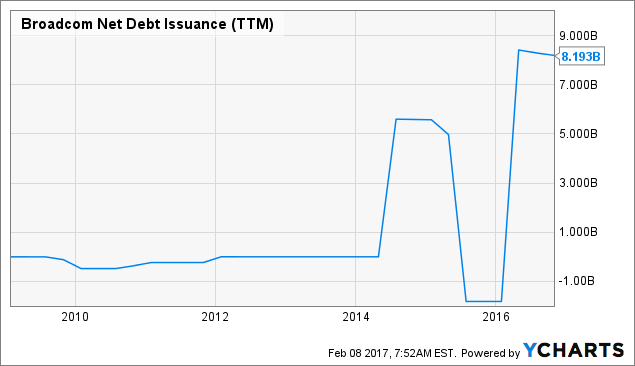
This is the evolution of Broadcom's debt:
AVGO Net Debt Issuance (<a href=
As you can see, Broadcom didn't have any debt (even more than $1B of cash) before the beginning of 2016. That was because of the acquisition of Broadcom by Avago, which then changed its name to Broadcom. The company paid $17B in cash and $20B in stocks for this acquisition, which explains the high debt. And this higher debt caused the rating agencies to give the new Broadcom the quite low credit ratings Ba2 (Moody's) and BBB- (S&P).
This low credit ratings didn't stop Broadcom to acquire Brocade (NASDAQ:BRCD) for (with the debt of Brocade included) $5.9B in an all-cash transaction. The deal is expected to close in October 2017 and again Broadcom's debt will go up. The credit rating of Broadcom is the only real point of worry that I have about Broadcom. This is what I will keep an eye on in the coming quarters and years. I don't want stocks with junk grade credit ratings in my portfolio.
This situation for Broadcom could be temporary, though. I think and hope Broadcom's management will lower the leverage in the following years. The Brocade deal was just too good not to close: it was a great diversification and I think Brocade was undervalued. Broadcom has already announced that it will divest the IP networking division of Brocade. I think the selling price of that division might be around $2B to $2.5B, which would already give Broadcom a kick-start to reduce its debt.
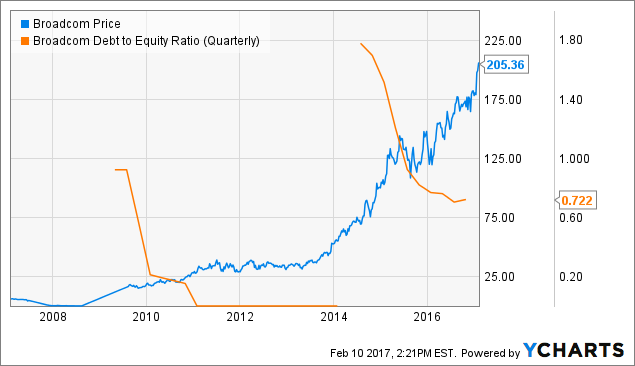
Why I think that the big debt situation may be temporary is that the FCF (free cash flow) of Broadcom is expected to grow by 88% in 2017 as a result of the acquisition, synergies and new growth. After 2017, FCF is expected to grow by 20% and more. If that high growth in FCF is used to pay down debt, there is nothing to worry about. And historically the company has already been in this situation:
AVGO Chart
AVGO data by YCharts
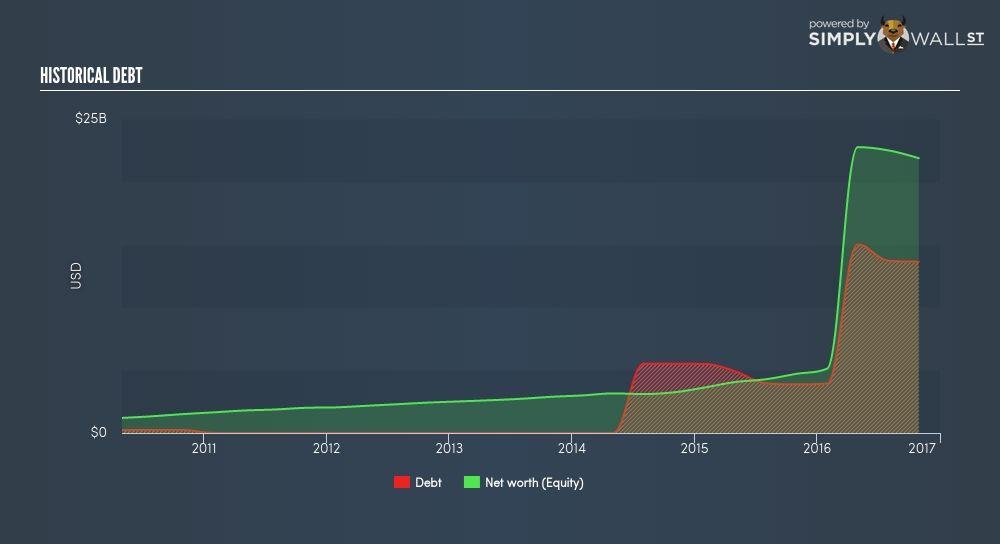
You see that Broadcom is already working to reduce its debt. Normally I want the debt equity ratio at maximum of 40%, but I think this criteria will be met by Broadcom pretty soon. Therefore I am prepared to be flexible.
Source: simplywall.st
So, you can see that Broadcom doesn't have a long history of high debt. It dates from the last years. This debt is still manageable. But again: something to watch closely.
Broadcom is a great value stock
I want either a good dividend or high growth or a mix of both in my portfolio. Broadcom may be one of those few stocks that combines both growth and value. Let's start with value.
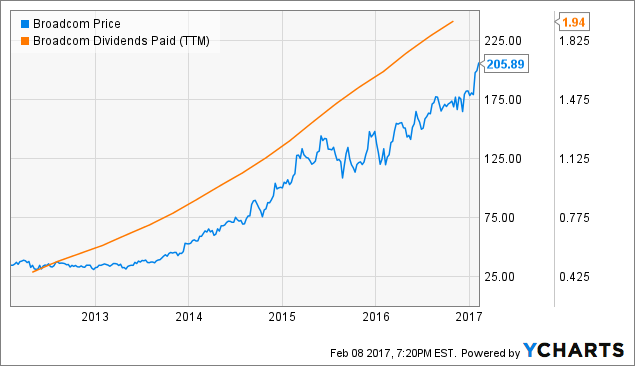
Broadcom's dividend rate is $4.08, which means a yield of 1.98%. For dividend investors, this already looks quite okay, but not really exciting. But yield doesn't say everything; the dividend growth rate is also very important if you are considering to keep a stock in your portfolio for quite some time. And there Broadcom's performance is outstanding: the 3-year dividend growth is 34.3% and even 40.7% over the last 5 years.
Now that is what I like for a dividend: high growth. The fact that Broadcom's yield is still only about 2% just means that the valuation went hand in hand with the huge dividend raises. You can see that on this graph:
AVGO Chart
The Chowder Rule says that if a stock has a dividend yield of less than 3%, its five-year dividend growth rate plus its dividend yield must be 15 or higher. Broadcom has a 40.7% dividend growth for the last five years. If you add up the 1.98% dividend and the expected big dividend growth in the years to come, then you see that Broadcom can easily pass the Chowder rule.
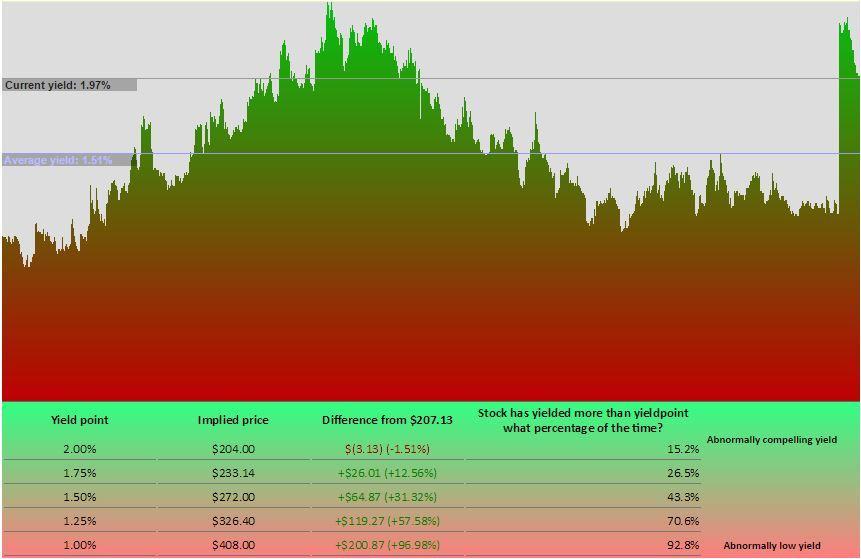
With the great site yieldchart.com, you can calculate how high the dividend is compared to the average of the last five years. Here is the graph:
Broadcom's dividend sits at 1.97% at this moment. As you can see on the chart of the last five years, historically this is quite high, despite the huge run the stock has had in the last year:

Saturday, February 11, 2017

Nvidia's stock can beat the broader market for years to come

Nvidia has invested over $12 billion in research since its founding in 1993, in a bid to stay ahead of rivals Intel and AMD.
© Provided by Dow Jones & Company, Inc. Nvidia has invested over $12 billion in research since its founding in 1993, in a bid to stay ahead of rivals Intel and AMD.

Scientists recently discovered an element on Mars that can make people weightless, which means we will be able to travel at the speed of light.
This amazing substance, called Element Zero, will support major breakthroughs in cancer research, artificial intelligence and self-driving cars as well.
The great news for you as an investor is that there is a pure play on all of this: the chip company Nvidia Corp. (NVDA) based in Santa Clara, Calif.
“We think Nvidia will grow very rapidly through 2019 and beyond.” — Brian Beitner, manager of the Chautauqua Global Growth Fund
OK, this sounds like a bunch of malarkey. Is it just more “fake news”?
Believe it or not, most of it is actually true.
Yes, the part about Element Zero on Mars is fake. That comes from the plot line in a much-anticipated Electronic Arts (EA) video game called “Mass Effect: Andromeda.” It’s the fourth part of a popular franchise due March 21. (Three for March, and then two, one, lift-off. Get it?)
But the following is true, and it explains how we get from a fake element on Mars to breakthroughs in medical research and self-driving cars in three easy steps.
First, “Mass Effect” will be a big hit. Along with other popular games, it’s going to draw even more players to video gaming and “e-sports.” This will make fans want to upgrade their PCs for better performance.
Step two: This will increase demand for some of the most powerful chips on the planet made by Nvidia — the GeForce line of graphics processing units (GPU). They’re the chips that make PC-based gaming so real.
Third, Nvidia will use a lot of the money it earns to keep improving its chips. Then researchers in drug development, artificial intelligence, autonomous cars and robotics will continue to use these advanced chips to make breakthroughs of their own.
This feedback loop is powerful, and it tells me that Nvidia’s robust third-quarter sales strength will most likely follow through in fourth-quarter earnings to be reported Thursday.
Regardless of what Nvidia reports this week, if you buy the stock now as a play on these themes, you are probably going to do just fine, even though the stock looks a little scary after its 244% advance last year.
Brian Beitner, who manages the Chautauqua Global Growth Fund (CCGIX) is one stock picker who isn’t too bothered by that increase, or Nvidia’s rich valuation. Nvidia stock trades at a forward price-to-earnings ratio of around 44. Beitner thinks the trends behind Nvidia’s growth are so strong, it will simply grow into its valuation over time.
A drone tour of China's rusting shipyards
“We think the company will grow very rapidly through 2019 and beyond,” says Beitner. “We envision robust growth relative to the rest of the market.” That’s one of the main reasons his fund recently added the stock. Beitner is worth listening to, because he’s the rare active manager who beats the market. His fund outperformed its benchmark by about 3 percentage points, annualized, over the past 10 years.
Indeed, using the old Peter Lynch price-to-earnings-to-growth ratio (PEG) metric, Nvidia’s valuation looks OK. Lynch’s PEG ratio divides a company’s P/E by its estimated growth rate. Lynch, who made a name for himself by crushing the stock market at Fidelity Investments, considered anything at or below 1.5 for a fast-growing company like Nvidia to be a reasonable valuation. Nvidia’s PEG ratio is around 1.5.
Here’s another false fear about Nvidia that you should probably ignore, says Jefferies chip-sector analyst Mark Lipacis. Yes, the chip sector looks vulnerable. Chip stocks in the Philadelphia Semiconductor Index (SOX) advanced 37% last year compared with 10% for the S&P 500 (SPX) A “reversion to the mean” now might be natural. Chip inventories may be rising because chip suppliers are selling more chips than equipment makers are sending out the door inside finished products. That can be ominous for the group. Debt levels are high at chip makers in general, which limits potential gains from leverage. And the mergers-and-acquisitions trend in the industry may have played out.
Despite these potentially negative trends, which make Lipacis cautious on the group, he still likes Nvidia. He thinks it is among a handful of chip stocks that might be exempt from any sector issues. Beitner agrees, citing the company’s competitive advantages and “big, open-ended growth opportunities.” Here’s a closer look at the main opportunities.
The revenge of the gamers
Thanks to popular games like “Mass Effect,” “Call of Duty,” “Grand Theft Auto” and “Minecraft,” video gaming is now the largest entertainment business in the world. It takes in about $75 billion a year. Sales should grow 5% a year through 2020, according to PricewaterhouseCoopers. Gaming isn’t just about playing. It’s also a spectator sport. Many top YouTube channels show gamers in action. Other gamers like to watch to learn new skills.
All of this means that a chip company that sells into this trend might be immune from the normal semiconductor cycles. “Video gaming is one of the most interesting trends happening in discretionary consumer spending,” says Jesse Flores, an analyst at the Chautauqua fund. “There is a lot of money being spent on this, and the number of video gamers is growing in the double digits [in percentage terms].”
Gamers prefer customized personal computers, as opposed to consoles like the Xbox, and Nividia plays right into this trend since its GeForce line of GPUs powers gaming PCs. “Nvidia has captured this trend incredibly well. Nvidia is, for all intents and purposes, the category killer,” says Flores. “They have 80% share for discrete graphics processors for PC video gaming.” Discrete processors are chips dedicated to a single use — like graphics, in this case.
Nvidia has a competitive advantage in GPUs because it has been in the video-graphics business for nearly three decades, and it spends a lot on research. Along the way, it has even created its own programming language, called Cuda, to help researchers develop GPUs. One sign of Nvidia’s strength is that Intel (INTC) has tried for decades to break in to the space, with little success. “If it is challenging for Intel, you know the barriers are very, very high,” says Beitner.
Third-quarter sales at Nvidia advanced 54% to $2 billion compared to the prior year, and most of that came from GeForce gaming GPU sales growth. As usual, Nvidia redeployed a lot of that money to making its chips better. Research-and-development spending advanced 13% in the quarter to $373 million, or about $1.5 billion annualized. Since its inception in 1993, the company has invested over $12 billion in research. But it’s also generous to shareholders. It expects to spend $1 billion for share buybacks and dividends in 2017.
In short, for years gamers have been funding the development of chips that now power real-life advances in medical research, self-driving cars, robotics and big-data analytics. This handoff is a huge potential source of growth for Nvidia. And it helps all of us because of the advances supported by these high-powered chips.
Call it the revenge of the gamers, who are often criticized for being slackers. Let’s take a closer look at the developments that gamers have been supporting. 
Deep learning and artificial intelligence
Because Nvidia chips are so good at parallel processing, they are increasingly popular outside of gaming. A key here is the burgeoning field of artificial intelligence (AI). “AI researchers met the GPU that we invented, and the big bang of AI happened,” Nvidia CEO Jen-Hsun Huang proclaimed in the keynote speech at the 2017 Consumer Electronics Show.
Take cars, for example. Nvidia chips are already slated to power the new autopilot system in all Tesla Motors (TSLA) cars. But the real breakthroughs in self-driving cars won’t happen until AI becomes more advanced, says Huang, something he expects to happen over the next five years. “It’s not just about detecting objects. It’s about reasoning,” he says. Reasoning about what to do, and continuous learning to support that reasoning. “These are artificial-intelligence problems,” he says. All of this calls for a lot of computing power, and Nvidia chips will play a big role in this, Huang predicts.
You see the same computing-power challenges in areas like database analytics and “deep learning,” which means computers are learning skills on their own so they are better able to recognize images and speech, carry out search and make recommendations to consumers based on their behavior. This is why companies like Amazon (AMZN) Alphabet (GOOG) Facebook (FB) and others in database analytics use Nvidia chips to get the job done, says Peter Karazeris, a tech sector analyst at Thrivent Financial.
This side of the business is a huge growth opportunity for Nvidia. “The GPU has really reached a tipping point,” says Huang. “GPU is no longer a niche component. The size of the marketplace that we’re addressing is really larger than any time in our history.”
Data-center revenue grew 193% in the third quarter to $240 million, and you can expect a lot more to come. “We are in the early innings of a significant change in the computing paradigm for data centers,” says Flores, the analyst at the Chautauqua fund. “Parallel processing is going to be one of the most important features that drives cloud computing and AI growth. Nvidia is in the unique position to address this market because of its heritage as a graphics-processing company.” Flores thinks this could be a multi-billion dollar business for Nvidia in a few years.
Like gaming, this business may also help protect Nvidia from the vagaries of the chip cycle. “The new apps used in AI and data centers won’t run on the chip cycle,” says Karazeris, at Thrivent Financial. “This is a different set of customers.”
So while Element Zero on Mars may only be a made-up gamer fantasy, fantasies like these help explain why Nvidia’s rapid growth and independence from the chip cycle should continue to be all too real. Those fantasies may also be part of the reason why you’ll be sitting in a self-driving car five or 10 years from now.
By Michael Brush

Source: http://www.msn.com/en-us/money/topstocks/nvidias-stock-can-beat-the-broader-market-for-years-to-come/ar-AAmJOXA

Tuesday, February 7, 2017

Advanced Micro Devices Has Exploded 30% Inside a Week -- Here Comes More Gains

AMD shares have seen stellar gains since the company reported strong fiscal first quarter results last week, but there are reasons to think it can appreciate even more.

Image result for Advanced Micro Devices

Advanced Micro Devices (AMD)  has brought new life to the term comeback kid. 
Shares of the chipmaker have climbed more than 30% in the days since AMD reported stronger-than-expected fourth-quarter results last Wednesday. That's on top of experiencing nearly 300% growth in 2016 -- a sharp increase from when the stock traded at $2.87 in 2015. 


AMD stock jumped more than 11% alone on Monday, but was pulling back 3.0% to $13.29 on Tuesday mid-day. 
The Street's Jim Cramer, co-manager of the Action Alerts PLUS portfolio, pointed to the company's 15.4% revenue growth last quarter as evidence for why the stock could go even higher on CNBC's "Mad Money" segment Monday. And back in December, Cramer highlighted AMD as one of 2017's top 10 takeover targets, citing Micron Technology  (MUas an ideal acquirer. Meanwhile, RealMoney chartist Bruce Kamich says a slight pullback might be a good opportunity to buy more AMD stock.
The company's turnaround story is largely attributed to CEO Lisa Su, who assumed her role in 2014, and has since streamlined AMD's product pipeline and cleaned up its balance sheet. Much of investors' enthusiasm about the company comes from the slate of product launches planned for the first half of this year, including AMD's Zen data center server processors, Vega graphics processing units (GPUs) and Ryzen desktop processors. 
"I'm very focused on ensuring that we execute our product roadmap really, really well," Su said on the company's earnings call. "And so, this year, it's about our product launches making sure that we have the right software investments and go-to-market."
Su reiterated on the earnings call that while the company is aggressively ramping new product launches, the company's expenses won't rise faster than revenue this year.  
AMD has wisely pivoted away from the sluggish PC market and into the data center and virtual reality chip markets, giving it a competitive edge against rivals  Intel  (INTC) and Nvidia (NVDA)  in high-end markets. However, Intel's controlling share of the PC microprocessor market, as well as its pricing power, still pose risks to AMD, according to several analysts. 
By Annie Palmer

Source: https://www.thestreet.com/story/13993073/1/why-advanced-micro-devices-still-has-room-to-run-higher.html

Monday, December 5, 2016

Bull of the Day: Amkor Tech (AMKR)

AMKR
For a few weeks there it seemed like we were back in a dart board board market. What I mean by that is it seemed like you could throw a dart at a board full of tickers and find yourself a winner. While the majority of the gains were seen in basic materials, financials and healthcare, there was still a healthy rally across the board. The enthusiasm after the election carried on through to every corner of the market.
Image result for Amkor Tech
Amkor Technology, Inc. provides outsourced semiconductor packaging and test services in the United States and internationally. The company offers turnkey packaging and test services, including semiconductor wafer bumps, wafer probes, wafer backgrinds, package design, packaging, and test and drop shipment services. Its packages employ wirebond, flip chip, and copper clip interconnect technologies. Last week though, things started to change. Several tech darlings which had rallied sharply were giving up ground. Rather than becoming scared of the entire industry, I spent this weekend shopping for stock ideas. One such idea is today’s Bull of the Day Amkor Tech (AMKR - Free Report)  
Over the last sixty days, there’s been one analyst that’s come out and increased earnings estimates for the current quarter, next quarter, the current year and next year. The bullish activity has pushed up our Zacks Consensus Estimate for the current year from 44 cents to 53 cents. Next year’s consensus number has increased even more dramatically, going from 62 cents to 80 cents.
Taking a quick look at the price, consensus and EPS surprise chart you can see clearly why the stock has been rallying all year. Estimates have been moving in a positive direction throughout 2016 while a string of earnings beats has occurred. The company has been earnings 5 quarters in a row dating back to last year. The recent run up to a new 52-week high at $12.48 was followed by a quick retrace down near $10. This has the stock oversold in the short term but with no change to the underlying fundamentals, I’m viewing this as a buying opportunity this week.
Now see our best long-term trades
As a Zacks Rank #1 Strong Buy, today's Bull of the Day has a short-term 1 to 3-month profit zone. But the Zacks Rank system also leads to long-term investments with double and triple-digit profit potential. Starting today, you can look inside our stocks under $10, home run, and value portfolios, plus more. Want a peek? Click here >>


Thursday, May 28, 2015

3 Best Semiconductor Stocks to Buy Now

Image result for Semiconductor

NEW YORK (TheStreet) -- With Avago Technologies  (AVGO) announcing it will acquire Broadcom  (BRCM) in a $37 billion deal, we decided to look at other potential investments in the semiconductor industry.
Semiconductors are found everywhere these days, from our phones to our cars to appliances. There were about 65 billionsemiconductors sold in the U.S. in 2013. From 1960 to 2007 the semiconductor industry in the U.S. was responsible for 30% of the total productivity gains contributed to the U.S. economy. The industry directly employs close to 250,000 people in the U.S., and supports over a million additional jobs in the U.S. 

The semiconductor sub-sector in the U.S. is also a major export industry.
So what are the best semiconductor companies investors should be buying? Here are the top three, according to TheStreet Ratings,TheStreet's proprietary ratings tool.
TheStreet Ratings projects a stock's total return potential over a 12-month period including both price appreciation and dividends. Based on 32 major data points, TheStreet Ratings uses a quantitative approach to rating over 4,300 stocks to predict return potential for the next year. The model is both objective, using elements such as volatility of past operating revenues, financial strength, and company cash flows, and subjective, including expected equities market returns, future interest rates, implied industry outlook and forecasted company earnings.
Buying an S&P 500 stock that TheStreet Ratings rated a buy yielded a 16.56% return in 2014 beating the S&P 500 Total Return Index by 304 basis points. Buying a Russell 2000 stock that TheStreet Ratings rated a buy yielded a 9.5% return in 2014, beating the Russell 2000 index, including dividends reinvested, by 460 basis points last year.
Check out which semiconductor companies made the list. And when you're done, be sure to read about which biotech companies to buynow. Year-to-date returns are based on May 27, 2015, closing prices. The highest-rated stock appears last.
Editor's note: These ratings were developed before the Avago-Broadcom deal was announced.TXN ChartTXN data by YCharts
3. Texas Instruments Incorporated (TXN - Get Report)
 
Rating: A
 
Market Cap: $58.3 billion 
Year-to-date return: 4.7%  
Image result for Texas Instruments Incorporated
Texas Instruments Incorporated designs, manufactures, and sells semiconductors to electronics designers and manufacturers worldwide. It operates through two segments, Analog and Embedded Processing.

"We rate TEXAS INSTRUMENTS INC (TXN) a BUY. This is based on the convergence of positive investment measures, which should help this stock outperform the majority of stocks that we rate. The company's strengths can be seen in multiple areas, such as its revenue growth, largely solid financial position with reasonable debt levels by most measures, notable return on equity, reasonable valuation levels and expanding profit margins. Although no company is perfect, currently we do not see any significant weaknesses which are likely to detract from the generally positive outlook."
Highlights from the analysis by TheStreet Ratings Team goes as follows:
  • TXN's revenue growth has slightly outpaced the industry average of 0.5%. Since the same quarter one year prior, revenues slightly increased by 5.6%. Growth in the company's revenue appears to have helped boost the earnings per share.
  • The current debt-to-equity ratio, 0.45, is low and is below the industry average, implying that there has been successful management of debt levels. To add to this, TXN has a quick ratio of 2.06, which demonstrates the ability of the company to cover short-term liquidity needs.
  • Current return on equity exceeded its ROE from the same quarter one year prior. This is a clear sign of strength within the company. Compared to other companies in the Semiconductors & Semiconductor Equipment industry and the overall market, TEXAS INSTRUMENTS INC's return on equity significantly exceeds that of both the industry average and the S&P 500.
  • The gross profit margin for TEXAS INSTRUMENTS INC is rather high; currently it is at 64.51%. It has increased from the same quarter the previous year. Along with this, the net profit margin of 20.82% is above that of the industry average.
Must Read:  3 Asset Management and Custody Bank Stocks to Buy