Foreign investors are rushing to cash in on a bonanza in Iran since UN economic sanctions from the West were lifted in January. That's because the country's $400 billion economy — the second largest in the Middle East after Saudi Arabia — may surge in the months ahead as President Hassan Rouhani works to diversify the oil-based economy.
So far, investor enthusiasm for the frontier market has not waned, despite ballistic missile tests conducted over the last two days by Iran's Islamic Revolutionary Guards Corps. The actions defy U.S. sanctions and may be in violation of the UN resolution.
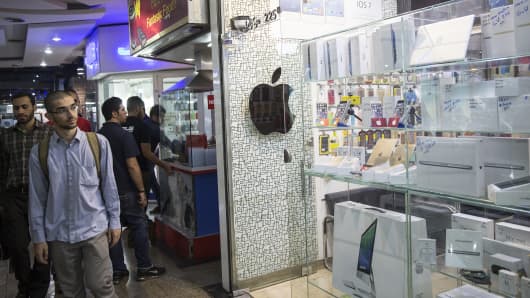
Simon Dawson | Bloomberg | Getty Images
Customers browse Apple Inc. computer products in the window of a retail outlet inside an electronics superstore in Tehran, Iran.
Iran's GDP is expected to grow 6 percent this year and almost 7 percent next year, according to the World Bank. The country has three great strengths: natural resources, including oil, gas and minerals; a huge population of nearly 80 million; and manufacturing capacity unrivaled in the Middle East. Oil and gas account for only 10 percent of the GDP.
Investors worldwide have a myriad and growing number of options to invest in Iran, probably the world's hottest geographic investment opportunity in the last 20 years — all except for Americans.
Though they have been eyeing the Iranian market, U.S. institutional and individual investors are hitting some brick walls because of the still-in-place U.S. sanctions that make it nearly impossible for U.S. companies to set up a physical presence in Iran, partner with an Iranian company or even sell most goods there. U.S. bilateral sanctions remain in place, President Barack Obama has said, over Iran's violations of human rights, support for terrorism and its ballistic missile program. Yesterday's missile tests make an early removal of U.S. sanction less likely. Vice President Joe Biden condemned the action, and noted there could be U.S. retaliation.
There are a few exceptions, though, including food, medical equipment, transportation and some IT products. And some U.S. companies may be able to get licenses through the U.S. Treasury's Office of Foreign Asset Control (OFAC) to work in sectors defined as aligning with U.S. policy interests, including oil and gas and aviation. Companies, such as Honeywell International, General Electric andBoeing, are expected to get licenses to trade with Iran, said Cyrus Razzaghi, CEO of Ara Enterprise, a consultancy in Tehran working to help foreign companies and investors navigate Iranian laws and find business partners.

"We get a lot of calls from American investors," said Dominic Bokor-Ingram, portfolio advisor to the Turquoise Variable Capital Investment Fund, established in December with 50 million euros to invest in public companies in Iran. His London-based firm tells them: No, sorry, you can't invest.
Meanwhile, European and Asian companies are moving in to get early footholds. Airbus has a $27 billion deal to provide 118 jetliners to Iran's state airline company; Peugeot returned with a 400 million euro ($435 million) deal to update its factory and begin manufacturing cars; theRenault-Nissan alliance is in aggressive talks with local partners Saipa and Iran Khodro to expand car manufacturing; and Italian and French mining companies, including Persiana Metalica and Fiault, are in talks to invest more than 5 billion euros in aluminum and steel projects, according to Iranian news sources, which also reported that Chinese firms are negotiating to finance coal production.
Getting a piece of the action
For now, individual U.S. investors and institutions are exploring ways to invest in Iran through offshore entitles, foreign subsidiaries or funds based in Europe, said sources. But "it's like speeding down the Dulles toll road at 90 mph," said Farhad Alavi, managing partner of the Akrivis law firm, naming a highway near Washington, D.C. "You can do it 50 times and be fine, but the 51st, you might not be."
In other words, no one knows how the U.S. Department of Justice will interpret the U.S. sanctions in the new environment, especially against individual and institutional investors. In the past, it has prosecuted many companies, large and small, for breaking the embargo, including a 2014 $8.9 billion fine against Paris-based financial services giant BNP Paribas.
The risks for investors are undeniable. The biggest is the geopolitical risk and the possibility of the U.S. reimposing sanctions if Iran violates the terms of the nuclear agreement down the road. In addition, the country has infrastructure problems, an unfamiliar legal and regulatory regime that lacks transparency, complex regulations, and all the usual challenges of finding good business partners. Another wild card is how soon global banks will reengage in Iranian business. Many are sitting on the sidelines to see how events unfold.
By Elizabeth MacBride

No comments:
Post a Comment