Summary
Healthcare stocks are a pillar of the defensive portfolio.
We look at two healthcare stocks with strong fundamentals, comparing them with the main healthcare ETF: XLV.
We find that during the last market crash, both of these stocks kept more of their gains than a diversified healthcare portfolio.
Healthcare stocks have been a pillar of the defensive portfolio. As healthcare is always needed, even in a down economy, these stocks tend to do well in spite of the general market. But the defensiveness of healthcare stocks has changed in the minds of many investors, thanks to the explosion of Valeant Pharmaceuticals (NYSE:VRX).
Still, investors should not attach unnecessary fear to the healthcare sector. Provided you perform the necessary fundamental analysis on healthcare stocks and investigate how they performed during the last market crash, you can still locate those safe yet growing companies that will certainly bolster your portfolio. Healthcare stocks offer growth, dividends, and defensiveness against a market crash.
In an uncertain market, such as the one we see today, the standard approach is to simply buy the Health Care Select Sector SPDR ETF (NYSEARCA:XLV) as the healthcare part of your portfolio. But I believe we can do better than the ETFs available to us. And so do you - otherwise you wouldn't be on this site, reading this article.
I want to show you two healthcare stocks that are superior in this market, both in fundamentals and in defensiveness. These two stocks are Becton, Dickinson and Company (NYSE:BDX) and AmerisourceBergen Corporation (NYSE:ABC). Both of these stocks recently reported their earnings, making now a good time to reconsider adding them to our portfolio.
Fundamentals
At its current price, BDX offers a 1.57% yield. While its debt-to-equity is somewhat high, at over 1.5, it has been dropping. This drop is mainly due to an increase of equity, not a decrease in debt.
That said, BDX has a BBB+ rating, which is strong enough to justify its current levels of debt. The debt has been financing overseas expansion, which has been paying off and is a major factor in the equity increase. The main downside at this point is that BDX is at an all-time high, causing investors to hesitate to buy.
In contrast, ABC took a nosedive after earnings. ABC missed on revenue, which hurt the stock. Investors are concerned about slowing growth.
The pullback should be attractive to many investors, as it raises the yield to 1.77%, higher than that of BDX. It also allows for a good entry point.
Still, debt-to-equity is above 2.0, as debt has slowly crept up on the rather unreliable equity growth. But many times, return on equity is more important than actual equity. In this respect, ABC blows BDX out of the water, often hitting double-digit ROE numbers.
These two healthcare companies have strong but different fundamentals and cannot be directly compared. But I write this article not to crown either ABC or BDX a winner; instead, I want to point out that both of these stocks beat XLV as portfolio holdings.
ABC and BDX vs. XLV
Over the long term, both ABC and BDX have outperformed XLV:
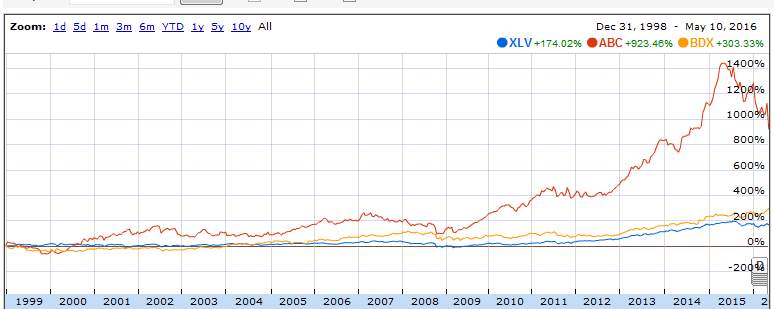
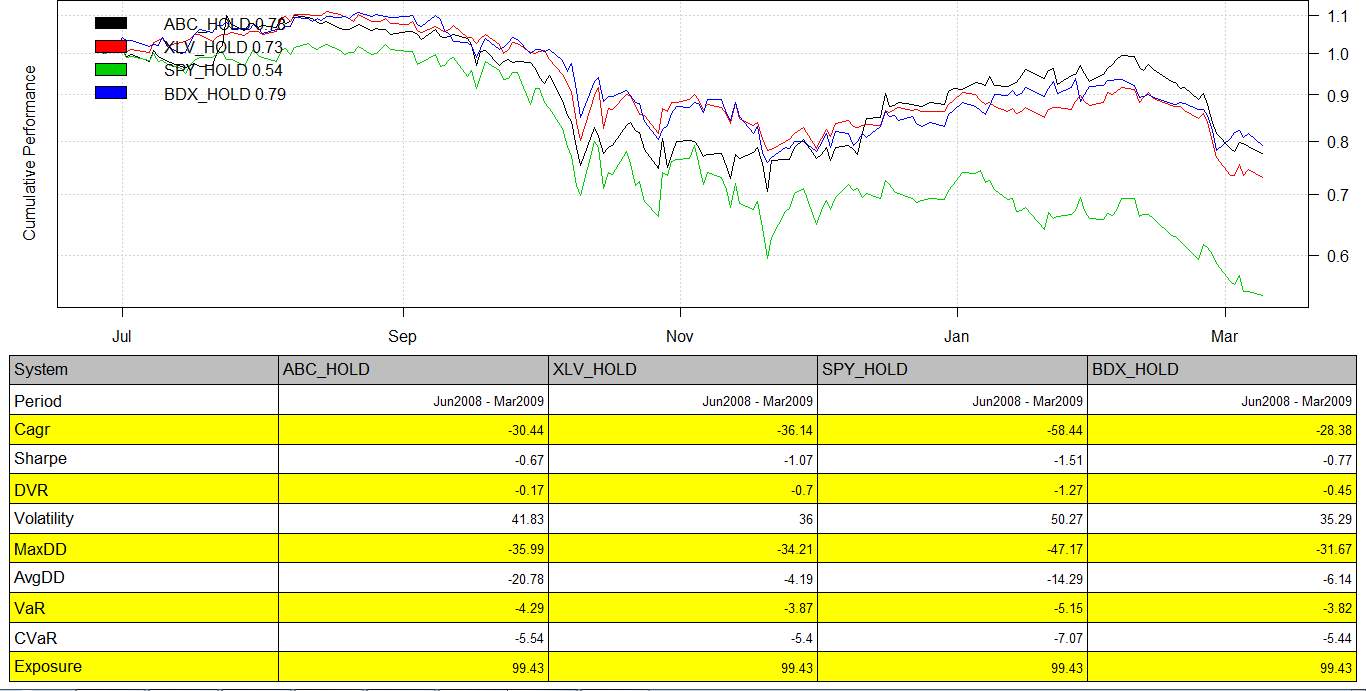
This usually implies higher market risk. But if this were the case, I wouldn't be writing this article on only these two stocks. I chose to present ABC and BDX for a reason: They are both more resilient than the healthcare sector and the general market, as measured by the SPDR S&P 500 Trust ETF (NYSEARCA:SPY).
During the last market crash, both of these stocks kept more of their gains than a diversified healthcare portfolio:
Bottom Line
Stocks that outperform the market during good times and fall to a lesser extent during hard are diamonds in the rough. If you're considering adding healthcare stocks to bolster your portfolio, choose ABC and BDX. The benefits are threefold: consistent growth (though slower in ABC's case), strong and stable dividends, and defensiveness in the case of a market crash.
While BDX is certainly more expensive than it has ever been, the recent earnings report implies that the stock will continue its steady upward movement. In contrast, ABC took a dip and is likely undervalued, making now a good entry point. If you must only choose one, I would say ABC is your better bet for upside but also a bit riskier considering its slowed growth and downward momentum.
By Damon Varial
Disclosure: I/we have no positions in any stocks mentioned, and no plans to initiate any positions within the next 72 hours.
No comments:
Post a Comment